






Executive Summary
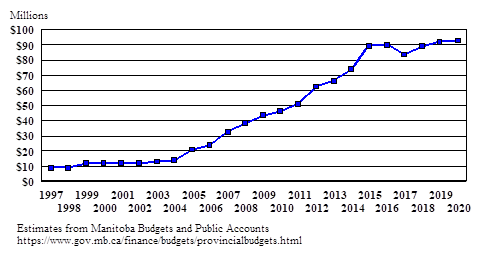
This study examines the land transfer tax (LTT) in Manitoba and options for its reform. The tax was originally introduced in 1987 with the rates and thresholds unchanged since 2004. Obviously, with inflation, land transfer tax payments have therefore increased over time as real estate property has become increasingly expensive to buy. Land transfer tax revenues have increased ninefold from 1997 to 2019 (Figure I below). The average land transfer tax rate has more than doubled.
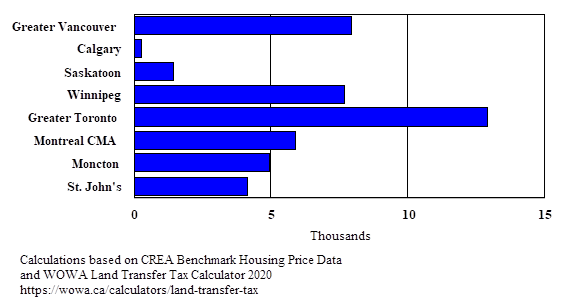
Compared to other Canadian cities, the land transfer tax in Winnipeg for a property sold at $500,000 is third highest in the country (Figure II below).
The land transfer tax is a much less important source of tax revenue compared to income, sales and property taxes, representing only 1.03 percent of total provincial tax revenues in 2020. As a tax, however, it is hard to defend. Unlike income, wealth and consumption, which are related to some measure of the well-being of individuals, a land transfer tax is only paid when a purchaser buys residential or non-residential property. It is thus a tax on those who move to new locations and does not apply to people or businesses who do not move. It is unrelated to services provided by governments unlike a local property tax, which is arguably related to municipal services. So, on philosophical grounds, it is a strange tax since it is neither related to public benefits nor the well-being of individuals engaged in a land transfer.
Economic studies have focused primarily on residential property. They generally find that a land transfer tax has a relatively high economic cost because the LTT discourages people from moving to more favourable locations or housing when they can do so. Instead, they stay longer in their home, electing perhaps to renovate it.
In some studies, the incidence of a land transfer tax on residential property has been found to fall more heavily on the seller of housing property. It is not a particularly fair tax since the seller could be rich or poor. To the extent the tax falls on the buyer, it tends to hurt most young families and those moving to Manitoba.
No studies on economic distortions have looked at land transfer taxes on non-residential real estate (and multi-residential apartment blocks). The Manitoba LTT is refunded if the business also pays retail sales tax on improvements. It is also clear that much of the LTT on non-residential property is avoided since property need not be owned by a company, partnership or trust directly. Instead, the property can be owned by intermediate entities (e.g., trusts or limited liability partnerships) of which their shares or units of the intermediary can be sold, thereby avoiding the LTT altogether. To the extent it is paid, especially when land and property is assembled or acquired by smaller investors unable to use complex tax structures, in part because of personal income tax considerations, it can discourage investment and distort decisions to move. This can especially impact businesses that typically have high entry and exit rates in an industry.
Unfortunately, there are no data available to us on LTT paid on non-residential property sales. We suspect little revenue is collected but it cannot be confirmed. We suggest abolishing the LTT on non-residential property since it is likely a small percentage of total LTT revenue, but it results in unnecessary administrative and compliance costs. However, without better data, further study is recommended.
Our options are therefore focused on reforms to the LTT on residential property transfers, which are assumed to account for most land transfer tax revenues. We consider three potential reforms, keeping in mind the revenue implications for the government.
- The first is a revenue-neutral change which would exempt the first $150,000 of a transaction from land transfer tax with a 2.45 percent rate applied to the value of the transaction in excess of $150,000 (this would simplify the tax by eliminating three other brackets in the existing system).
- The second would be an exemption for the first $150,000 with a 2 percent tax rate applied to the excess (this would reduce modestly government revenues).
- The third involves indexing tax brackets with a one-time correction from 2004 to 2020.
The impacts are shown in Table I below taking into account (i) efficiency gains from fewer LTT-induced distortions on the housing market, (ii) gross gains (efficiency gains plus lower LTT paid), and (iii) net gain (efficiency gain from reducing the LTT plus any gains or losses from substituting the LTT for a less distortionary tax to keep the government’s budget balanced – the retail sales tax for example). A positive net gain would result in benefits to the economy.
As Table 1 shows, the first option provides an efficiency gain of $15.4 million by reducing distortions (total LTT revenue is unchanged, so the gross and net gains are the same as the efficiency gain).
Option 2 results in an efficiency gain of $28.1 million and gross gain of $45.2 million from adding on the reduction in LTT payments. Under Option 2 the net gain falls to $23.4 million since the reduction in LTT tax payments is offset by an increase in the retail sales tax rate resulting in no change in tax revenues. Further, the retail sales tax discourages consumption and capital investment, eroding some of the efficiency gain from reducing the LTT.
Under Option 3 (indexation), the efficiency gain is only $3.2 million, and the net gain is negative (the existing land transfer rates remain the same – 0.5, 1.0, 1.5 and 2 percent) but the first bracket increases from $39k to $117k, the second bracket from $117k to $195k, $195k to $260k and the last bracket is over $260k). The loss in LTT revenue is made up by an increase in the retail sales tax.
Table I: Efficiency, Gross and Net Gains of Three Land Transfer Tax Options
Millions of Dollars
| Option | Efficiency Gain due to LTT changes | Gross Gain (Efficiency gain due to LTT changes and lower LTT payments) |
Net Gain (Efficiency gain due to LTT changes and shift from LTT to retail sales tax) |
|---|---|---|---|
| Option 1: A Revenue Neutral Flat Rate | $15.4 | $15.4 | $15.4 |
| Option 2: A 2 Percent Rate Above $150K | $28.1 | $45.2 | $23.4 |
| Option 3: Full Indexation of Tax Brackets | $3.2 | $16.7 | -$5.8 |
The second option has strongest effect in reducing market distortions and provides the highest net gain to the economy (assuming any loss in revenue is made up by an increase in a less distortionary tax similar to the retail sales tax). However, we are not recommending that the retail sales tax should be increased to make up the loss in revenue since it not only taxes consumption but also capital and intermediate goods.
1. Background
Manitoba introduced a provincial land transfer tax (LTT) in 1987 with rates varying according to the amount transferred and a top rate of 1.5 percent on values in excess of $150,000. In 2004, the LTT was revised with the top rate increased to 2 percent for values over $200,000 – the current tax rates and tax brackets have been in effect since that time. LTT revenue has increased from $10 million in the fiscal year ending 1997 to $93 million in 2020 (Figure A). As a percentage of total provincial tax revenues, LTT has increased from 0.28 percent in 1996-97 to 1.03 percent in 2019-20. By comparison, education property tax revenue was $874 million 2019-2020. There are no data available separating transactions between residential and non-residential property. However, as discussed below in a section on non-residential property, we expect most of the revenue comes from the sale of residential housing only.
Table 1 shows the LTT rates, the number of land transfers, the average value of land transfers, and the revenue collected per tax bracket in 2018-19. Of the 30,284 taxable land transfers in Manitoba, 56.9 percent were subject to the 2 percent tax on the amount above $200,000. The average value of a land transfer above $200,000 was $346,563. In total, $85,073,665 was collected from land transfers subject to the top tax rate.1See Appendix 1 for the trend in the number of land transfers and the average values by tax bracket from 2015-2016 to 2018-19.
Table 1: Land Transfer Taxes by Tax Bracket in 2018-19
| Value of Property | Rates (%) | Number of Land Transfers | Average Value | Revenue Collected |
|---|---|---|---|---|
| On the first $30K | 0.00 | 2,057 | — | 0 |
| $30K to $90K | 0.50 | 3,072 | $61,003 | $476,206 |
| $90K to $150K | 1.00 | 4,125 | $116,557 | $2,332,959 |
| $150K to $200K | 1.50 | 3,812 | $170,218 | $4,586,838 |
| Over $200K | 2.00 | 17,217 | $364,563 | $85,073,665 |
| Land Transfer Tax Adjustment | 1 | — | $660.00 | |
| Total | 30,284 | $92,470,328 |
It should perhaps be noted that multi-residential property (apartment blocks) may be subject to higher land transfer taxes when a whole apartment block is sold rather than individual condominiums (which may be owner-occupied or rented). This would mean that multi-residential rental property could be subject to higher land transfer tax. As to be discussed further below, however, landlords selling their apartment blocks have opportunities to avoid the land transfer tax altogether similar to the case with commercial property.
Land transfer taxes are levied by all provincial governments, except Alberta and Saskatchewan, and by municipalities in Quebec, Nova Scotia and Ontario. Appendix 2 shows the tax rates and summarizes some key features of provincial and municipal land transfer taxes in Canada.
Land transfer taxes vary across provinces and cities because of variations in the tax rates and the average value of residential property. To compare the burden of land transfer taxes across provinces, Figure B shows the land transfer taxes and fees that would be levied on a $500,000 property in 2020. The land transfer tax in Winnipeg is $280 less than in Vancouver, but higher than in Montreal ($1,772), Moncton ($2,720), and St. John’s ($3,540). Land transfer tax on a $500,000 property transfer is highest in Toronto because both the Province of Ontario and the City of Toronto levy the tax at similar rates.
Property values vary greatly across provinces and cities and a tax on a $500,000 property transfer may not be representative of the land transfer tax levied on a typical property in the cities shown in Figure B. To compare the land transfer taxes and fees that would be paid on comparable residential properties across cities, we have used Canadian Real Estate Association (CREA) data on the prices of four benchmark houses to calculate the land transfer tax that would be levied on these benchmark properties.2The CREA data are available through the Canadian Real Estate Association’s MLS Home Price Index. See the CREA resources for the methodology used in developing the price indices of benchmark homes. Land transfer taxes are much higher in Vancouver and Toronto than in the other cities because housing prices are much higher than in other cities. Figure C compares the land transfer taxes and fees on the single storey, two storey, townhouse, and apartment benchmark homes in Winnipeg and five other Canadian cities with comparable housing prices and LTT rates. Figure C shows that Winnipeg’s land transfer taxes are lower than in Montreal but higher than in Moncton and St. John’s for all benchmark homes except the apartment category.
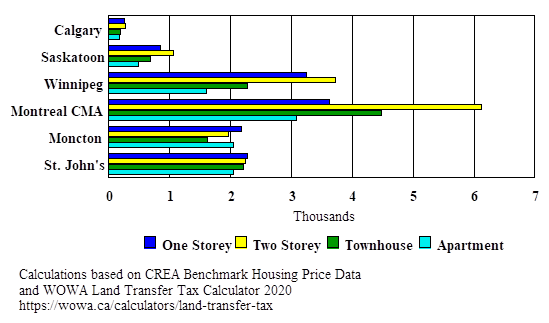
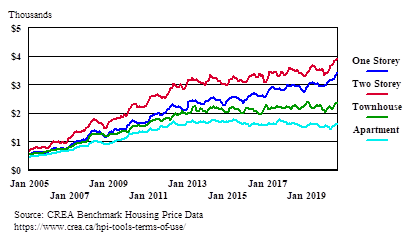
Figure D shows the increase in land transfer taxes on the four CREA benchmark homes in Winnipeg from January 2005 to August 2020. Over this period, land transfer taxes increased by 530 percent for the single storey benchmark home, 475 percent for the two storey, 323 percent for the townhouse, and 239 percent for an apartment. Even accounting for the general increase in prices, as measured by the increase in the Consumer Price Index, there was a substantial increase in the real (inflation adjusted) tax burden of 382 percent for the one storey benchmark, 340 percent for a two storey, 224 percent for a townhouse, and 160 percent for the apartment.
As noted above, the land transfer tax rates and tax brackets have been frozen since 2004. Therefore, the increases in the LTT have been due to the increase in real estate prices. Average tax rates have increased because higher prices have pushed residential properties into higher tax brackets including a higher percentage of the transfers subject to the top 2 percent tax rate. Table 2 shows that the average land transfer tax has more than doubled for all benchmark homes except the apartment class.
Table 2: Average Land Transfer Taxes on Benchmark Homes in Winnipeg
| Year | One Storey | Two Storey | Townhouse | Apartment |
|---|---|---|---|---|
| 2005 | 0.51% | 0.56% | 0.50% | 0.46% |
| 2019 | 1.12% | 1.20% | 0.98% | 0.81% |
Source: Calculations by the authors based on CREA Benchmark Housing Price Data.
Around two-thirds of the increase in the LTT burden on these benchmark homes has been due to an increase in the average tax rate as rising house prices have pushed properties into higher tax brackets. If the tax brackets had been adjusted upward to reflect housing prices, average land transfer tax rates would have remained constant. Therefore, most of the increase in the LTT has resulted from the absence of any adjustment to the tax brackets in the face of rising real estate prices. We return to this issue in Section 4 of this report where reforms are considered with respect to the LTT.
2. Evaluation of the Land Transfer Taxes Applied to Residential Property
This section focuses on residential property only (non-residential property is discussed below). As shown in Table 2, the land transfer tax now represents a substantial cost in completing the sale of a residential property after more than doubling for most housing properties in Manitoba. As with any tax, there are concerns about the distribution of the tax burden, its fairness, and its impact on economic activity. In this section, we review recent econometric studies based on international experience with land transfer taxes on residential property to provide some insights into the questions: Who bears the burden of the land transfer tax? Has the land transfer tax discouraged or reduced the number of real estate transactions? Is a land transfer tax fair?
2.1 The Incidence of a Land Transfer Tax on Residential Property
In Manitoba, other Canadian provinces, and in most other countries, the purchaser of a property is responsible for the payment of the land transfer tax. However, sellers may bear the effective burden of a land transfer tax, in whole or in part, if property prices are suppressed because a land transfer tax is levied on real estate transactions. Studies of the incidence of a land transfer taxes, such as Besley, Meads and Surico (2014), adopt a bargaining model to analyze the shifting of a land transfer tax.
In this type of model, the sale of a property is only possible if the maximum price that a buyer is willing to pay for a property exceeds the minimum price that the owner of the property is willing to accept. The model predicts the degree to which the tax burden is shifted from the buyer to the seller depends on the bargaining power of the buyer and seller, which in turn depends on the state of the housing market.
If the housing market is tight, with few properties for sale relative to potential demand, sellers will have more bargaining power than buyers. In these circumstances, a seller can command the top price for the property, i.e., the maximum amount that a buyer is willing to pay for the property. A land transfer tax, by adding to the cost of a real estate transaction, reduces the amount that a buyer will pay for the property. Accordingly, sellers will tend to bear more of the land-transfer-tax burden in a tight housing market.
Conversely, buyers will bear a large share of the burden when the housing market is in a slump because a buyer will be able to negotiate a price that is close to the minimum that a seller will accept. Consequently, there is no scope for further reduction in the purchase price of the property if a land transfer tax is levied on the transaction. Under these market conditions, the seller would withdraw the property from the market rather than absorb the land transfer tax. Given that housing market conditions vary across jurisdictions and over time, the incidence of a land transfer tax will vary across cities, provinces, and countries over time.
With this caveat in mind, Dahlby and Larson (2019) reviewed eight recent econometric studies that estimated the impact of land transfer taxes on housing prices. Given that these studies are based on data from the U.S., U.K., Germany, France, Australia, and Canada with different housing market conditions, it is not surprising that the studies reached different conclusions.
For example, a study of land transfer tax in France found no impact on housing prices, while three U.S. studies found more than 100 percent shifting to the seller in jurisdictions, such as New York City, where the entire value of a property above a certain level is subject to a higher tax rate. Of particular interest is the study by Dachis, Duranton and Turner (2012), which examined the impact of the introduction of the land transfer tax in Toronto based on data for the 2006 to 2008 period. It found that housing prices declined by the amount of the tax, a result that is consistent with the bargaining model’s prediction that in a tight housing market, such as Toronto’s, sellers bear most of the land transfer tax burden.
2.2 The Distortionary Impact of a Land Transfer Tax on Residential Property Market Activity
A land transfer tax could reduce the number of real estate transactions because the tax raises the cost of a land transfer. People have a choice to move or stay at a location and perhaps renovate their home instead of moving. The economic losses from a decline in housing market sales are real.
For example, some families do not move to homes that are more suited to their needs or to a location closer to employment. The dollar value of the loss of well-being from a reduction in housing transactions can exceed land transfer tax revenues, i.e., the tax creates a deadweight loss.
Further, differential average land transfer tax rates under a progressive rate schedule encourages households to buy cheaper housing (with perhaps some renovation following the purchase). The optimal choice of a house is affected, leading to another source of distortion or economic cost (deadweight loss). These distortions have not been incorporated into the studies that are reviewed below.
The magnitude of these economic losses will depend on impact of a land transfer tax on the volume of housing market transactions. Dahlby and Larson (2019) review 11 econometric studies of the impact of land transfer taxes on the volume of housing market transactions. The bulk of these studies found a significant reduction in housing market transactions.
Of note are the studies by Dachis, Duranton, and Turner (2012), which found that the introduction of a 2 percent land transfer tax in Toronto reduced the number of house sales by 14 percent, and Davidoff and Leigh (2013), which concluded that the increase in Australian state land transfer taxes from 1993 to 2005 reduced the number of housing sales transactions by about 11 per cent. They estimated that this decline in sales imposed an annual welfare loss of between $300 million and $800 million.
Stamp duties on conveyances [land transfer taxes] are inconsistent with the needs of a modern tax system. While a significant source of State tax revenue, they are volatile and highly inefficient and should be replaced with a more efficient means of raising revenue.
Conveyance stamp duty is highly inefficient and inequitable. It discourages transactions of commercial and residential property and, through this, its allocation to its most valuable use. Conveyance stamp duty can also discourage people from changing their place of residence as their personal circumstances change or discourage people from making lifestyle changes that involve a change in residence. It is also inequitable, as people who need to move more frequently bear more tax, irrespective of their income or wealth (Commonwealth of Australia, 2010 pp. 48-49).
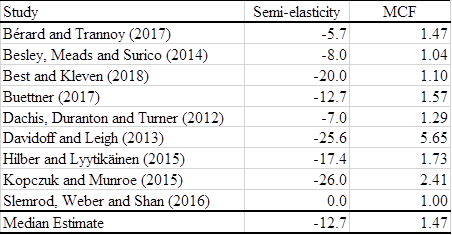
Table 3: Summary of Key Results from Land Transfer Tax Studies
Source: Dahlby and Larson (2019).
Table 3 above summarizes two key measures of the impact of land transfer taxes on the volume of housing market transactions from nine econometric studies. The second column in the table shows the estimated semi-elasticity, which is the percentage change in the number of transactions from a one percentage point increase in a land transfer tax rate, ranged from zero (no effect) to -25.6 with a median estimate of -12.7.
The third column shows the implied marginal cost of public funds (MCF), which is the cost to the private sector in raising an additional dollar of tax revenue from a land transfer tax: this cost includes one dollar of revenue plus the economic loss from raising one additional dollar of revenue.3See Dahlby (2008) on the concept and measurement of the MCF. In general, taxes impose a loss or cost on the economy if they alter taxpayers’ consumption, production, and asset allocation decisions, leading to a less efficient allocation of resources.
Raising an additional dollar of tax revenue costs the private sector more than a dollar if the allocation of resources in the economy is more distorted. The MCF indicates which taxes impose the greatest economic losses in generating additional revenues and can be used to measure the gains from tax reforms that shift the burden from the high-cost tax bases to ones with lower costs.
In the nine studies reviewed by Dahlby and Larson (2019) the implied MCFs for a land transfer tax varied from 1.00, indicating no marginal welfare loss from raising additional land transfer tax revenues, to very little in the Slemrod, Weber, and Shan (2016) study, which did not find significant effect of a land transfer tax on housing sales, to 5.65 in the Davidoff and Leigh (2013) study. The median MCF in these studies was 1.47.
In general, the MCFs are higher in the studies that found larger semi-elasticities of housing sales to land transfer tax increases and in the studies where the land transfer taxes rates were higher. In Section 4, we will use the semi-elasticity estimates to calculate the MCF for the land transfer tax in Manitoba and use those estimates to calculate the gains from reforming the land transfer tax.
2.3 Is a Land Transfer Tax Fair?
Since a land transfer tax and a property tax are both levied on the value of the property, it is natural to compare the fairness of one with the other. However, one important difference is that a property tax is levied each year on the property’s owner, while a land transfer tax is only levied when the ownership of the property is transferred.
Note if the land transfer tax results in lower property values, households could save more in the present value of property tax payments over time than they pay in land transfer tax. This also means, though, that governments could receive more or less revenue (in present value) once taking into account these interactions.
As previously noted, the distributional effects of these taxes depend on the shifting of the tax burden. The literature indicates that the land-transfer-tax burden may be split between buyer and seller, but in many cases, individuals will be both a buyer and a seller, sometimes almost simultaneously.
To the degree that land transfer taxes are shifted to the owners of residential property, which Dachis, Duranton and Turner (2012) concluded in their study of the land transfer tax in Toronto, then the tax will be capitalized in the value of all residential property at the time that it is imposed.4Other evidence for the capitalization of land transfer taxes in property values includes a recent study by Koetter et al. (2021) which found that a one percentage point increase in the LTT in Germany reduced house prices by 1.2 percent, while the effect on rental rates was not economically significant. If a reduction in property taxes is also capitalized in residential property values, then the overall property value would not change, and the effective incidence of the land transfer tax and the property tax would be the same.
Since a family’s demand for housing reflects their current and expected future income, the burden of both taxes is roughly proportional to a household’s lifetime earnings. Those who inherit more wealth may live in larger, more expensive homes than their lifetime labour earnings would otherwise provide, but this makes a property tax more progressive than a land transfer tax, if a land transfer tax is not levied on residences transferred as part of an estate.
Given this caveat, and also recognizing that the capitalization of land transfer taxes and property taxes into property values means that it is difficult to assign the burden of these taxes to current taxpayers, the distributional impact of a land transfer tax, over the long term, is likely similar to a property tax.
On the other hand, if the land transfer tax is not shifted to owners and is fully borne by homebuyers, it would impose an additional burden on those who move more frequently – sometimes with limited choice because of changes in the location of employment.5See Commonwealth of Australia (2010) for an estimate of the effective tax rates based on frequency of moves under the states’ land transfer taxes. For example, Nowlan (2007) shows that if a 1.25 percent land transfer tax were substituted for property taxes, an average property owner in Toronto would be better off in present-value terms if their property is sold and another bought after 10 years.
In other words, frequent movers will pay more often, and infrequent movers will pay less. Although younger cohorts are more likely to be renters initially, over their lifetimes they will on average purchase homes more frequently than older cohorts, which means that a non-shifted land transfer tax will generally impose a larger burden on younger generations.
This last point raised above is important to keep in mind the cash flow impacts of the LTT especially on young buyers or new immigrants coming to Manitoba. A land transfer tax represents a significant additional cost for young first-time buyers who frequently make a 5 percent down payment to purchase a home. On a $300,000 home, the LTT raises the funds that they need to make the purchase by 25 percent from $15,000 to $18,720.
Given that average land transfer taxes vary across properties of different value due to the progressive rate structure, it might be expected that higher income households that can afford more expensive housing will pay more land transfer tax. However, the incidence of differential rates is complicated. For example, if the land transfer tax is shifted forward to tenants of a multi-residential property, the land transfer tax could be regressive.
To summarize, it is difficult to assess the fairness of the land transfer tax because the degree to which it is shifted from buyers to sellers likely varies with the state of the housing market. It is further complicated with differential rates applied to housing. To the extent that the land transfer tax is shifted to the seller, a land transfer tax is capitalized in housing prices and the distribution of the land transfer tax is similar to a residential property tax. To the extent that the land transfer tax falls on the buyer, it will impose a larger burden on younger generations or on households that move more frequently because of changes in the location of employment.
3. Evaluation of Land Transfer Tax Applied to Non-Residential Property
Under Manitoba law, similar to other provinces, land transfer tax is also applied to non-residential property. However, as to be discussed below, the land transfer tax is difficult to apply to commercial and industrial property and in many cases can be easily avoided. The land transfer tax rates follow the same schedule as applied to residential property. The tax is paid by the registered purchaser upon transfer of property. Owners of non-residential property include corporations, trusts, partnerships or individuals.
Exemptions are provided for farmland, veterans or spouses, a band defined under the Indian Act (Canada), and petroleum or gas leases. LTT is also refunded if retail sales tax is paid on the transaction (the LTT refund is limited by the retail sales tax paid on buildings or improvements).
It includes any fractional interest in the land, which “means a legal interest, an equitable interest or beneficial interest in land that is a part, share, port or fraction of a whole legal, equitable or beneficial interest in the land” (Part III of the Tax Administration and Miscellaneous Tax Act). Further,
Where a fractional interest in land is transferred, the transferee shall pay tax under this Part in an amount that bears the same proportion to the tax payable upon transfer of the land as a whole calculated in accordance with the formula in subsection (1), as the fractional interest in the land bears to a whole interest in the land. (Section 112(3) of the Act).
This provision reduces avoidance to some extent when ownership changes. For example, when a partner sells an interest in the land, LTT will be paid according to the percentage of ownership as if the whole property were sold. Without this provision, for example, a person selling real estate investment trust units (which could be less than $30,000) would be able to avoid LTT altogether. Instead, the partner will pay LTT on its interest in the property as if the whole property were sold. LTT is therefore triggered when partners are added on or leave the partnership. In a real estate investment trust (REIT), frequent turnover of units potentially results in multiple taxation over time.
However, it is possible to avoid the LTT altogether by transferring ownership in a corporation, partnership or trust holding interests in the corporation, or trust or partnership holding interest in the land. The trust or corporation are beneficial owners of the property but the LTT will not be paid if investors exchange interests in the corporation, trust or partnership and are not direct owners of the land.6More significantly, it does not apply to the sale of shares of a corporation that owns the underlying land. Where title is held by a nominee corporation, proper transaction structure can result in substantial land transfer tax savings.
In Ontario, Scotiabank sold a downtown building for $1.27 billion without attracting land transfer tax because the nominal trust holding the building remained the beneficiary.7See Financial Post, “Some of Canada’s Largest Companies Facing Ontario Land Transfer Tax Hit Worth Millions.” Some jurisdictions like New York define a transfer as a change in control looking at both direct and indirect ownership. However, this would mean LTT would not be paid if minority interests were sold.
Some exceptions will arise whereby a purchaser is unable to use a structure to avoid the LTT. For example, small investors in multiple-unit housing cannot use a tax structure without bearing additional costs including the loss of depreciation deductions under the income tax unless they own the property directly.
More problematic is multi-residential real estate (this is rental property such as condominiums defined as owner-occupied housing). Similar to non-residential property, LTT could be avoided by establishing corporate, trust or partnership owners of the property – no LTT is paid if owners exchange shares or units of the underlying entity holding the property rather than selling the property itself. If the LTT on multi-residential property is avoided, it creates a preference towards rental property (however, this benefit is more than offset by the personal income tax exemption for principal residence under the income tax).
As mentioned above, we have no data on how much LTT is paid on non-residential property transfers. However, we expect little is collected since it is relatively easy to avoid the tax. Not only can the LTT be easily avoided as described above but, if payable, may be reduced by retail sales tax paid on purchase of the buildings or improvements.
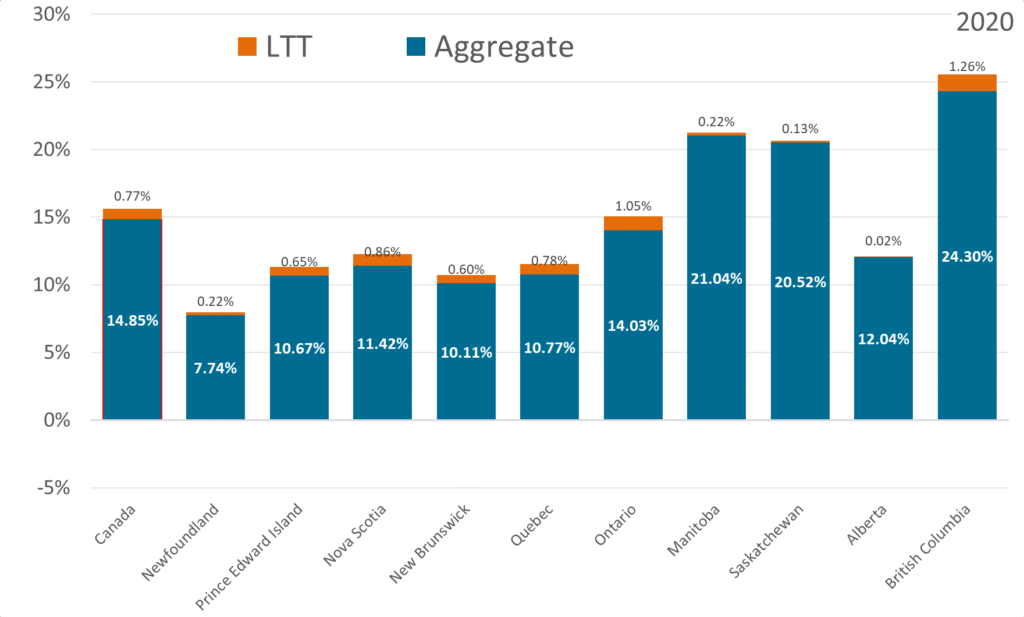
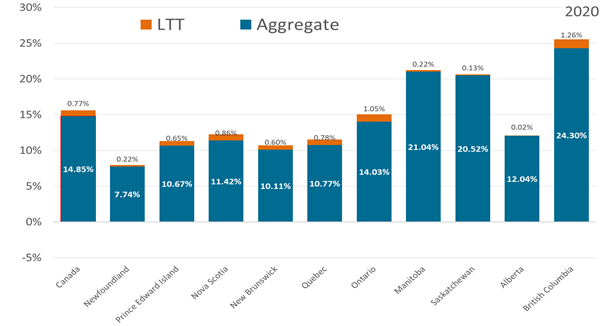
In Figures E and F, it is assumed that LTT is initially paid on assembly of land and structures (with LTT avoided on future transactions). The LTT is also reduced on structures if the RST paid is more than the LTT rate (RST paid on structures is often more than the LTT rate). The first figure below provides the corporate marginal effective tax rates (METR)8The METR measures the difference between the pre- and post-tax rates of return on capital for investments that earn a sufficient return to attract financing from international or domestic markets. The METR is calculated as the ratio of corporate income taxes, sales taxes on capital purchases, land transfer taxes and asset-based taxes as a share of profits earned by marginal projects that require land, structures, machinery and inventories as investments. Provincial and municipal property taxes as well as the resource and finance sectors are not included due to lack of data. See Bazel and Mintz (2016) for details of the model. on investments by large firms in structures, land, machinery and inventories across provinces. The second figure provides an estimate of corporate METRs by province for small firms qualifying for small business deductions (less than $10 million in taxable capital).
As is shown in Figures E and F, the LTT at a 2 percent rate on marginal investments has only a small impact on the incentive to invest in Manitoba. For large and medium-size companies, the total METR, including federal and provincial corporate income tax, Manitoba RST and land transfer tax is 21.3 percent of which only 0.2 percentage points is due to the LTT. For small companies, the METR on investment is 16.7 percent of which the LTT is only 0.2 percentage points as well. Both the ability to avoid LTT and the RST adjustment result in the LTT having almost negligible impact on investment.
Source: School of Public Policy University of Calgary.
Next to British Columbia, Manitoba has the highest METR on investments among all provinces. However, the LTT is not the significant reason for the difference. Instead, it lies with the retail sales tax on capital purchases (important in BC, Saskatchewan, and Manitoba) as well as relatively high corporate income tax rate on large and medium-size companies in Manitoba compared to Alberta, Ontario, and Quebec. For small companies, Manitoba has the lowest corporate income tax rate among provinces at 0 percent, but its advantage is lost by the retail sales tax on capital purchases.
The LTT would have a larger impact without the RST adjustment but is still relatively small. If it were simply an additive tax, the METR on large and medium-size firms would be 21.5 percent (only 0.2 percentage points higher than the case with the RST adjustment). For small companies, the METR would be 17.1 percent (0.4 percentage points more without the RST adjustment). Overall, the ability to avoid the LTT (assumed here for subsequent transfers after the assembly of land and structures) results in it having little impact.
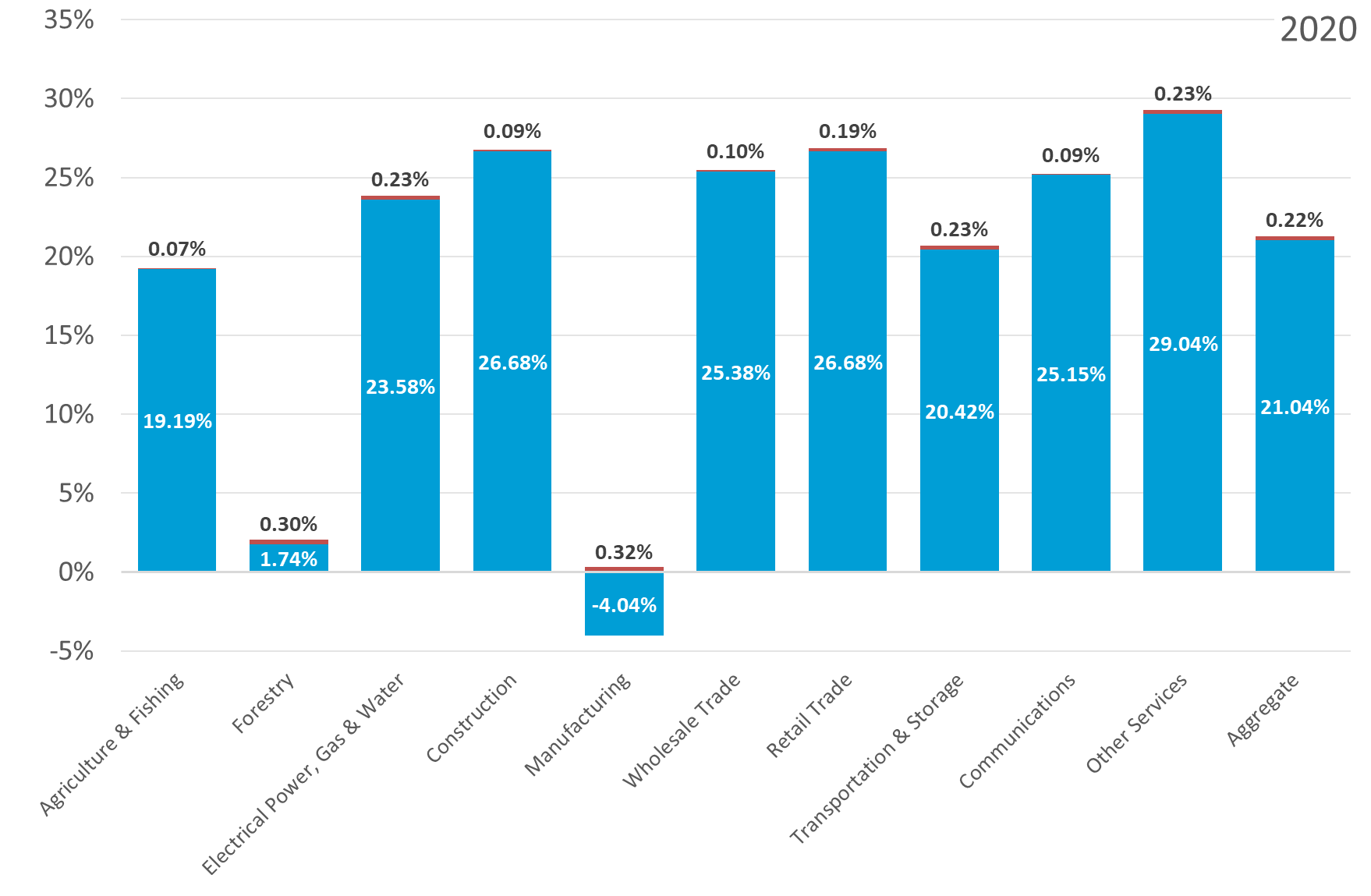
The effect of the LTT can differ across industries. Since the tax is paid on land and structures (in excess of any RST), industries with capital structures more intensive in property would obviously have higher METRs due to the LTT. As is shown in Figure G, the LTT impact is small (large and medium-size companies) across industries. Albeit small, the above average impacts are in forestry, utilities, manufacturing, transportation and storage, and other services. Thus, a tighter LTT would be more distortive for high-METR sectors like utilities, transportation and services. This creates even larger tax distortions among business activities.
4. Options for Reforming the Land Transfer Tax in Manitoba
In this section, we discuss reform options focussing separately on residential and non-residential property. The primary role of taxation is to provide revenues to pay for public goods and services. Thus, the amount of taxes to be raised is dependent on public programs’ spending plans.
For a given level of taxation, taxes should be chosen keeping in mind three objectives. First, the tax system should be efficient, distorting as little as possible the allocation of resources that would otherwise be based on non-tax considerations. The tax system should also be fair, treating taxpayers with similar resources on a similar basis (horizontal equity) and taxing people according to their capacity to pay taxes (vertical equity). The tax system should also be as simple as possible, keeping administrative costs low for governments and compliance costs low for taxpayers.
At times, the tax system may also be used for other objectives such as correcting for market failures (e.g., pollution or underinvestment in innovation) although the use of tax interventions should be compared to spending and regulation that may serve better in accomplishing objectives.
4.1 Residential Property
The data in Section 1 indicate that the land transfer tax in Manitoba on a $500,000 residential property sale in Winnipeg is slightly lower than in Vancouver and higher than in Montreal, Moncton, and St. John’s. (Recall as well that Alberta and Saskatchewan levy fees but do not levy land transfer taxes.) Analysis of price data on benchmark homes in Winnipeg since 2005 indicates that land transfer taxes have increased by between 382 and 160 percent in real (inflation adjusted) terms. For apartments, the average tax rate has increased by 75 percent and for the other benchmark homes it has more than doubled.
Econometric studies have indicated that land transfer taxes reduce the volume of residential sales and consequently impose relatively large economic losses on society. Although we are not able to estimate the cost of the housing market distortion caused by the LTT in Manitoba, it is likely large given its significant increase over time. Thus, there is a case to be made for lowering, if not eliminating the LTT.
In this section, we propose three options for reforming the LTT on residential property in Manitoba. Given that the Government of Manitoba’s is facing a series of budget deficits, we consider either a revenue neutral reform or reforms that would involve only relatively modest reductions in LTT revenues. Under each option, we attempt to simulate the impact the reforms would have had if they had been implemented in 2018-19.
4.1.1 A Revenue Neutral Flat Rate
Under this option land transfers below $150,000 would be tax free and land transfers above $150,000 would be taxed at a 2.45 percent rate on the value above $150,000. If this reform had been adopted in 2018-19, it would have generated the same revenue as the existing four-bracket tax system: $92.47 million, in the absence of any behaviour changes.9Revenues would likely increase because of an increase in the number of land transfers because of the tax rate reduction. However, we are unable to estimate the magnitude of this increase.
With this revenue neutral tax reform, 21,029 land transfers in 2018-19 would have been taxed. Figure H shows that the reductions in LTT would peak at $900 at $150,000. A total of 20,948 land transfers valued below $295,000, or 74.2 percent of the total taxable land transfers in 2018-19, would have an LTT reduction. Conversely, 7,278 land transfers would have had an LTT increase. For example, the LTT on a $500,000 land transfer would increase by $932.
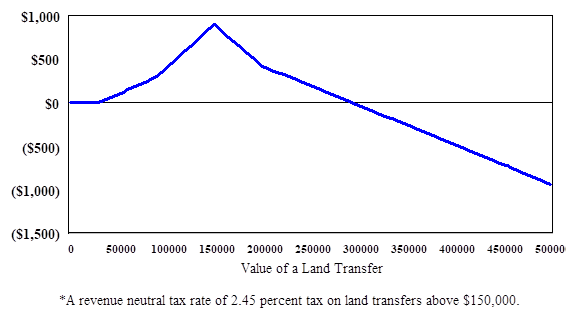
The advantage of a revenue neutral tax reform is that it would lower the LTT on the almost 75 percent of the taxable transfers in 2018-19 but would continue to raise the same or slightly higher tax revenues. The 2.45 percent rate would be lower than the top marginal land transfer tax rates in British Columbia, Ontario, and Quebec (Montreal).
On the other hand, at the $500,000 level, the LTT in Manitoba would be higher than in Vancouver, Montreal, Moncton, and St. John’s. A major concern is the higher rate would most likely increase the METR on large commercial and industrial property sales to the extent they are taxable. Also, a once-and-for-all move to a flat 2.45 percent tax rate on land transfer values above $150,000 would not be revenue neutral in future years and bracket creep with increasing house prices would increase average tax rates in the future.
4.1.2 A 2 Percent Rate on Land Transfers Values Above $150,000
Under this option, land transfers valued at less than $150,000 would be tax free and the two percent tax rate would be imposed on values above $150,000. Figure I shows that if this reform had been adopted in 2018-19, 7,197 land transfers between $30,000 and $150,000 would have had LTT reductions of up to $900, 3,812 land transfers between $150,000 and $200,000 would have reductions between $650 and $900, and 17,217 land transfers above $200,000 would have a $650 reduction in LTT.
If this reform had been adopted in 2018-19, it would have generated revenues of $75.42 million, a reduction of about $17 million, in the absence of an increase in the number of land transfers as a result of the lower taxes on land transfers.
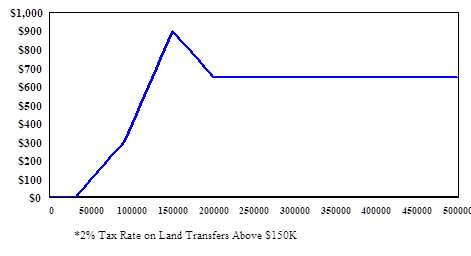
The advantage of this option is that it would reduce the LTT on all taxable land transfers, although the percentage reduction would be very small for large land transfers. As with Option 1, in the absence of a regular inflation adjustment in the $150,000 bracket, increases in property values would lead to bracket creep and higher average tax rates in the future.
4.1.3 Indexing the Tax Brackets to the Consumer Price Index
As noted above, higher land transfer values lead over time to higher average tax rates if the tax brackets are not increased. The absence of an adjustment in the tax brackets in Manitoba has resulted in a significant increase in the land-transfer-tax burden. In this scenario, we analyze the impact of an adjustment in the tax bracket to the 30 percent increase in the Consumer Price Index in Winnipeg since 2005.
Table 4 shows the LTT tax brackets and revenues in 2018-19 if the tax brackets had been increased by an inflation factor of 1.30. For example, the 0.5 percent tax rate would apply to land transfers between $39,000 and $117,000, while the top tax rate of 2.0 percent would apply to the land transfer values above $260,000.
Table 4: Land Transfer Taxes in 2018-19 With Tax Brackets Indexed to the CPI
| Value of Property | Rates (%) | Number of Land Transfers | Average Value | Revenue Collected |
|---|---|---|---|---|
| On the first $39K | 0.00 | 3,174 | — | 0 |
| $39K to $117K | 0.50 | 4,457 | $62,322 | $519,776 |
| $117K to $195K | 1.00 | 5,184 | $150,809 | $3,774,497 |
| $195K to $260K | 1.50 | 7,850 | $225,875 | $12,819,480 |
| Over $260K | 2.00 | 9,628 | $473,932 | $61,846,511 |
| Land Transfer Tax Adjustment | 1 | — | $660.00 | |
| Total | 30,284 | $78,960,865 |
Figure J below shows the reduction in LTT based on the value of the land transfer. The LTT would be reduced for all taxable land transfers in 2018-19. The 9,628 land transfers above $260,000 would have a $705 average reduction in LTT. The percentage of taxable land transfers in the 2.0 percent tax bracket would have declined from 56.9 percent to 31.8 percent.
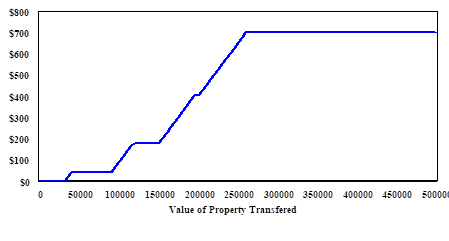
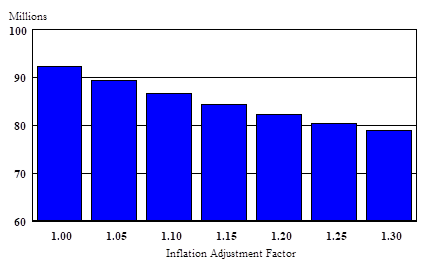
With the adjustment in the tax brackets to the CPI increase since 2005, total LTT revenues would have been $78.96 million in 2018-19, a reduction of $13.51 million. As shown in Figure K, a partial indexation of the tax brackets would limit the revenue reduction while still maintaining LTT on a wide range of property transactions. To prevent future bracket creep, the option would involve annual adjustments in the tax brackets based on the annual increase in the CPI in Winnipeg.
4.1.4 Evaluation of the Three Options for Reforming the LTT on Residential Property
We begin our analysis of the three options by calculating the marginal cost of raising revenues (the MCFs) for the existing LTT rate structure and each option. As noted in Section 2.2, the economic distortions created by a land transfer tax, and therefore the magnitude of the MCF, depend on the tax rates and the sensitivity of housing transactions to the land transfer tax.
As there are no studies of the LTT effects on residential property sales in Manitoba, we use the median semi-elasticity -12.7, from the nine studies listed in Table 3 to calculate the MCF. Table 5 shows the MCFs under the current tax structure and under the three tax reform options based on the distribution of the land transfers in 2018-19.
Table 5: The Marginal Cost of Public Funds under the Current Tax Structure and Three Reform Options
| Tax Structure | Brackets | Tax Rates (%) | MCF |
|---|---|---|---|
| Current Tax Structure | $30,000 to $90,000 | 0.50 | 1.16 |
| $90,000 to $150,000 | 1.00 | 1.20 | |
| $150,000 to $200,000 | 1.50 | 1.30 | |
| Over $200,000 | 2.00 | 1.74 | |
| Option 1: A Revenue Neutral Flat Rate | Value Over $150,000 | 2.45 | 1.55 |
| Option 2: A Two Percent Rate Above $150K | Value Over $150,000 | 2.00 | 1.41 |
| Option 3: Full Indexation of Tax Brackets | $39,000 to $117,000 | 0.50 | 1.13 |
| $117,000 to $195,000 | 1.00 | 1.19 | |
| $195,000 to $260,000 | 1.50 | 1.52 | |
| Over $260,000 | 2.00 | 1.74 |
Under the current tax structure, the MCF increases with the tax rates in the tax brackets from 1.16 in the bottom tax bracket to 1.74 in the top tax bracket, which generated 92 percent of LTT revenue in 2018-19. The MCF in the top tax bracket, at 1.74, is well within the range of the MCFs in previous studies summarized in Table 5.
Under Option 1, the MCF is reduced to 1.55 because, even though the top marginal rate increases, from 2.0 percent to 2.45 percent, 74.2 percent of the land transfers in 2018-19 would have had an LTT reduction in 2018-19.
The MCF is further reduced to 1.41 under Option 2 because the top 2.0 percent tax rate is retained but has the same tax bracket as in Option 1. Under this option, all taxable land transfers would have had a reduced LTT in 2018-19, and total LTT revenue would have declined by about $17.0 million.
Under Option 3, with tax brackets adjusted for inflation since 2005 and retaining the current tax rates, LTT revenues in 2018-19 would have been reduced by about $13.5 million. The MCFs in the first and second brackets are similar to the MCFs in the first two brackets with the current tax structure. The MCF of 1.52 in the third bracket would be higher than the current MCF on sales between $195,000 and $200,000, but lower than the current MCF of 1.74 on land transfers between $200,000 and $260,000.
By lowering land transfers tax rates, these tax reforms will reduce the LTT-induced distortions in the housing market. The efficiency gains from reducing these distortions can be calculated based in the reductions in the MCFs compared to the current tax structure. Column two in Table 6 shows an efficiency gain of $15.4 million for Option 1, $28.1 million for Option 2, and $3.2 million for Option 3.10Appendix 3 shows the sensitivity of the calculated welfare gains from the three tax reforms to the semi-elasticity used in the calculations.
While Option 1 would generate approximately the same revenue as under the current tax structure, the tax burden would be reduced by about $17.0 million with Option 2 and $13.5 million with Option 3. The total benefit to the private sector from the tax reforms is the efficiency gain plus the reduction in total tax burden.
The gross gain to the private sector from the tax reforms is the efficiency gain plus the reduction in LTT collected. Because Option 1 is a revenue-neutral tax reform, the gross gain is the same as the efficiency gain. For Options 2 and 3, adding the reductions in LTT revenues to the efficiency gain results in gross gains of $45.2 million and $16.7 million, respectively.
However, a reduction in LTT revenue would have to be offset by increased revenues from other sources or reduction in expenditures, now or in the future, if the government is to avoid a further deterioration in its deficits, a consideration of importance today in ensuring a sustainable fiscal policy in this post-COVID period.
Therefore, in calculating the net gain from the tax reform, we need to take into account the loss to the private sector in raising an equivalent amount of revenue from another tax source or the value of the public services that would be forgone with an equivalent reduction in public services.11As noted above, property tax revenues could also be increased if the reductions in LTT lead to higher property values. If property taxes revenues are increased to make up for the loss in LTT revenues as well, it might be a better option than increasing income or sales taxes. Since it is very difficult to measure the value of forgone public services, we will consider the impact on the private sector of offsetting any loss of LTT revenues from an increase in other taxes.
Economic studies have shown that capital and corporate income taxes have the highest distortionary costs, and that general sales taxes and property tax have the least distortionary costs, per dollar of tax revenue collected.12See, for example, Johansson et al. (2008). Progressive personal income taxes generally impose efficiency costs that are between these two extremes.
Estimates of the MCFs of the main taxes levied by the Canadian provincial governments by Dahlby and Ferede (2012, 2018) are generally consistent with this ranking of taxes in terms of their MCFs, with corporate income taxes having the highest MCFs, followed by personal income taxes, and with provincial sales taxes having the lowest MCFs.
In particular, the Dahlby and Ferede (2019) study indicates that Manitoba’s corporate and personal income taxes have MCFs in excess of 2.00 while the provincial sales tax has an MCF of 1.28.13Studies have shown that retail sales taxes (RSTs) are levied on some business inputs and significantly increase the METR on investment as discussed above. The estimated MCF for the RST in Manitoba by Dahlby and Ferede did not fully reflect the impact on business activity and likely underestimates the efficiency cost of raising additional revenues from the provincial sales tax.
While we are not recommending that any loss of revenue from the LTT be made up through an increase in the provincial sales tax, using this estimate of the MCF for a sales tax is a useful benchmark for calculating the cost of replacing LTT revenues because it illustrates the potential efficiency gain from a tax reform.
Therefore, column (4) in Table 6 shows the net gain from the tax reforms if an MCF of 1.28 is used to calculate the cost of replacing any reduction in LTT revenue. Again, because Option 1 is a revenue neutral reform, the net gain is simply the efficiency gain from the reform. For Option 2, the net gain is $23.4 million, while there is a net loss of $5.8 million for Option 3.
While these results are sensitive to the assumptions concerning the impact of the LTT on the volume of land transfers and the cost of replacing any revenue reductions, they indicate that eliminating the progressive rate structure and imposing a single tax rate on land transfers above $150,000 has the potential for achieving a positive impact on taxpayers in Manitoba.
Table 6: Measures of the Gains from Three Tax Reforms
$ Millions
| Option | Efficiency Gain | Gross Gain | Net Gain |
|---|---|---|---|
| Option 1: A Revenue Neutral Flat Rate | $15.4 | $15.4 | $15.4 |
| Option 2: A Two Percent Rate Above $150K | $28.1 | $45.2 | $23.4 |
| Option 3: Full Indexation of Tax Brackets | $3.2 | $16.7 | -$5.8 |
4.2 Non-Residential Property
Most of our analysis is based on the assumption that a large part of LTT revenues is raised from the sale of residential property. Some non-residential LTT revenues are likely raised, which would diminish the revenue estimates used in Section 4.1. However, unless data became available to show otherwise, we would assume that the amount of non-residential LTT raised is a relatively small portion of total LTT revenues.
Given that non-residential LTT is minimal, Manitoba has two potential options. The first is to tighten rules so that more LTT revenues are raised on non-residential property with reductions in LTT revenues in accordance with Options 1 to 3 described for residential property. Any additional revenue on non-residential property could be used to reduce LTT on residential property. The second would be to simplify or abolish altogether the LTT on non-residential property, assuming that the revenue cost is small as we suspect.
4.2.1 The Efficiency Issues with LTT on Non-Residential Property
The land transfer tax can affect businesses in several ways. First, it is an additional tax on investment in land and structures, thereby discouraging investment. Second, it is a tax on companies that move their operations when they must move to a different location or need to expand their operations in a new structure. Third, the LTT can discourage new companies from entering a jurisdiction if purchased land and buildings make a new investment unprofitable. Fourth, the LTT is avoidable for those companies that can set up tax structures as discussed above.
As shown above, the LTT has a minor impact on investment if resales are typically avoided. To the extent it cannot be avoided, it tends to hit more heavily mobile firms and start-ups purchasing land and capital as they enter Manitoba. Existing firms may be less willing to sell real estate, preferring to hold real estate or renovate for longer tenures.
While we lack data to understand how much LTT is paid on non-residential property, we suspect the amounts may be small but, in some cases, meaningful, especially in situations when the LTT is not avoidable for smaller or new start-ups.
To get a sense of the degree to which businesses might turnover, it may be useful to consider entry and the exit rates for businesses. Statistics Canada estimates that the entry rate of new firms is 12.5 percent in 2019 and exit rate is 11 percent in the 4th quarter of 2019 (annualized basis).14Statistics Canada. These entrant-and-exit rates have fallen since 2000, reflecting a less dynamic business sector. Due to avoidance, the LTT is unlikely a significant factor although it could have some impact.
Similar to the above discussion, the LTT paid by a company will be shifted back to commercial real estate owners or absorbed as higher business costs. To the extent the LTT is shifted forward, the company will either raise consumer prices, negotiate lower wages or distribute fewer profits to owners. As the old adage goes, businesses do not pay taxes, people do. It is therefore not a simple exercise to determine whether the LTT is fair since it has differential impacts across firms depending on the incidence of the tax.
In summary, the LTT on non-residential property can be inefficient and unfair although its impact is substantially muted by avoidance. To the extent it is not avoided, it could fall more heavily on mobile businesses and result in higher business investment costs, affecting income paid to workers.
4.2.2 Reforming the LTT on Non-Residential Property
Given the LTT is easily avoided and reduced by RST payments on structures, it could be argued that it makes little sense to continue taxing non-residential property. Thus, one option would be to exempt non-residential real estate altogether (similar to farmlands). This would save administrative costs for governments and compliance costs for businesses with little loss in revenue (the latter assumes a significant amount of LTT revenues are avoided).
The exemption would not create administrative difficulties in assessing LTT on residential property since the latter is easily identified. The property tax already distinguishes between residential and non-residential property, so it is a simple matter to do the same for the LTT in applying rates.
The other option is to stiffen the rules to limit LTT tax avoidance. In some jurisdictions (like New York City), the LTT is applied on the purchase of property if there is a change in control. This would require looking through the ownership structure to determine the owner that controls investment decisions.
Minority owners who buy or sell property would be exempt as they would not be identified as a purchaser. However, this would increase effective LTT rates on non-residential property and therefore create investment distortions as discussed above. Even if more revenues are obtained by tightening rules, the distortions caused by the LTT on non-residential property by discouraging a change in property use or ownership are more significant than distortions caused by upward adjustments in other revenue sources as discussed above.
5. Conclusions
The Land Transfer Tax in Manitoba should be reformed. It was originally introduced in 1987 with the rates and thresholds unchanged since 2004. Obviously, with inflation, land transfer tax payments have increased over time as real estate properties have become increasingly more expensive to buy. Compared to other Canadian cities, the land transfer tax in Winnipeg for a property sold at $500,000 is third highest in the country.
The Land Transfer Tax is a much less important source of tax revenue compared to income, sales and property taxes, representing only 1.03 percent of total provincial tax revenues in 2020. As a tax, it is hard to defend. Unlike income, consumption and property taxes that are related to some measure of well-being of individuals, the Land Transfer Tax is only paid when a purchaser buys residential or non-residential property.
Economic studies have focused primarily on land transfer taxes on residential property. They generally find that a land transfer tax has a relatively high economic cost due to its distortions (roughly 50 cents in economic losses for each dollar collected). The reason is that a land transfer tax discourages people from moving to more favourable locations or housing when they can do so. Instead, they hold on longer to their home, electing perhaps to renovate it.
Our options are therefore focused on land transfer taxes levied on residential property. We consider three potential reforms, keeping in mind the revenue implications for the government.
- The first is a revenue-neutral change in which would exempt the first $150,000 of a transaction from land transfer tax with a 2.45 percent rate applied to the excess (this would simplify the tax by eliminating three other brackets in the existing system).
- The second would be an exemption for the first $150,000 with a 2 percent tax rate applied to the excess (this would reduce modestly government revenues).
- The third involves indexing tax brackets with a one-time correction from 2004 to 2020 (this would reduce modestly government revenues).
The second option has the strongest effect in reducing distortions and provides the highest net gain to the economy (even if the revenue is made up by an increase in a less distortionary tax).
As for land transfer taxes on non-residential property (and multi-residential apartment blocks), a significant portion of the land transfer tax is refunded if the business pays retail sales tax on improvements associated with the purchase of property. It is also clear that much of the LTT on non-residential property is avoided since property may not be considered sold although the underlying ownership changes. We suspect little revenue is collected but it cannot be confirmed.
We recommend abolishing the Land Transfer Tax on non-residential property given that any revenue received is likely a small share of LTT revenues and likely less important than the economic, administrative and compliance effects associated with revenue collection. However, without better data, further study is recommended.
References
Bazel, Philip, and Jack Mintz. 2020. “The Tax Competitiveness Report: Canada’s Investment and Growth Challenge.” SPP Research Paper 13:21. School of Public Policy, University of Calgary.
Bérard, Guillaume, and Alain Trannoy. 2017. “The Impact of a Rise in the Real Estate Transfer Taxes on the French Housing Market.” Working papers, Aix Marseille School of Economics.
Besley, Timothy, Neil Meads, and Paolo Surico. 2014. “The Incidence of Transaction Taxes: Evidence from a Stamp Duty Holiday.” Journal of Public Economics 119 (July): 61-70.
Best, Michael Carlos, and Henrik Jacobsen Kleven. 2018. “Housing Market Responses to Transaction Taxes: Evidence from Notches and Stimulus in the U.K.” The Review of Economic Studies 85: 157-193.
Buettner, Thiess. 2017. “Welfare Cost of the Real Estate Transfer Tax.” CESIFO Working Paper 6321 (January).
Commonwealth of Australia. 2010. “Australia’s Future Tax System Report to the Treasurer December 2009,” also known as the Harvey Report.
Dachis, Ben, Gilles Duranton, and Matthew A. Turner. 2012. “The Effects of Land Transfer Taxes on Real Estate Markets: Evidence from a Natural Experiment in Toronto.” Journal of Economic Geography 12 (May): 327-354. DOI: 10.1093/jeg/lbr007.
Dahlby, Bev. 2008. The Marginal Cost of Public Funds: Theory and Applications. MIT Press, Cambridge, Mass.
Dahlby, Bev, and Ergete Ferede. 2012. “The Effects of Tax Rate Changes on Tax Bases and the Marginal Cost of Public Funds for Canadian Provincial Governments.” International Tax and Public Finance 19: 844-883.
Dahlby, Bev, and Ergete Ferede. 2018. “The Marginal Cost of Public Funds and the Laffer Curve: Evidence from the Canadian Provinces.” FinanzArchiv 74(1): 173-199.
Dahlby, Bev, and Braeden Larson. 2019. “Should Alberta Adopt a Land Transfer Tax?” SPP Research Papers 12.
Davidoff, Ian, and Andrew Leigh. 2013. “How do Stamp Duties Affect the Housing Market?” Economic Record 89: 396-410.
Haider, Murtaza, Amar Anwar, and Cynthia Holmes. 2016. “Did the Land Transfer Tax Reduce Housing Sales in Toronto?” IMFG Papers on Municipal Finance and Governance, no. 28. Munk School of Global Affairs.
Hilber, Christian A.L., and Teemu Lyytikäinen. 2015. “Transfer Taxes and Household Mobility: Distortion on the Housing or Labor Market?” SERC Discussion Paper 187 (October).
Johansson, Åsa, Christopher Heady, Jens Arnold, Bert Brys and Laura Vartia. 2008. “Tax and Economic Growth.” Economics Department Working Paper No. 620, OECD, Paris.
Koetter, Michael, Philipp Marek, and Antonios Mavropoulos. 2021. “Real Estate Transaction Taxes and Credit Supply.” Discussion Paper, No. 04/2021, Deutsche Bundesbank.
Kopczuk, Wojciech, and David Munroe. 2015. “Mansion Tax: The Effect of Transfer Taxes on the Residential Real Estate Market.” American Economic Journal: Economic Policy 7(2): 214-257.
Nowlan, David M. 2007. “Economic Implications of the Proposed City of Toronto Land Transfer Tax,” published as Attachment 1 to “New Taxation Measures Supplemental Report – City of Toronto Act 2006,” Toronto City Council agenda, July 16. Ontario. “Calculating Land Transfer Tax.” Accessed July 27, 2018.
Slemrod, Joel, Caroline Weber, and Hui Shan. 2016. “The Behavioral Response to Housing Transfer Taxes: Evidence from a Notched Change in D.C. Policy.” Journal of Urban Economics 100 (July): 137-153.
Appendix 1: Recent Trends in Land Transfers
The number of land transfers valued at more than $200,000 steadily increased from 15,825 in 2014-15 to 17,217 in 2018-19. This is to be expected as rising property values push more property sales in the highest tax bracket. Correspondingly, there are overall declines in the number of land transfers in the three lower tax brackets.
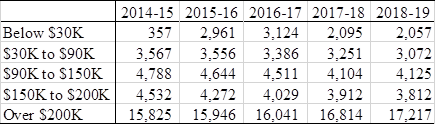
a The number of land transfers below $30,000 in 2014-15 is anomalous and may be an error in the data.
The highest average value of a land transfer in the top tax bracket was in 2014-15 at $379,935. The average value then declined by 7.2 percent to $352,566 in 2015-16. Subsequently, the average value increased to $365,022 in 2017-18, with only a slight reduction to $364,563 in 2018-19.

Appendix 2: Provincial and Municipal Land Transfer Tax Rates
| Province | Rate Structure | Notes | |
|---|---|---|---|
| Manitoba | First $30,000 | 0.0% | Exemptions: Farmland bought by a farmer or family farm corporation where the land will continue to serve farming purposes; where the transferee is a registered charity; If the transfer is made to benefit an Indian band under the Indian Act; if the transfer is made to shareholders of a dissolved corporation; and if the transfer is made to a spouse for non-commercial property |
| $30,000 to $90,000 | 0.5% | ||
| $90,000 to 150,000 | 1.0% | ||
| $150,000 - $200,000 | 1.5% | ||
| Over $200,000 | 2.0% | ||
| British Columbia | First $200,000 | 1.0% | A First Time Buyer receives a full rebase if purchase price is less $500,000 and a partial rebate if purchase price is $500,000 to $525,000. No rebate if purchase price is over $525,000. A foreign national, foreign corporation, or a taxable trustee pays an additional 20% provincial land transfer tax. In Capital Regional District, Fraser Valley Regional District. Metro Vancouver Regional District, Regional District of Central Okanagan, and Regional District of Nanaimo. |
| $200,000 to $2,000,000 | 2.0% | ||
| $2,000,000 to $3,000,000 | 3.0% | ||
| Over $3,000,000 | 5.0% | ||
| Ontario – Toronto | First $55,000 | 1.0% | First-Time Buyer Rebate-Full Refund if price of home is less that or equal to $368,333; otherwise $4,000 refund. The Non-Resident Speculation Tax (NRST) is a 15% tax payable by homebuyers who are not citizens or permanent residents of Canada or are foreign corporations or trustees if they purchase a property in the Greater Golden Horseshoe Region. The NRST applies to residential property which contains at least one and not more than six single family residences. |
| $55,000 to $250,000 | 2.0% | ||
| $250,000 to $400,000 | 3.0% | ||
| $400,000 to $2,000,000 | 4.0% | ||
| Over $2,000,000 | 5.0% | ||
| Ontario – Outside of Toronto | First $55,000 | 0.5% | |
| $55,000 to $250,000 | 1.0% | ||
| $250,000 to $400,000 | 1.5% | ||
| $400,000 to $2,000,000 | 2.0% | ||
| Over $2,000,000 | 2.5% | ||
| Quebec – Montreal | First $51,700 | 0.5% | The Montreal Home Ownership Program provides financial assistance to first-time homebuyers. See Quebec Land Transfer Tax 2020 https://wowa.ca/calculators/quebec-welcome-tax for details.
Exemptions: The building value is less than $5,000; the transfer is occurring between spouses, family members; a company and its shareholder; or other the transferor and transferee are registered charities |
| $51,700 to $258,600 | 1.0% | ||
| $258,600 to $517,100 | 1.5% | ||
| $517,100 - $1,034,200 | 2.0% | ||
| $1,034,200 to $2,000,000 | 2.5% | ||
| Over $2,000,000 | 3.0% | ||
| Quebec – Rest of the Province | First $51,700 | 0.5% | |
| $51,700 to $258,600 | 1.0% | ||
| Over $258,600 | 1.5% | ||
| New Brunswick | Flat Rate | 1.0% | Exemptions: a lease that lasts for under 25 years; property transferred between executor to a beneficiary under a will; property is transferred between spouses; property is transferred to a Crown corporation; property was transferred to pay off a loan or debt |
| Prince Edward Island | First $30,000 | 0.0% | Exemptions: if a first-time home buyer and Canadian Citizen/Permanent Resident and the property is valued at less than $200,000; if he property is being transferred between family members or as a result of marriage breakdown; if the property being transferred is from one corporation to another and both have the same owner |
| Above $30,000 | 1.0% | ||
| Nova Scotia: Halifax | Flat Rate | 1.5% | Land transfers tax rates vary by municipality between 0 and 1.5%. |
| Newfoundland and Labrador | Two-part tax to a maximum of $5,000 | $200 + 0.8% | Total fee based on value of the property and the mortgage amount. |
Sources: https://wowa.ca/calculators/land-transfer-tax
Appendix 3: The Sensitivity of the Gains from the Three Tax Reforms to the Semi-Elasticity
The calculation of the marginal cost of funds (MCF) for the LTT in Manitoba in Table 5 and the gains from reforming the LTT in Table 6 were based on a semi-elasticity of -12.7. This is the median estimated semi-elasticity from the nine econometric studies listed in Table 3. (The semi-elasticity is the percentage change in the number of transactions from a one percentage point increase in a land transfer tax rate.)
The table below shows how sensitive the calculations of the gains from reforming the land transfer tax are to the semi-elasticity value used in the calculations.
If the semi-elasticity is -7.0, which is the estimate from the Dachis, Duranton, and Turner (2012) study of the impact of the land transfer tax in Toronto on housing sales, the gains from tax reform are reduced because the lower value for the semi-elasticity means that a transfer tax has a smaller impact on sales.
With the lower value for the semi-elasticity, the model still implies that there is a net gain from two proposed reforms – a revenue neutral flat rate and a two percent rate above $150,000 – but that full indexation would result in a net loss for Manitobans.
With a higher semi-elasticity of -25.6, which is the estimate in the Davidoff and Leigh (2013) study for the states’ land transfer taxes in Australia, the net gains from all three reforms are very large because the higher value implies that the land transfer tax has a much larger negative impact on residential property sales.
Sensitivity of the Gains from Tax Reform to the Semi-Elasticity
| Scenario | Option | Efficiency Gain | Gross Gain | Net Gain |
|---|---|---|---|---|
| Semi-elasticity of -7.0 | Option 1: A Revenue Neutral Flat Rate | $5.3 | $5.3 | $5.3 |
| Option 2: A Two Percent Rate Above $150K | $10.7 | $27.8 | $6.0 | |
| Option 3: Full Indexation of Tax Brackets | $1.3 | $14.8 | -$2.5 | |
| Semi-elasticity of -25.6 | Option 1: A Revenue Neutral Flat Rate | $190 | $190 | $190 |
| Option 2: A Two Percent Rate Above $150K | $264 | $281 | $259 | |
| Option 3: Full Indexation of Tax Brackets | $31.0 | $44.5 | $27.3 |