





The Study In Brief
Technological change is a driving force behind economic growth. It can improve productivity for existing goods and services, meaning the same output can be achieved with fewer inputs, or more can be produced with the same amount of human labour. Technologies also enable the development of new products and services that can create new occupations and consumer demand where none existed before. The process of technological change is, however, disruptive, rendering particular occupations obsolete or changing entire industries relatively quickly. At the same time, new business models and occupations grow to replace them.
This Commentary assesses the likely impact of technological automation on Canada’s labour market and compares these results to past predictions. In fact, they show a lower proportion of employment at high risk of automation (about 22 percent) than most previous estimates. There are some occupations that are obviously highly automatable, and many are being automated already – gas station attendants, bank tellers and store cashiers, for example.
There are others that are quite obviously not automatable due to a particular human element or specialized set of skills – neurosurgeons or detectives, for example. Most occupations are not fully automatable but they are not completely immune from automation either. The occupations that are more likely to be automated generally contain more well-defined tasks and repetition, such as those in manufacturing.
About one in five Canadian workers are employed in a job that could theoretically be automated. By 2028, projections indicate that employment in these occupations will decline by only about 90,000 jobs. Meanwhile, jobs that are only somewhat susceptible to automation (medium risk) make up about 40 percent of current employment. This proportion is projected to decline slightly to about 37 percent by 2028. These projections indicate that the labour market has been adapting to technological change over time and is likely to continue along a similar trajectory.
The analysis of automation susceptibility by individual characteristics indicates that Black and Indigenous Canadians are employed in occupations that are highly susceptible to automation in higher proportions than the population average. It is likely that the relatively higher susceptibility to automation is related to the worse average employment outcomes of Black and Indigenous people relative to the Canadian average.
Men, women and immigrants, however, face a similar average risk from automation. Overall, the differences are not large enough to warrant targeted pre-emptive policies specifically to prevent technology-induced unemployment for particular groups. Instead, the inequality effects of automation could be indirectly addressed through education and labour-market policies that target inequality more broadly. However, with growth in non-standard employment, traditional job-support policies may not be available to all workers impacted by automation. Following the current COVID-19 crisis, the government should analyze the effects of its emergency income support programs and use the insights to modernize employment insurance and address income- and employment-support gaps.
Introduction
Technology has transformed human life in previously unimaginable ways. Innovation liberated society from darkness with electric light and from deadly diseases with water treatment and plumbing, germ theory and vaccinations.
Innovations in telecommunications technologies have connected the world to information, news, entertainment and myriad consumer and business services via the Internet. More recent improvements in quantum computing, robotics and artificial intelligence have led some to speculate that software and machines will soon be able to replace human workers in many occupations.
Technological change is a driving force behind economic growth. It can improve productivity for existing goods and services, meaning the same output can be achieved with fewer inputs, or more can be produced with the same amount of human labour. Technologies also enable the development of new products and services that can create new occupations and consumer demand where none existed before. The process of technological change is, however, disruptive, rendering particular occupations obsolete or changing entire industries relatively quickly. At the same time, new business models and occupations grow to replace them.
The fear that machines and, more recently, software might replace people in performing many tasks is not new.11 The earliest written example of the idea that technology might destroy jobs faster than new ones are created, to my knowledge, is Aristotle’s speculations about slaves becoming redundant due to the invention of brooms (Campa 2014). There is, however, some evidence that the debate may have begun some 3,000 years earlier with the invention of the wheel (Woirol 1996). Recent developments in artificial intelligence, machine-to-machine communication and increased digitalization of various services have led to speculation that jobs will be automated faster than new ones are created to replace them. Furthermore, there are a number of unsettling predictions that large portions of the population face unemployment in the near future (Brynjolfsson and McAfee 2014, Frey and Osborne 2013, Lamb 2016). In contrast to these dire predictions, others show technology increasing employment (Bessen 2018) or proceeding similarly to past eras of technological change (Oschinski and Wyonch 2017). There is significant uncertainty about the proportion of employment at risk of being automated, with estimates for the US labour market ranging from 9 percent to 47 percent (Arntz, Gregory and Zierahn 2016, Frey and Osborne 2013). For Canada, estimates suggest that 9 percent to 42 percent of the labour market is at high risk of unemployment due to technology change (Arntz, Gregory and Zierahn 2016, Lamb 2016, Oschinski and Wyonch 2017).
This Commentary assesses the likely impact of technological automation on Canada’s labour market and compares these results to past predictions. It also reviews recent literature on the implications of technological change: when it leads to employment growth, when it doesn’t, and how these insights apply to Canada. Results from this analysis show no evidence of accelerating technological unemployment.22 Technological unemployment refers to job losses caused by changes in technology. The concept encompasses both incremental process improvements that result in reduced demand for labour and significant technological change that disrupts established industries and business practices. In fact, they show a lower proportion of employment at high risk of automation (about 22 percent) than most previous estimates. The risk of automation also has no direct relation to wages, suggesting that technological change is likely to affect income inequality through compositional changes to employment.33 Previous research has implicated technology as a significant factor in US income inequality (Cheremukhin 2014). Employment changes in Canada, however, do not show significant income polarization related to potential for automation (Oschinski and Wyonch 2017).
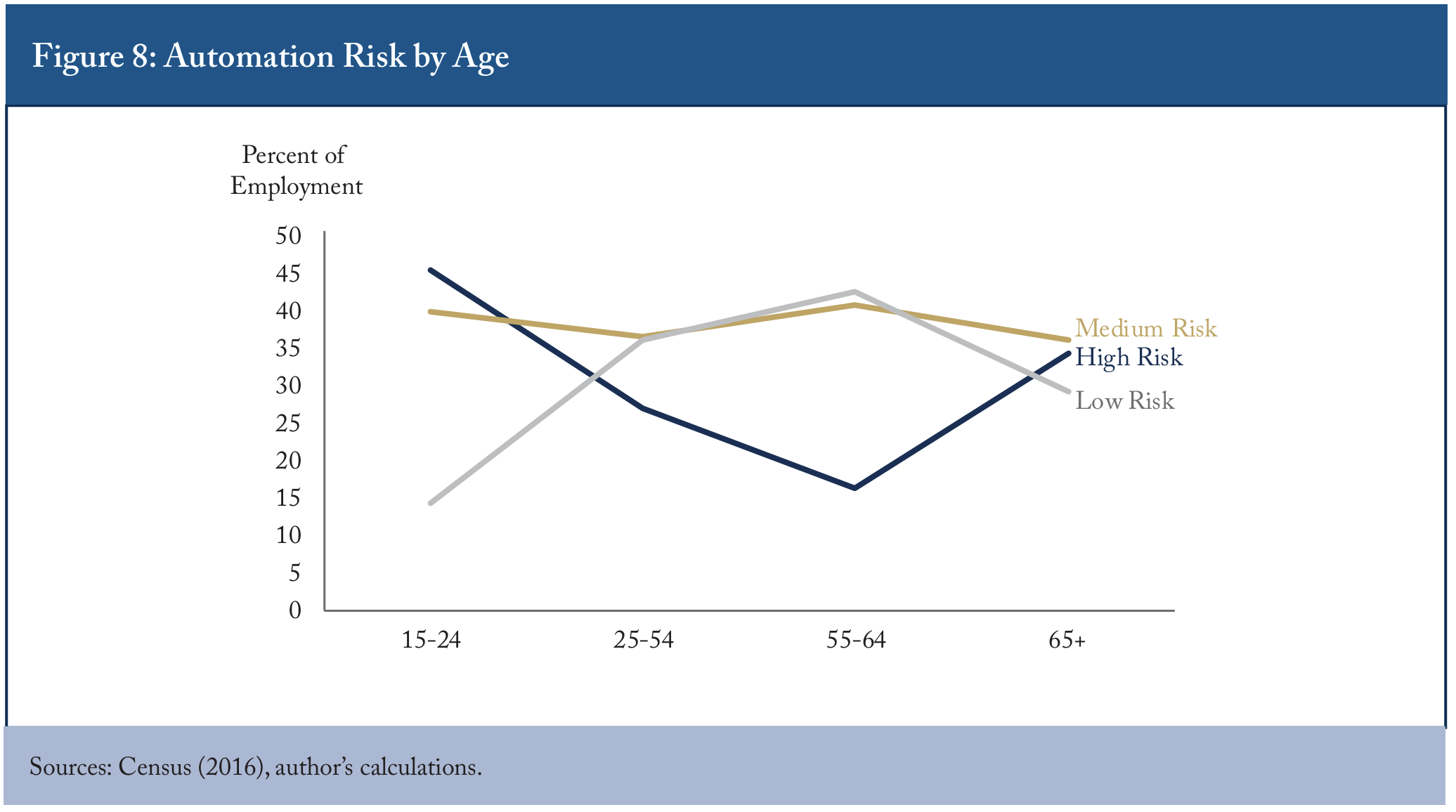
Meanwhile, individual worker characteristics such as race, immigration status or ethnicity are not significantly related to a likelihood of being automated. However, some significant differences arise in particular types of occupations for some groups. Indigenous people, for example, are at a significantly higher average risk of automation in most occupations except for those in natural resources and agriculture. Women are more likely than men to be employed in occupations that are either low or high risk, as opposed to medium risk; but average risk is similar between genders.44 Women are at higher average risk of losing their jobs to automation when working in business, finance, administration, manufacturing and utilities occupations. Men in education, law, social, community and government services occupations are at a slightly higher average risk of automation. The differences in risk arise from the underlying mix of jobs and who occupies them within each broad occupation type. The risk of automation also changes with age: young workers, 15 to 24 years of age, are more likely to be employed in occupations at a high risk of automation, while those aged 55 to 64 are the most likely to be employed in occupations with a low risk of automation.
Overall, this Commentary finds that Canada’s labour market has been adapting quite well to technological change and that the risk of significant technology-induced unemployment remains low for the near future. This suggests that government should be moderating technological change’s negative effects for those that are affected in the short term. Existing policies that provide job training and income support for unemployed and low-income people provide a buffer against economic hardship (technology-induced or otherwise).55 Further, the Canada Training Credit and the Employment Insurance Training Support Benefit, new programs announced in the 2019 federal budget, have not had time to take full effect and aim to address issues related to technological unemployment and the need to adapt to technological change throughout people’s careers. However, with growth in non-standard employment, traditional income- and employmentsupport policies may not be available to all workers affected by automation. The Canadian Emergency Support Benefit (CERB), an emergency income support program for individuals affected by the COVID-19 pandemic, was in part created to address coverage gaps in Employment Insurance. Following the current crisis, the government should analyze the effects of CERB, and use insights from the natural experiment to modernize Employment Insurance and address the income and employment support gaps revealed by COVID-19.66 This emergency policy should not be made permanent, but was necessary due to existing gaps in employment and income support. Post-crisis, addressing those gaps should be a priority.
The risk of automation is similar across different population groups, but some are at a disadvantage in particular types of occupations. It varies significantly with education level, which explains some of the variation related to individual characteristics. These results suggest that education is a critical factor in addressing the relative risk of being automated for more vulnerable population groups.
The Economics of Technological Change
Technological change has contributed massively to improvements in living standards and well-being. However, the process of technological change is one of “creative destruction” that renders some products, jobs, business practices or even entire occupations and industries obsolete as they are replaced by superior alternatives. At the same time, technology contributes to the growth of new industries, products, services and occupations. In the early 20th century, it would have been difficult, if not impossible, to envision occupations like data systems administrator or artificial intelligence researcher, but both existed by the beginning of the 21st century. Similarly, those living today cannot accurately predict what new technologies may be developed or the effects they might have on society in the distant future.
Over the long term, technology adoption contributes to economic growth, improves productivity and raises living standards. In the short term, however, it can be quite disruptive as some businesses fail to adapt to the changes and some people lose their jobs. In some cases, it has taken decades for the economy and society to fully adapt to significant technological change and for its benefits to be fully diffused.77 During the Industrial Revolution, real wages in England grew slowly from 1781 to 1819 but then grew quickly until 1851. In particular, blue-collar workers saw real wages double over the latter 32-year period (Lindert and Williamson 1983). New occupations created by technological change might require different skills than those that are automated, while some existing jobs change dramatically. Technology development and adoption don’t affect all sectors simultaneously, but rather in growth bursts in certain sectors and declines in others. Meanwhile, rapidly growing economies show high levels of both job creation and destruction (Howitt 2015).
The prevailing view of technological change is that it is desirable. Technology improvements allow more to be produced with the same or less human labour than was required before. Consequently, labour is freed up and directed toward other tasks. Improved productivity contributes to economic growth, which in turn contributes to higher wages. The fear of technological unemployment – that new technology will destroy jobs faster than new ones are created – has accompanied past eras of technological change. Yet, until now, the bogeyman of mass technological unemployment has failed to materialize. Still, recent developments in artificial intelligence and machine-to-machine communication have led to debate about whether this time it will be different.
In past eras of technological change, machines have predominantly replaced human labour in a physical sense. With the development and continued improvement in computing and communications technologies, machines are now starting to replace humans in performing cognitive labour in addition to physical. Some argue that digital technological development could replace human workers more quickly than new jobs are created (Krugman 2013, Levy and Murnane 2004, Sirkin, Zinser and Hohner 2011, Cowen 2013). Such a possibility means that large portions of the population would face technology-induced unemployment in the years to come (Brynjolfsson and McAfee 2014, Frey and Osborne 2013, Lamb 2016).
There are, however, counterbalancing factors such as the development of new occupations and complex tasks for humans to perform that moderate the negative effects of technological change. Demographic aging is associated with more rapid adoption of automating technologies as labour productivity improvements are required to maintain production levels as the proportion of population of working age shrinks (Acemoglu and Restrepo 2019). Still, if automation outpaces the creation of new jobs, it puts downward pressure on wages. When human labour is cheaper, the incentive to develop and adopt labour-saving technologies diminishes. As a result, investment in research and development is more likely to be directed toward the creation of new complex tasks than to laboursaving (automating) technologies (Acemoglu and Restrepo 2016, 2018). In addition, where automation has occurred, productivity is improved, which leads to lower prices and a higher quantity of demand (Acemoglu and Restrepo 2016, 2018, Autor and Salomons 2018, Bughin, Manyika and Woetzel 2017). Meanwhile, Bessen (2018) notes that both productivity-enhancing technologies and employment in manufacturing grew for a century or more before productivity gains brought declining employment. As a result, he postulates that until a market is saturated, technology can have positive employment effects.
Other research links demographic change to automation – countries experiencing more rapid population aging are also those with the most rapid development of automation technologies (Acemoglu and Restrepo 2019). This research also finds that almost half of the cross-country variation in the adoption of automating technologies can be explained by demographic factors.
Overall, the economic effects of current technological change are far from settled. There is research indicating little chance of significant technology-induced unemployment while others suggest that up to four in 10 workers could find themselves without work in the near future (Oschinski and Wyonch 2017, Lamb 2016). The fear that technology will replace humans faster than new occupations are created has accompanied past eras of technological change. The history of technological change, and the analysis that follows, suggests that this time is no different and that mass technological unemployment in the near future is highly unlikely.
However, as with past eras of technology growth, some people will likely face significant hardship in the short term. Government policy should be used to moderate the negative effects on the one hand, while encouraging the adoption and development of new technology on the other. Adopting technologies contributes to maintaining or improving the global competitiveness of Canadian industries and improves productivity, which lessens the fiscal strain of an aging population. For the economy’s long-term health, technology should be celebrated rather than feared.88 For an extensive analysis of the interactions between technology diffusion, business practices and government policy see Andres Criscuolo and Gal (2015).
Robots at Work
One area where automation has been ongoing for quite some time, and is likely to continue, is manufacturing. The adoption of industrial robots and their relation to manufacturing employment provide some basis for predicting future employment effects, as well as a measure of technology adoption that can be compared across countries. After years of annual growth, installations of industrial robots in Europe and the Americas declined in 2019, which indicates that automation is not increasing in pace, at least for industrial robot applications (International Federation of Robotics 2019).
Canada was the 13th largest market for industrial robots in 2018. Automotive and electronics manufacturing account for the largest number of installations, but the largest area of growth in sales has been in “unspecified” industries (44 percent increase in 2018), even though “collaborative” industrial robots remain a niche representing just 3 percent of global sales in 2018 (International Federation of Robotics 2019).
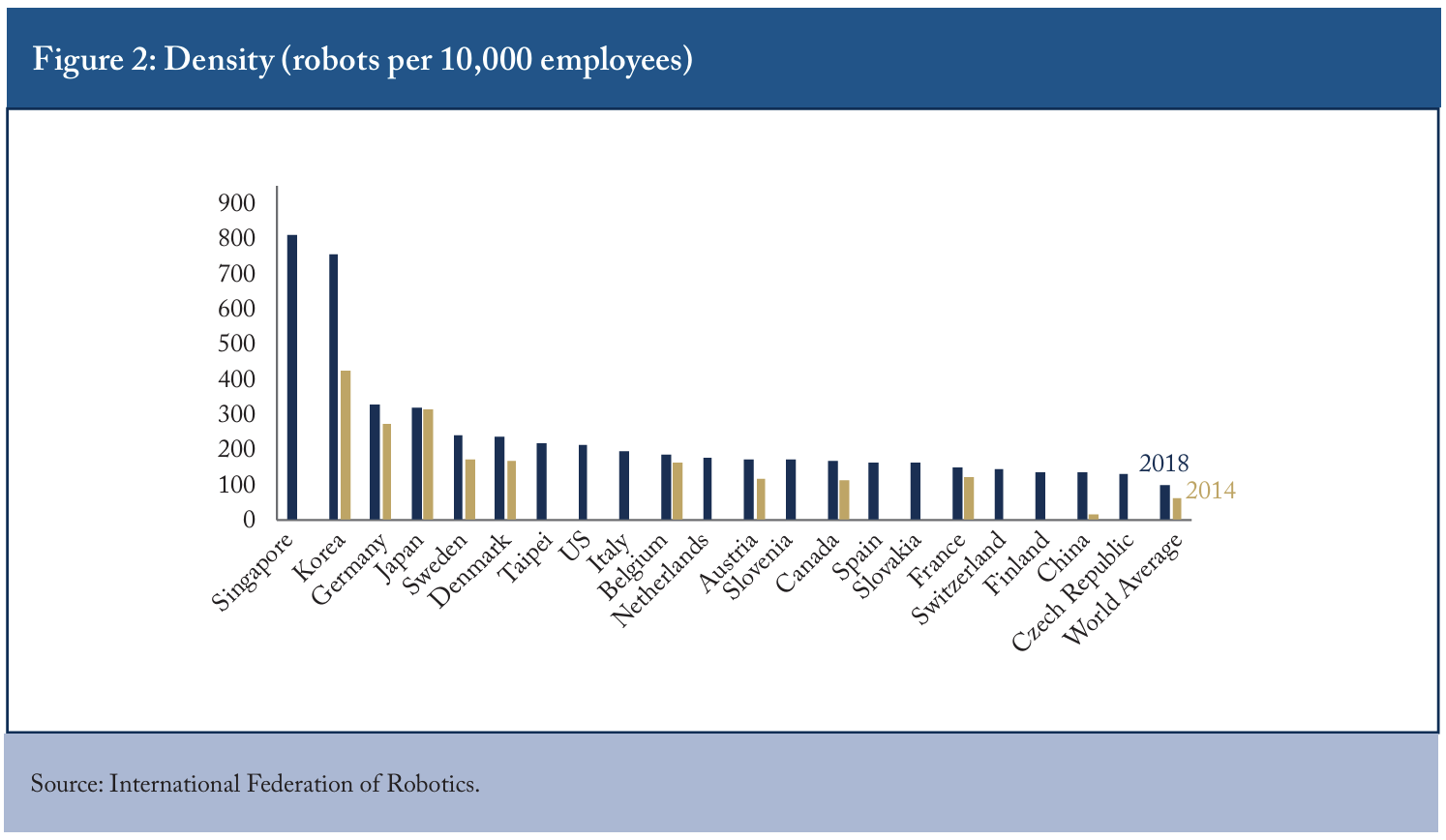
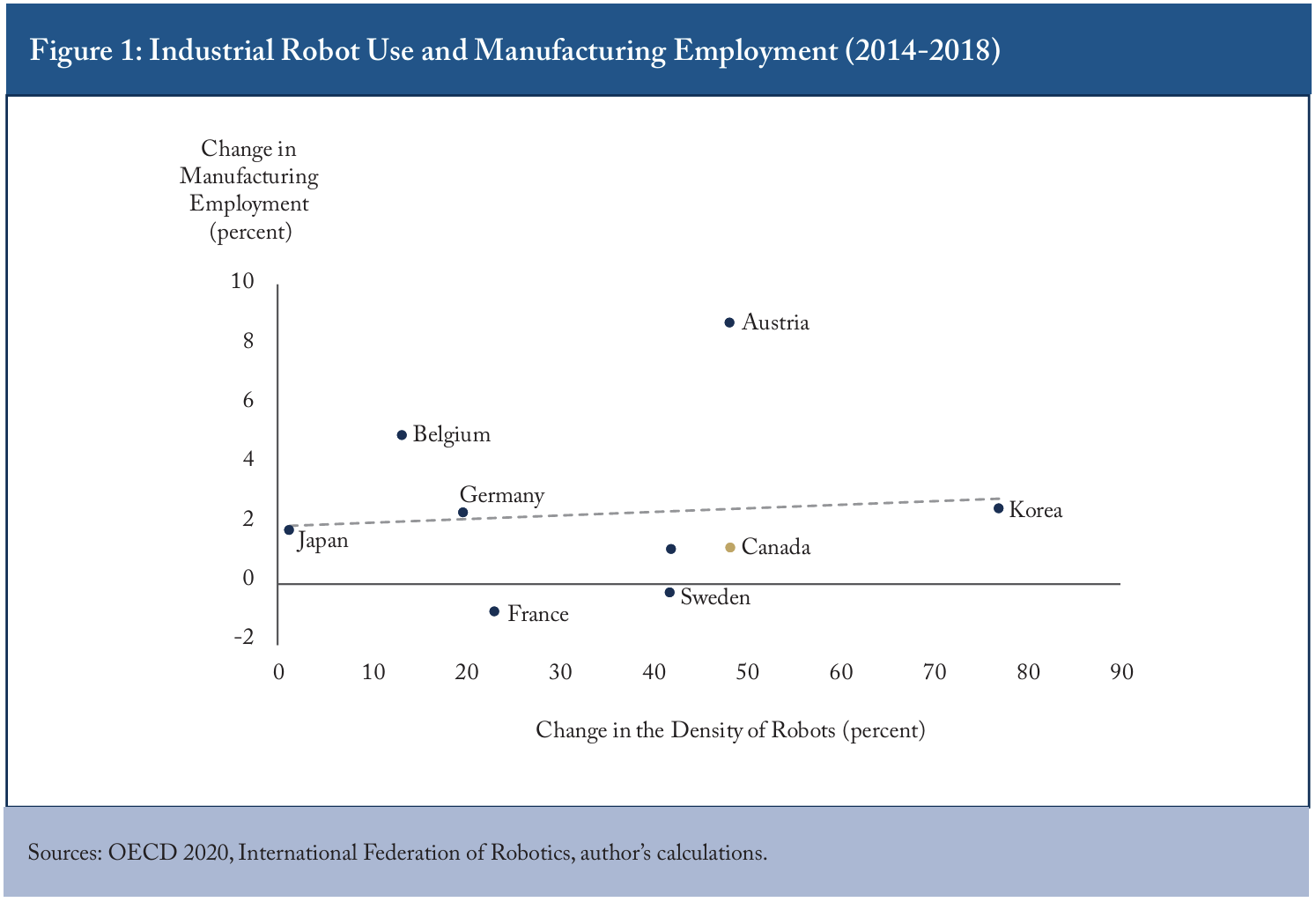
In Canada, the number of industrial robots per manufacturing worker has increased significantly in recent years. From 2014 to 2018, the density of industrial robots in manufacturing (the number of robots per 10,000 employees) increased 48 percent. With such a dramatic jump, one might expect a decline in manufacturing employment, but manufacturing jobs increased by 1.2 percent over the same period (OECD 2020). In fact, across countries, there is no relationship between robot density and manufacturing employment (Figure 1).99 Graetz and Michaels (2015) found a similar result for the 1993-2007 period using a larger sample of countries and defining manufacturing hours worked as the measure of employment. Graetz and Michaels (2015) found that increased robot density is associated with a slight growth in manufacturing employment when using a longer time period and larger sample of countries, but the correlation is statistically weak. Meanwhile, increased automation does not necessarily lead to a decline in employment (Autor and Salomons 2018, Bughin, Manyika and Woetzel 2017, Acemoglu and Restrepo 2016, 2018).
Despite the significant increase in the number of industrial robots performing various manufacturing and industrial activities, there remains significant potential for further adoption in Canada. There are many countries with a higher density of robotics in industrial applications than Canada (Figure 2). Indeed, Singapore and South Korea, the countries with the highest density of industrial robots, have more than 4.5 times as many robots per worker than in Canada. Similarly, Canada’s adoption of industrial robots in manufacturing lags behind that of Germany, Japan, Sweden, Denmark, the US and other nations. This international comparison signals that the potential for further robotic automation in Canadian manufacturing and other industrial applications remains quite high. But, since the density of industrial robots is not related to manufacturing employment, it is unclear what effects further technology adoption could have on employment.
Estimating the Likelihood of Automation
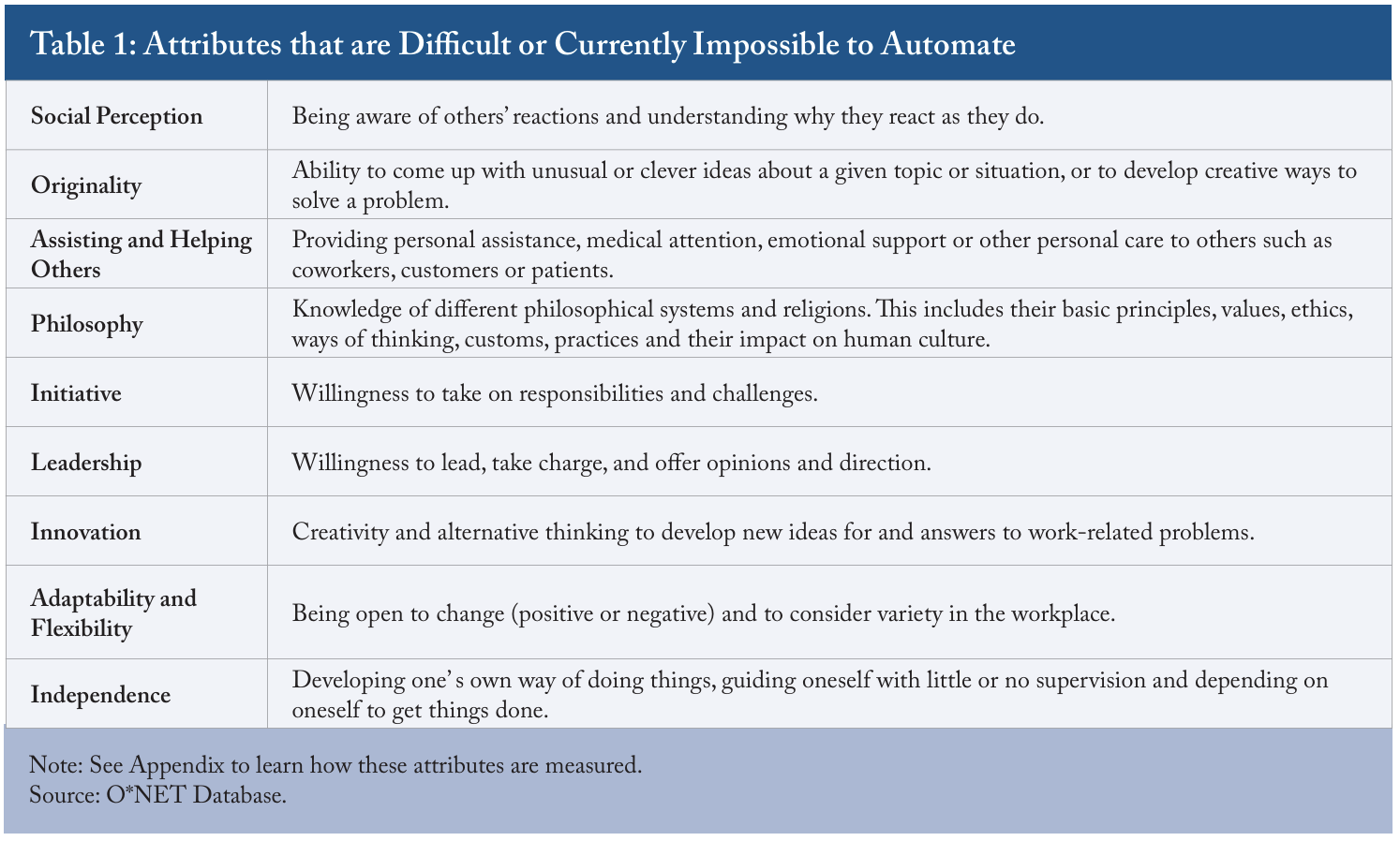
To estimate the effect of automation on the labour market, I follow methods similar to Frey and Osborne (2013) and Oschinski and Wyonch (2017). Data on skills, work activities and interpersonal interactions were sourced from the O*NET database, a US initiative containing hundreds of standardized and job-specific descriptors on almost 1,000 occupations.1010 The implicit assumption underlying use of this data is that occupations in Canada require similar skills, knowledge and activities to equivalent occupations in the US. The skills, knowledge and activities selected are those that are difficult or impossible for a computer or robot to perform and likely will be for the foreseeable future (Table 1).1111 These attributes are the same selected in Oschinski and Wyonch (2016). To validate the selection of non-automatable attributes and test the sensitivity of estimates to that selection, various other sets of attributes – selected in other research using various methods – were used to estimate the likelihood of automation (Autor and Dorn 2013, Josten and Lorden 2019, Frey and Osborne 2013). Attribute selection has marginal effects on the classification of individual occupations but does not significantly affect aggregate results. Different occupations require different levels and intensities of these attributes. In principle, occupations for which these attributes are very important or where a high level of performance is required are more difficult to automate. Some portion of these occupations may be computerized but while technology would improve labour productivity, it would be unable to replace people completely.
Conversely, occupations for which the selected attributes are unimportant are more likely to be automated. Automation is, therefore, more likely to replace labour in performing most of the tasks required by those occupations.
There are some occupations that are obviously highly automatable, due to examples of them being automated already – gas station attendants, bank tellers and store cashiers, for example. There are others that are quite obviously not automatable due to a particular human element or specialized set of skills – neurosurgeons or detectives, for example. Most occupations are not fully automatable but they are not completely immune from automation either. To construct a classification of occupations as “automatable,” “not automatable” and “somewhat automatable,” I use the classifications and outputs from four different labour-market automation studies: Autor and Dorn (2013), Josten and Lordan(2019), Frey and Osborne (2013) and Oschinski and Wyonch (2017). With the exception of Autor and Dorn (2013), which used binary classification, automatable or not, these studies classified occupations into three categories – high, medium and low risk of automation.1212 Lorden and Jorden (2019) classify occupations as “automatable,” “not automatable” and “polarized automatable” but use less granular occupational definitions. Across the four classification outputs, there were many occupations that were given a similar classification. Those cases form the vector to “train” the algorithm.
The statistical analysis estimates the likelihood an occupation could be automated based on the selected attributes and the classifications in the training vector. The method used is Gaussian Process regression, a basic machine-learning, nonparametric classification and probability-estimation technique.1313 See Appendix for detailed explanation of methods used in this analysis. The regression was implemented with the “kernlab” R statistical package (Karatzoglou, Smola and Hornik 2019). The resulting output provides an estimate of the probability that an occupation could be automated. This output, using US occupational codes, is then linked to Canadian labour market data,1414 See Census (2016) and Canadian Occupational Projection System (COPS) employment estimates (2019). using the concordance from Frenette and Frank (2017, 2018).
Automation in Canada’s Labour Market
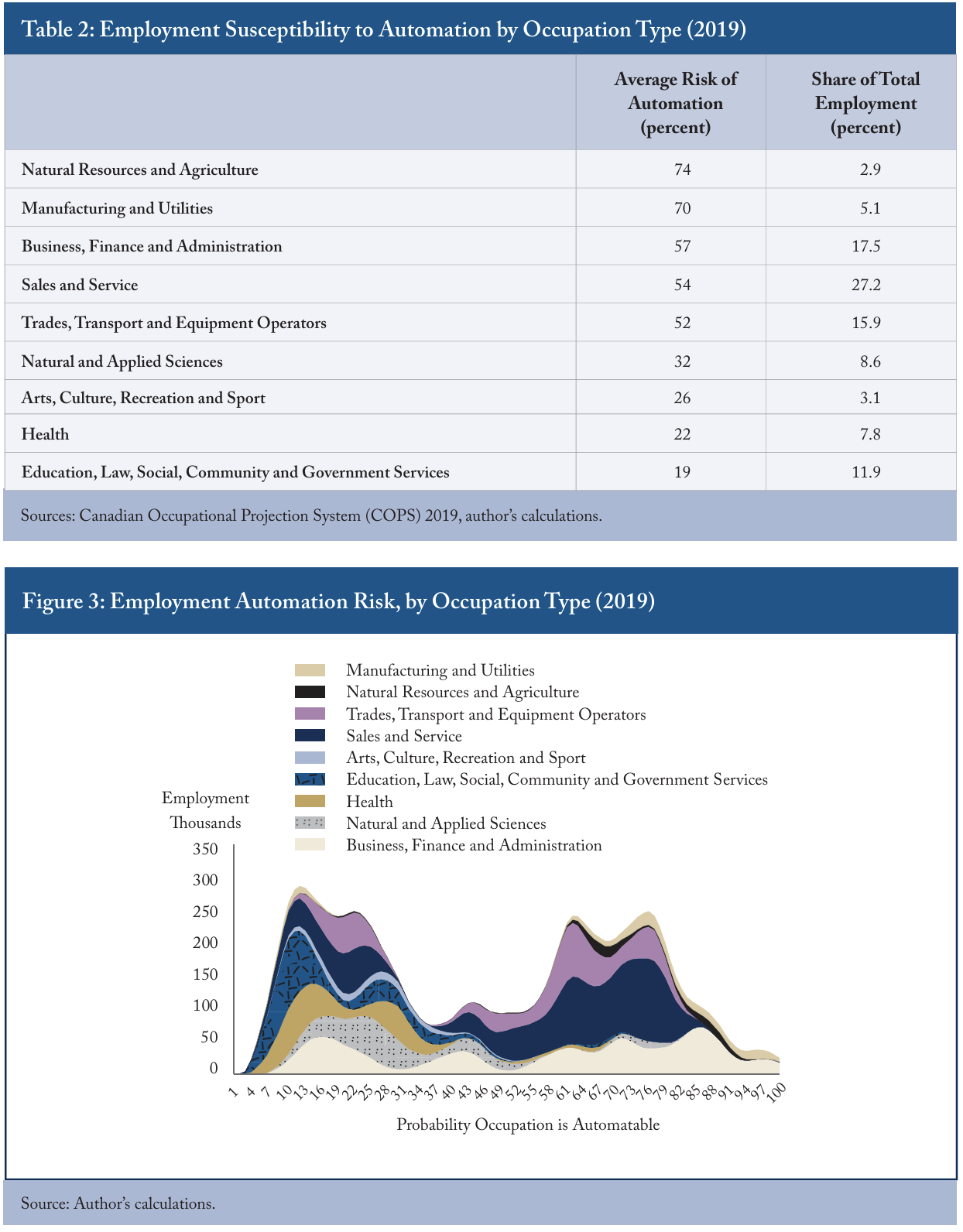
The results show that in 2019 about 22 percent of Canadian employment was in jobs highly susceptible to automation, while about 39 percent have low susceptibility.1515 Probability thresholds for categorization are: [0, 0.36) = low susceptibility; [0.36, 0.72) = medium susceptibility; [0.72, 1] = high susceptibility. Occupations in health, law, education and community, and government services are the job types least likely to be automated (Table 2 and Figure 3). Those in agriculture, natural resources, utilities and manufacturing are more susceptible to automation.
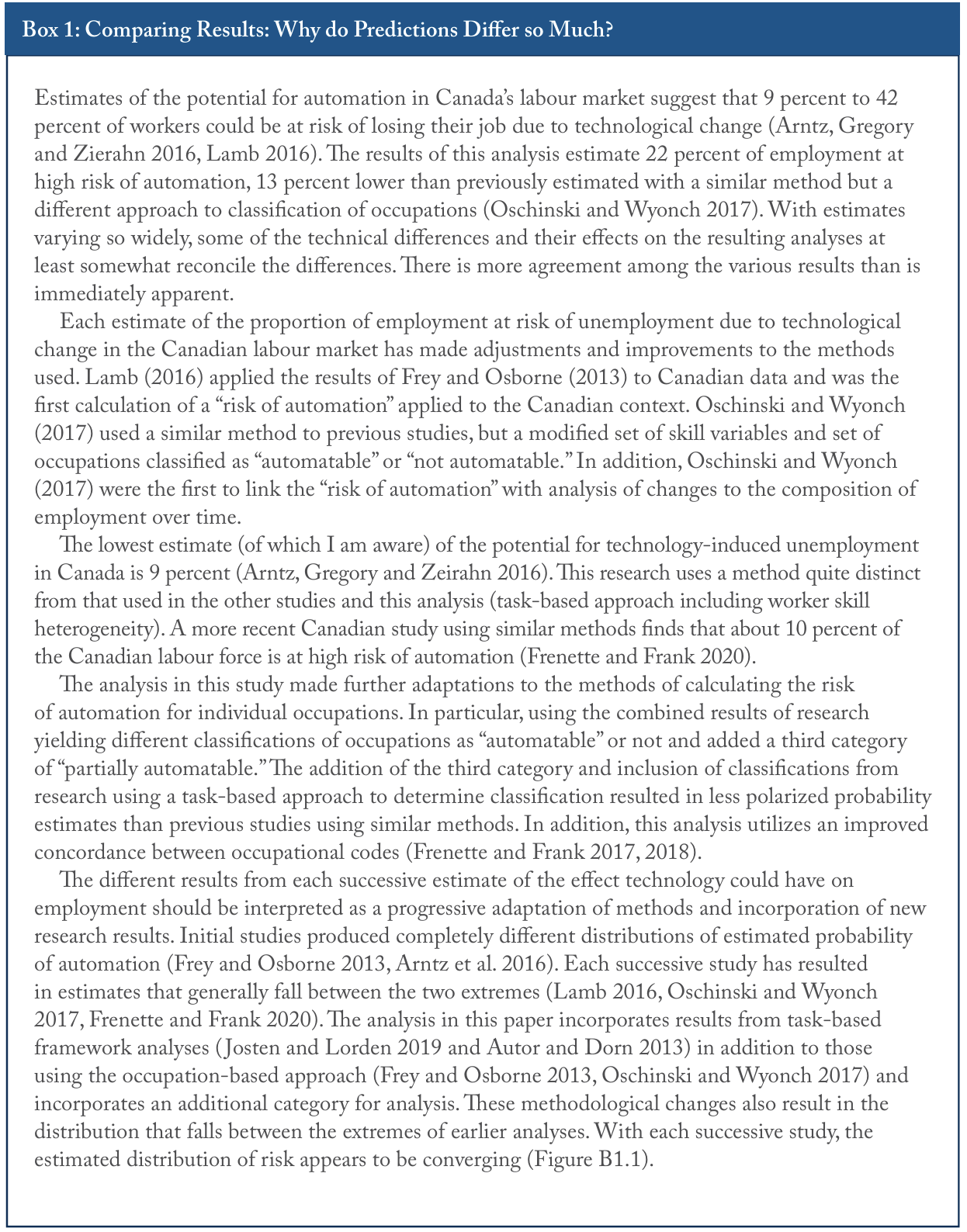
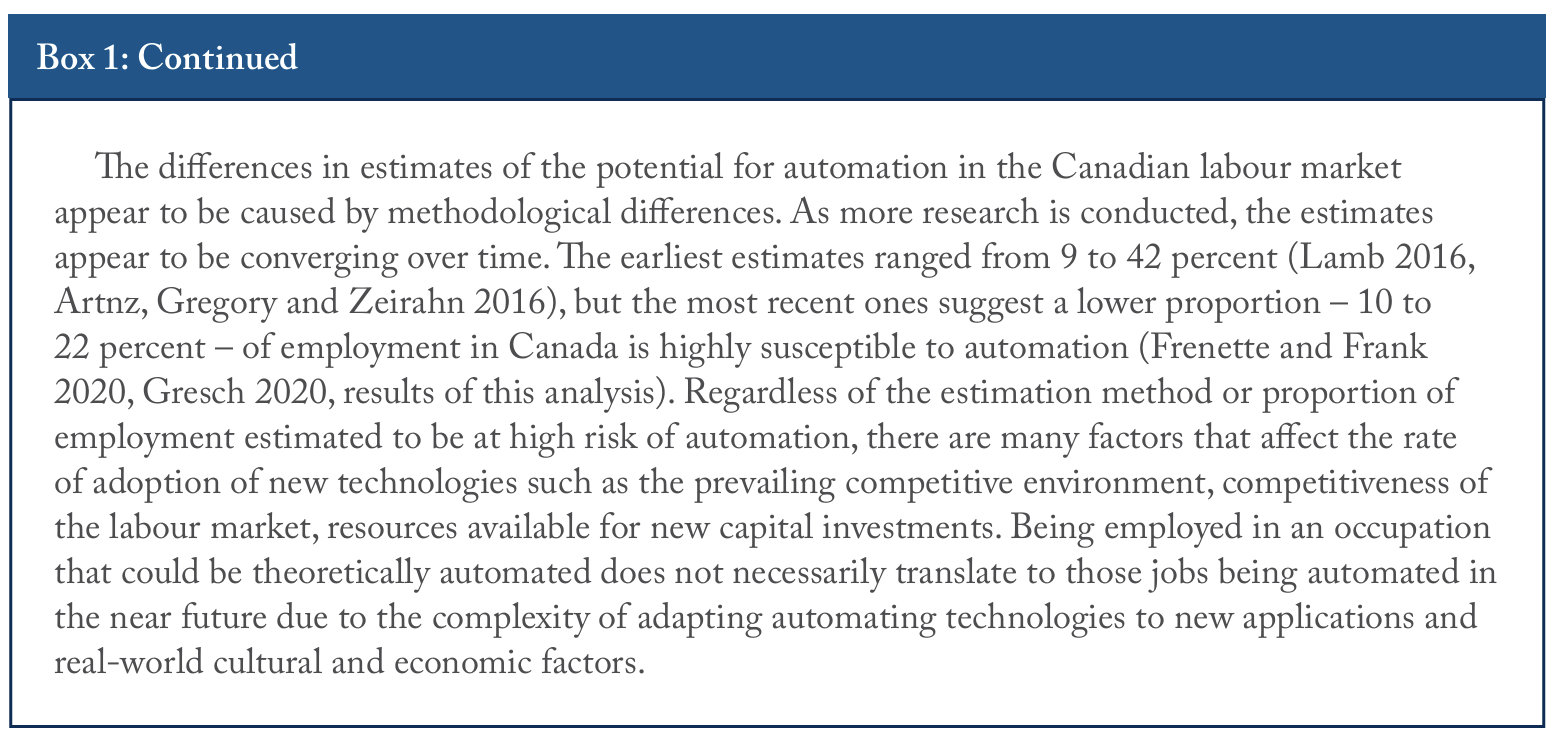
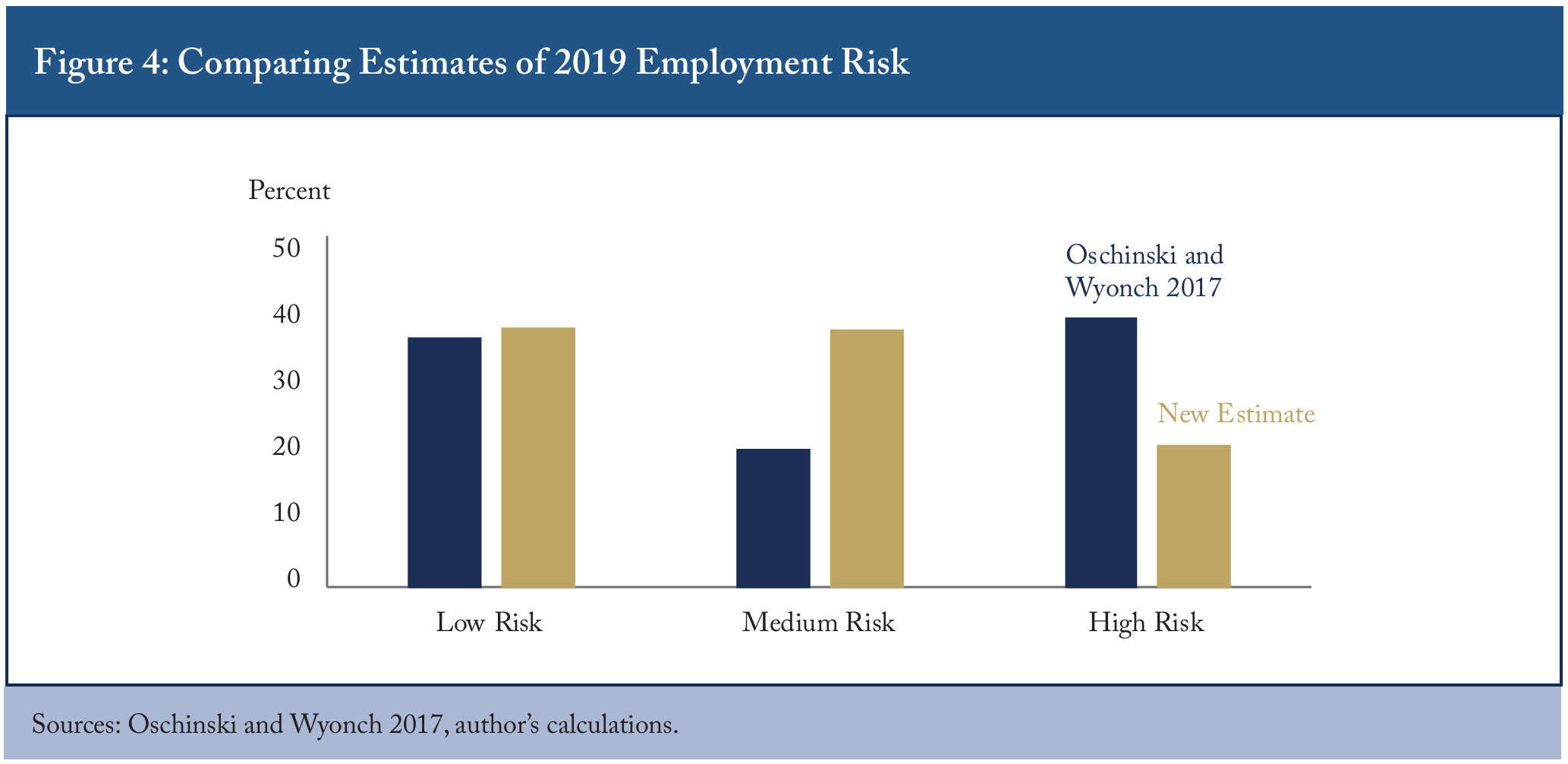
Notably, the estimated proportion of high-risk employment is lower than found in previous studies using similar methods: Lamb (2016) and Oschinski and Wyonch (2017) estimated the proportion of employment at high risk of being automated as 42 percent and 35 percent, respectively (see Box 1 for further discussion of comparative results.). Furthermore, this analysis’s estimated results for 2019 are more favourable than was projected by Oschinski and Wyonch (2017) (Figure 4).
Meanwhile, the proportion of employment at low risk of automation, 40 percent, is slightly higher than previous studies. The proportion of employment at high risk of automation is significantly lower than previous analyses using similar methods, but there were no significant increases in Canadian unemployment during the period between studies. The difference between the results could be explained by a number of different factors. For example, automation could be progressing faster than previously thought, since the proportion at high risk is declining more quickly than previously projected. In that case, the lack of significant unemployment growth during the 2015 to 2019 period signals that employment in Canada has been adapting to the potential for automation over time.1616 It is also worth noting that results calculated for this analysis combine the classifications of multiple research papers on automation. The resulting estimates are less polarized than those from Oschinski and Wyonch (2017), meaning that a larger proportion of occupations were classified here as “medium risk.” This difference had a larger effect on “high-risk” than “lowrisk” employment due to the composition of Canada’s labour market. The estimated probability that an occupation could be automated was calculated using the classifications individually and in combination. Results from the combined classification fall between extremes for all occupations.
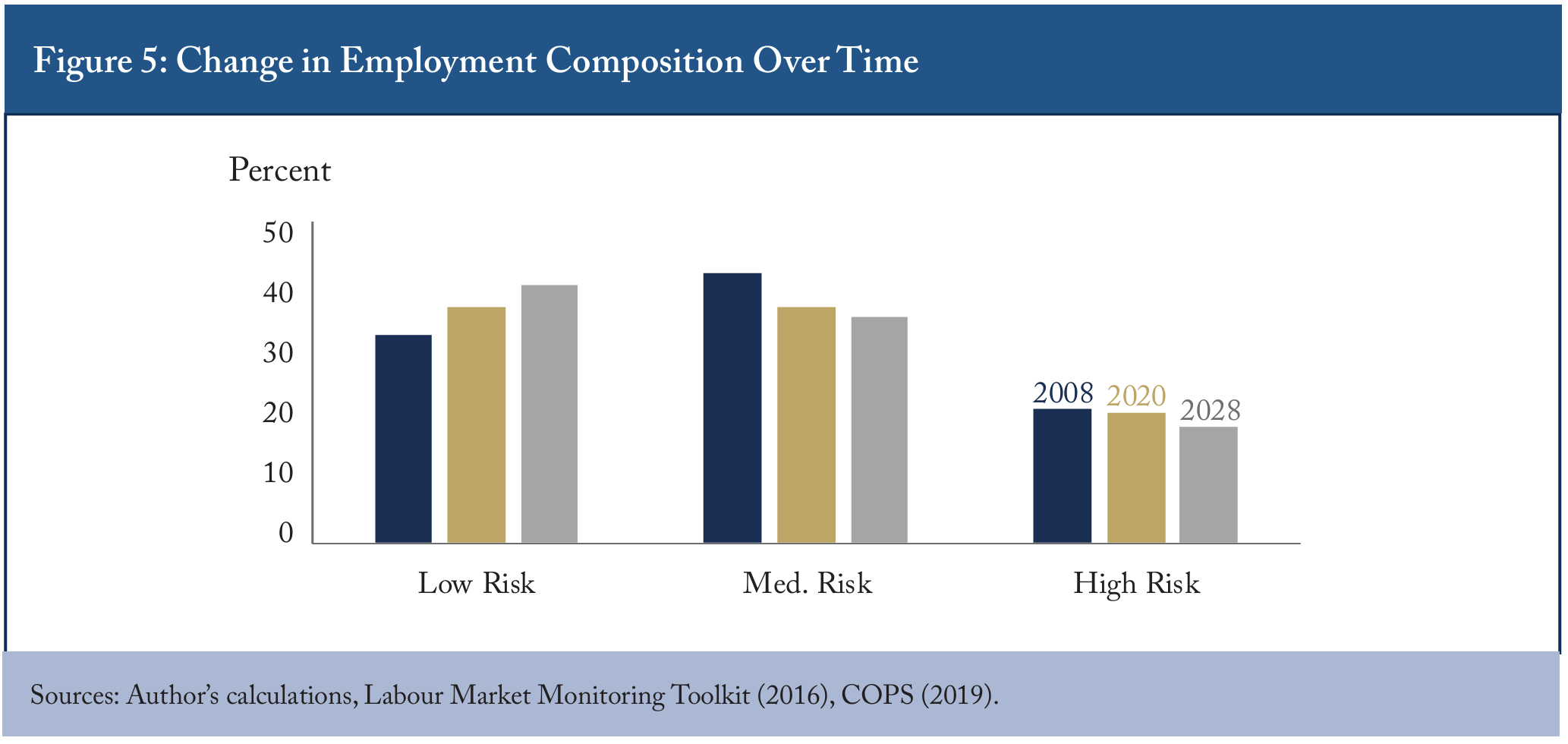
To project the effects of technological change and automation on Canada’s labour market in the years to come, I use data from the Canadian Occupational Projection System for employment forecasts.1717 The COPS projections include current employment data and projections of future trends in job openings and job seekers by occupation at the national level. The latest projections cover the 2019-2028 period. Employment data for past years is sourced from the Forum for Labour Market Ministers Labour Market Information Toolkit (2016). To model the effects of automation on employment growth, I assume a 2.1 percent annual adoption rate, equivalent to the projected average growth rate in productive capital stock across OECD countries (OECD 2019).1818 emp2020 = (emp2019 × growth2019) – (risk × adoptionrate × emp2019) calculated for each occupation, then aggregated to project total employment composition by risk category. To test the sensitivity of the projections to the assumption of a 2.1 percent technology adoption rate, I also projected adoption rates of 1.7 percent and 4.3 percent, representing 2019 growth in Canadian productive capital stock and highest growth in productive capital stock among OECD countries. Projection results using different adoption rates can be found in the Appendix (Table A4). These projections represent employment effects from 2020 technology levels and do not include changes to, or projections for, future technology levels. They are based solely on the ongoing adoption of current technologies. If fundamental breakthroughs are made related to the attributes identified as difficult or impossible to automate, it would alter the susceptibility to automation of many occupations and would, therefore, also alter projected employment.
Furthermore, these projections show compositional change in employment in the coming years. In 2020, about 40 percent of employment is in jobs that are unlikely to be fully automated (Figure 5). By 2028, this proportion is projected to increase to 43 percent of the labour market, with about 490,000 new jobs created.
Employment in occupations categorized as at medium or high risk of automation is projected to decline collectively by about 580,000. Depending on the rate of adoption of new technology, the estimated change in jobs as a result of technological change ranges from a net gain of 90,000 to a net loss of 1.38 million, with a 2.1 percent annual adoption rate corresponding to a net decline of 90,000 jobs. One important limitation of these projections is that they don’t account for job growth due to the development of new innovative technologies or the creation of new occupations related to current technologies.
Further, since projected growth is sourced from COPS, it is worth noting that previous projections have tended to undershoot actual job creation.1919 For example, 2015 projections for employment estimated total employment of 18.72 million in 2020,2017 projections estimated 2020 employment at 18.8 million and 2019 projections predicted total 2020 employment at 19.1 million. These projections should be interpreted only as the decline in employment due to technological change, not growth in employment due to the creation of new jobs or further technological developments. Even so, these estimates suggest that only about 4 percent of current employees are at risk of losing their jobs due to automation over the next eight years. This is significantly less dire than previous predictions that about four in 10 workers could lose their jobs within a similar time frame.2020 Lamb (2016) stated that 42 percent of all Canadian jobs were highly susceptible to automation within a decade.
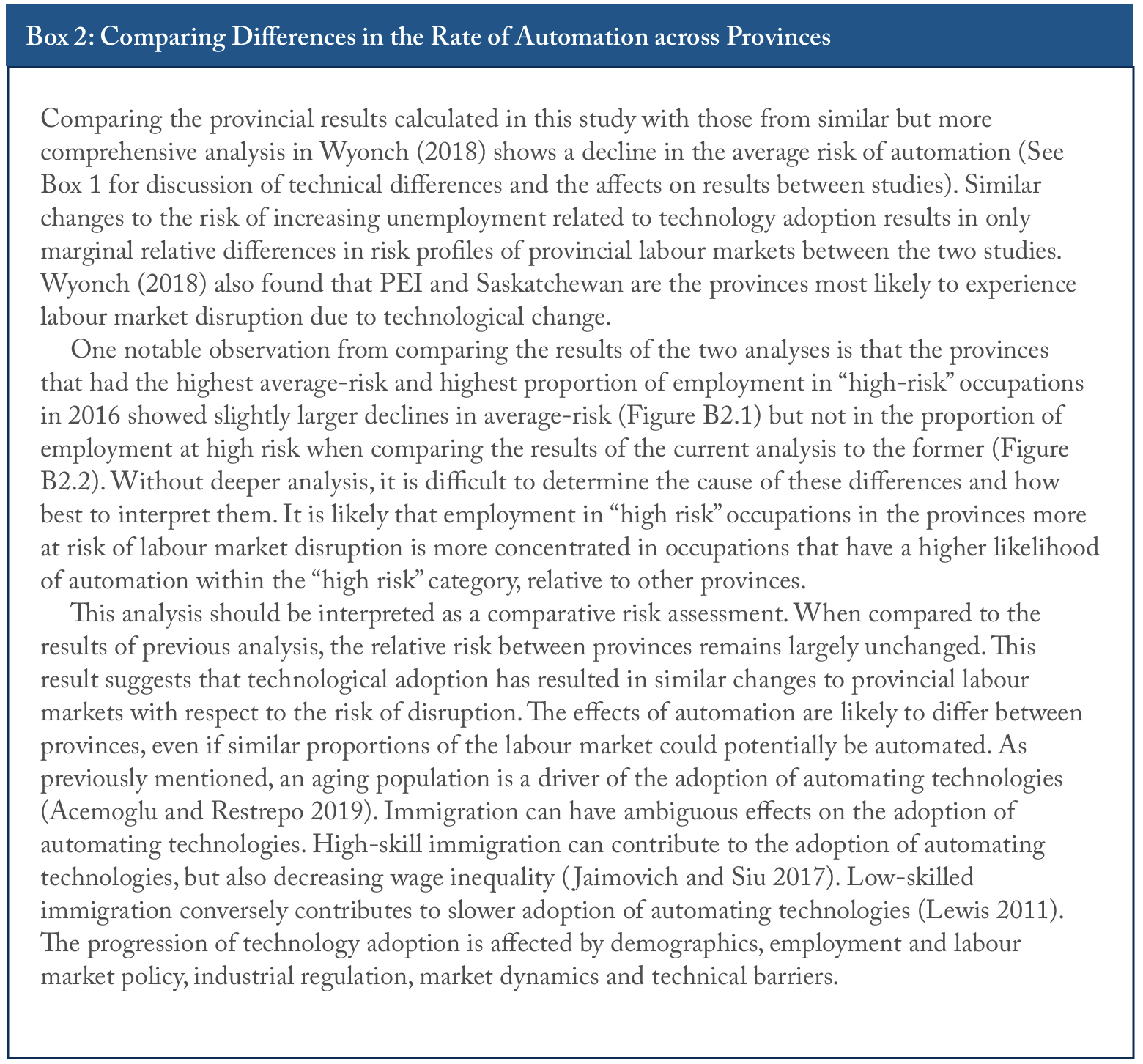
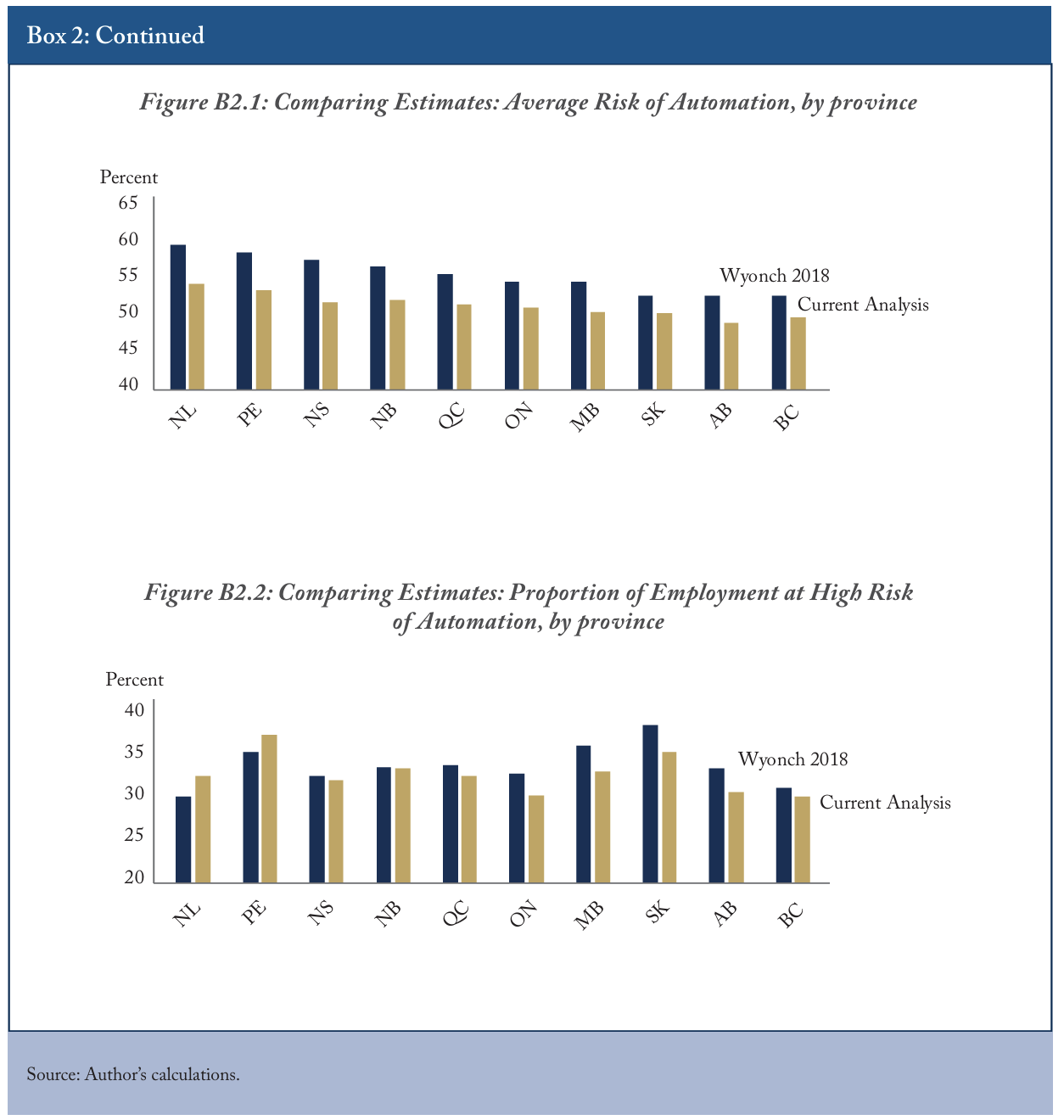
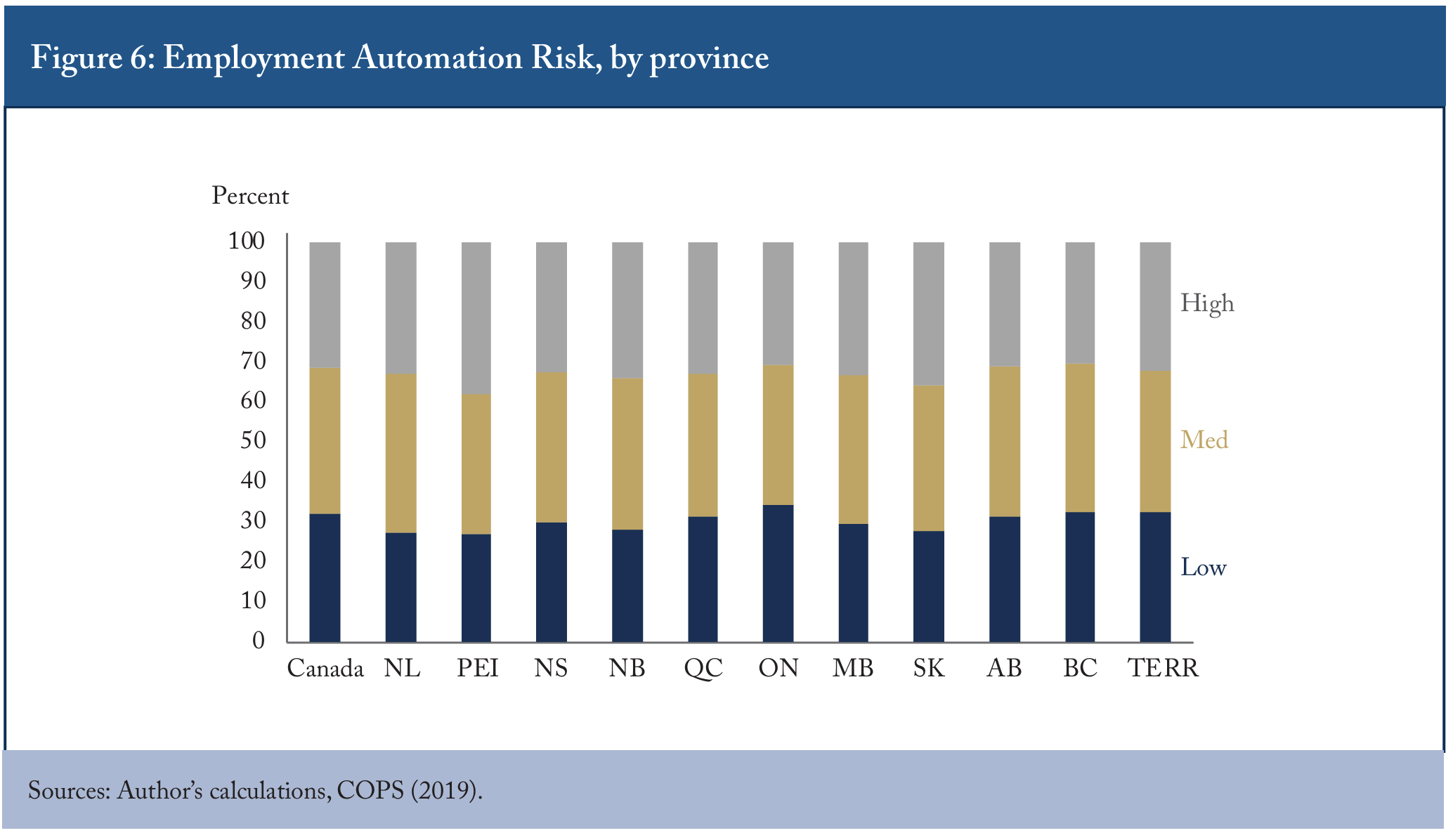
Overall, there is a relatively low risk of unmanageable disruption in the labour market due to automation in the near future. However, since the provinces have different economic and labour market compositions, some may be more susceptible to automation than others. In 2019, employment data by province showed a similar risk profile across the country (Figure 6). A slightly larger proportion of employment is in occupations at a high risk of being automated in PEI and Saskatchewan, while Ontario had the highest proportion of employment at low risk2121 These differences are not statistically significant. (see Box 2 for further discussion of provincial results).
Automation and Equality: Income, Age and Individual Characteristics
Aside from concerns of future mass technological unemployment, it is possible that automation could have different effects for different population groups. The occupations that are more likely to be automated generally contain more well-defined tasks and repetition, such as those in manufacturing. Historically, employees in those occupations account for a significant portion of middle-income jobs for those without advanced degrees and a university education. South of the border, middleincome jobs declined relative to both low- and high-wage jobs since the 1990s2222 In particular, following economic downturns in 1990-1991, 2001, 2008-2009 middle-income jobs did not recover during the expansions that followed, unlike earlier downturns (Cheremukhin 2014). (Cheremukhin 2014), and technology change has been identified as one of the factors driving the hollowing out of middle-income employment (Autor, Levy and Murnane 2003, Autor and Dorn 2013). In Canada, however, growth of low-income jobs has been outpaced by growth in both middle- and highincome jobs (Green and Sand 2015). That means Canada has not experienced wage polarization similar to the US, at least until recently.
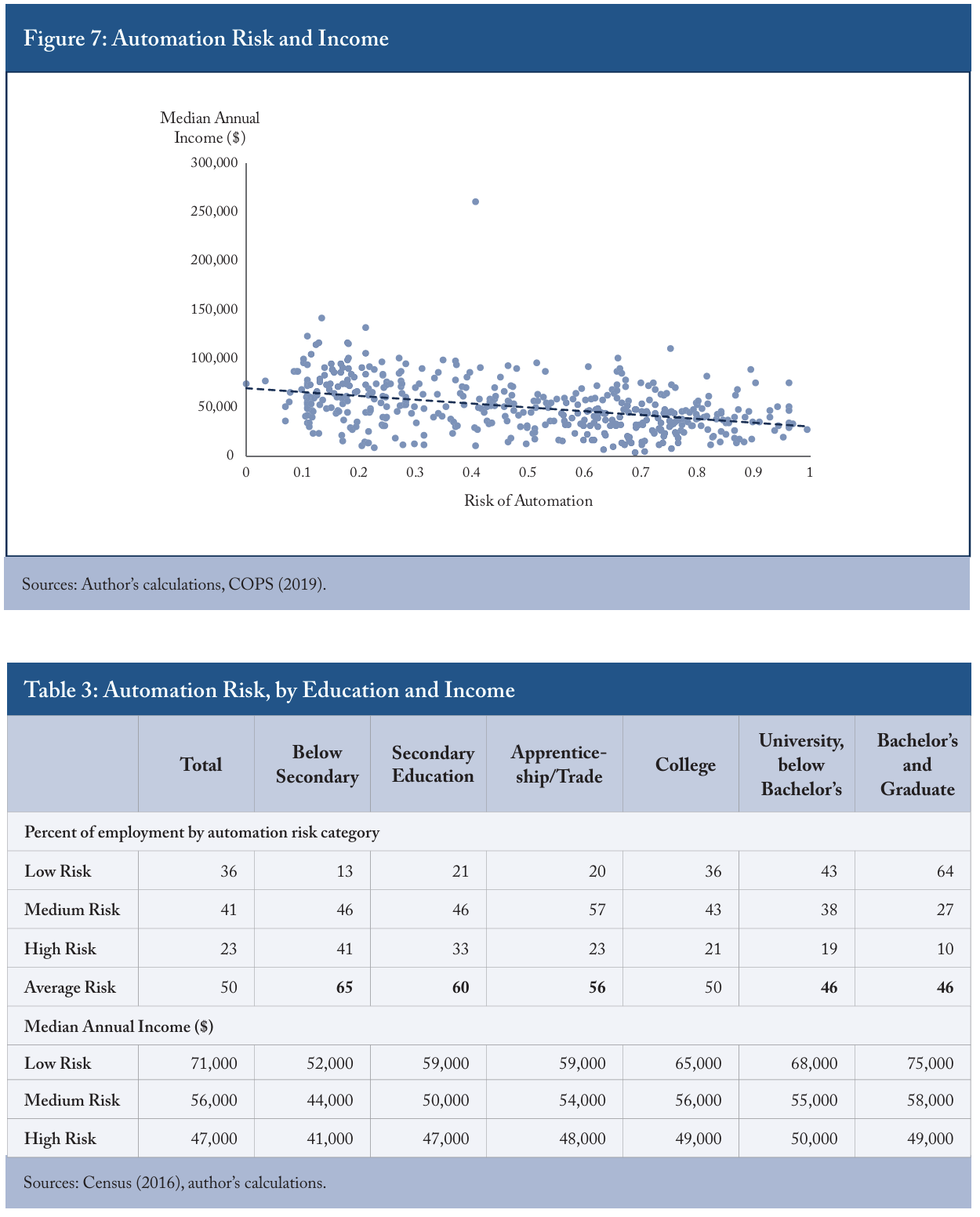
To determine if automation and technological change is likely to increase wage polarization in Canada, I use employment income data from the 2016 Census and match median income levels for each occupation to their estimated likelihood of automation (Figure 7). There is little relationship between income and susceptibility to automation in Canada, which suggests that wage differences are not the mechanism by which technology affects inequality.
However, technological change could affect inequality via compositional changes to the labour market over time. Research indicates that compositional changes to the labour market explain a larger portion of the changes in inequality related to technological advancements than changes to wages. As Kaltenberg and Foster-McGregor (2020) explain:
Workers are moving away from low-paying, high- and medium-automation risk jobs towards higherpaying low-automation risk jobs, but this shift is increasing inequality. Jobs that are at high risk of being automated tend to have relatively similar wage levels, while jobs that are less likely to be automated have a much higher dispersion of wages. Thus, as workers move into jobs that are less likely to be automated, inequality rises.
It is likely that compositional changes in employment due to technological change could have income-equality effects in Canada. Across education levels, a lower level is related to higher risk of automation and lower wages. The dispersion of wages is higher in jobs at low risk of automation than for jobs at high risk (Table 3). Furthermore, the dispersion of wages across risk categories increases with level of education. Together, these results suggest that technological change contributes to income inequality predominantly through compositional changes to the labour market, as opposed to changes in wages.
Technological change can have inequality implications aside from wages (Kaltenberg and Foster-McGregor 2020). While technology itself doesn’t discriminate based on age, younger workers have more of an incentive to adapt than older workers, who may choose to retire instead of investing in new skills and training. Older and younger workers are also employed in different jobs, meaning the risk profile of automation differs across age groups (Figure 8). Only about 14 percent of workers aged 15-24 years are employed in occupations with a low risk of automation, compared to about 43 percent of workers aged 5564. Conversely, only about 16 percent of workers aged 55-64 are employed in occupations are high risk of automation, while nearly half (46 percent) of young workers are highly susceptible to automation.
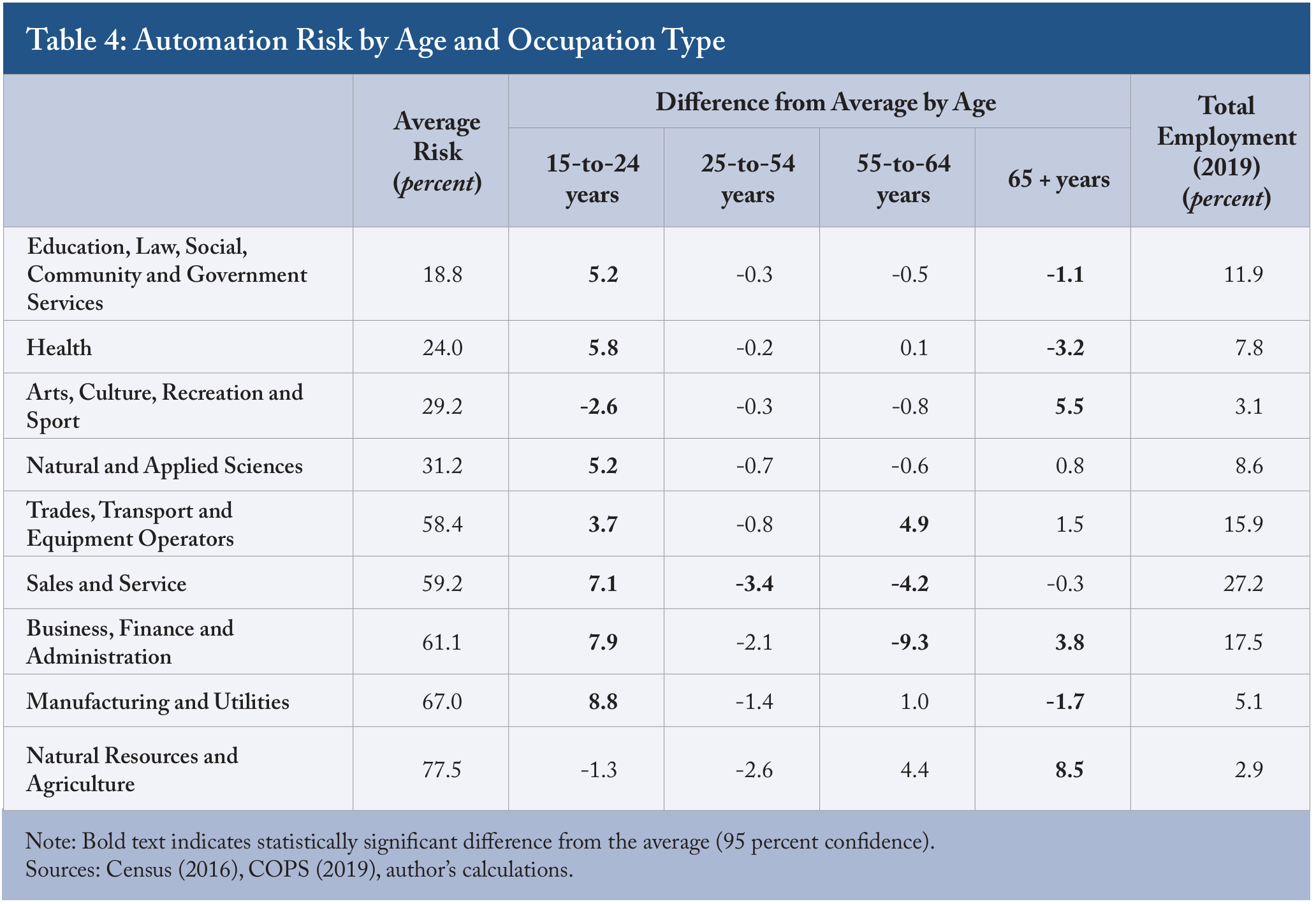
This result makes intuitive sense: since older workers have significantly more experience than those who have recently entered the labour market, they are more likely to have progressed to positions requiring higher skill levels and more likely to manage nuanced decisions related to resource and people management. They are, therefore, less likely to be in occupations subject to automation. Workers aged 15 to 24 are more likely to be employed part-time and are likely actively acquiring new knowledge and skills through education. With the exception of arts, culture, recreation and sportsrelated occupations, younger workers are employed in occupations more likely to be automated (Table 4). Older workers, those 55-to-64 years of age, are less likely to be automated if they are employed in business, finance, administration, sales and customer service occupations.
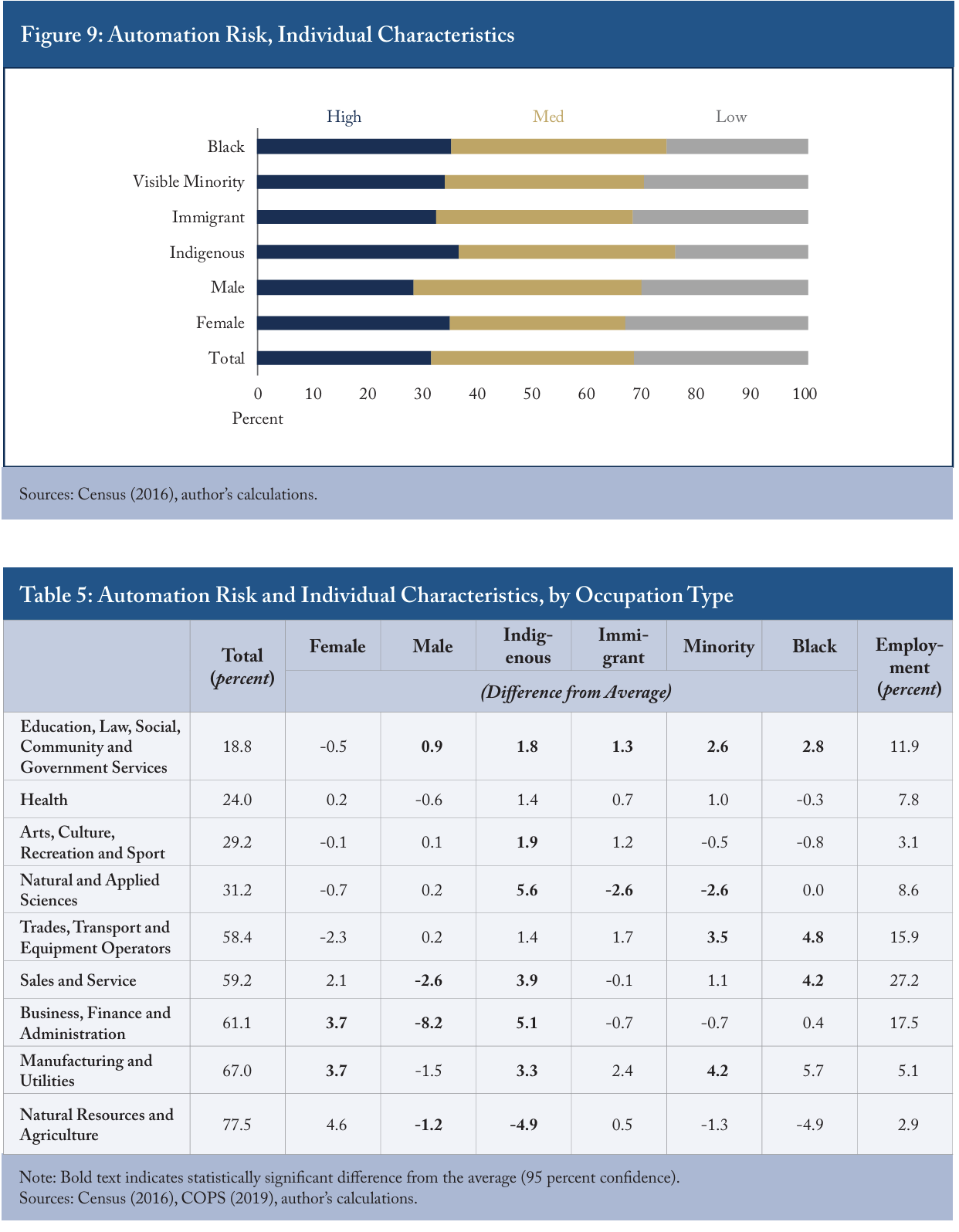
To further investigate the relationship between automation and equity in the labour market, I calculate the proportion of employment in each risk category for different individual characteristics: gender, race and immigration status (Figure 9).2323 The data sources and language used throughout this discussion reflect categorizations that do not reflect distinctions between biological sex and gender identity, visible minorities and racialized persons, and utilizes a single category for Indigenous peoples and does not reflect heterogeneity within different groups. The author would like to acknowledge these distinctions and that the language used in this analysis reflects data definitions of Statistics Canada. Results show some variation in the proportions of employment at high, medium and low risk of being automated, but generally provide a similar picture across groups. The proportion of employment at low risk of automation is lower than the Canadian average for both Black and Indigenous2424 Indigenous refers to the statistical definition of “Aboriginal” and includes First Nations, Metis and Inuk peoples. These are the three groups defined as the Aboriginal peoples of Canada in the Constitution Act, 1982, Section 35 (2). individuals.
Indigenous workers in particular have higher average likelihood of being automatable with the exception of those in natural-resource extraction, agriculture, trades or transport occupations (Table 5). Workers who identify as visible minorities employed in education, community, government and legal services, and trades and transport occupations are more likely to be automated than average for those occupations.
Results from occupation-level analysis, using a different underlying method for calculating the likelihood of automation, show that visible minority, Indigenous, female and youth workers are over-represented in occupations that are at a high risk of being automated (Gresch 2020). Overrepresentation of these groups in such occupations is likely one of the main drivers of the different risk profiles between groups at the aggregate level shown here.
The risk profile for immigrant employment is very similar to the Canadian average, though their employment profile gives a slight advantage in natural and applied science occupations and a slight disadvantage in education, law, community and government service occupations.
Men and women2525 Gender-specific language is used interchangeably with biological sex. While this use of language could be considered exclusionary of transsexual and non-binary individuals, the author is uncertain about proportion of survey respondents’ who chose to identify their biological sex or their gender identity. Throughout this discussion, “men” refers to respondents reporting “male” as their sex. face a similar average risk of automation, but female employment is more polarized – women are employed in both high- and low-risk occupations in larger proportions than men. Female workers in business, finance, administration, manufacturing and utilities occupations are, on average, more susceptible to automation. Meanwhile, male workers employed in business, finance and administration occupations are eight percent less likely to be automated than the average for those occupations.
Discussion and Policy Implications
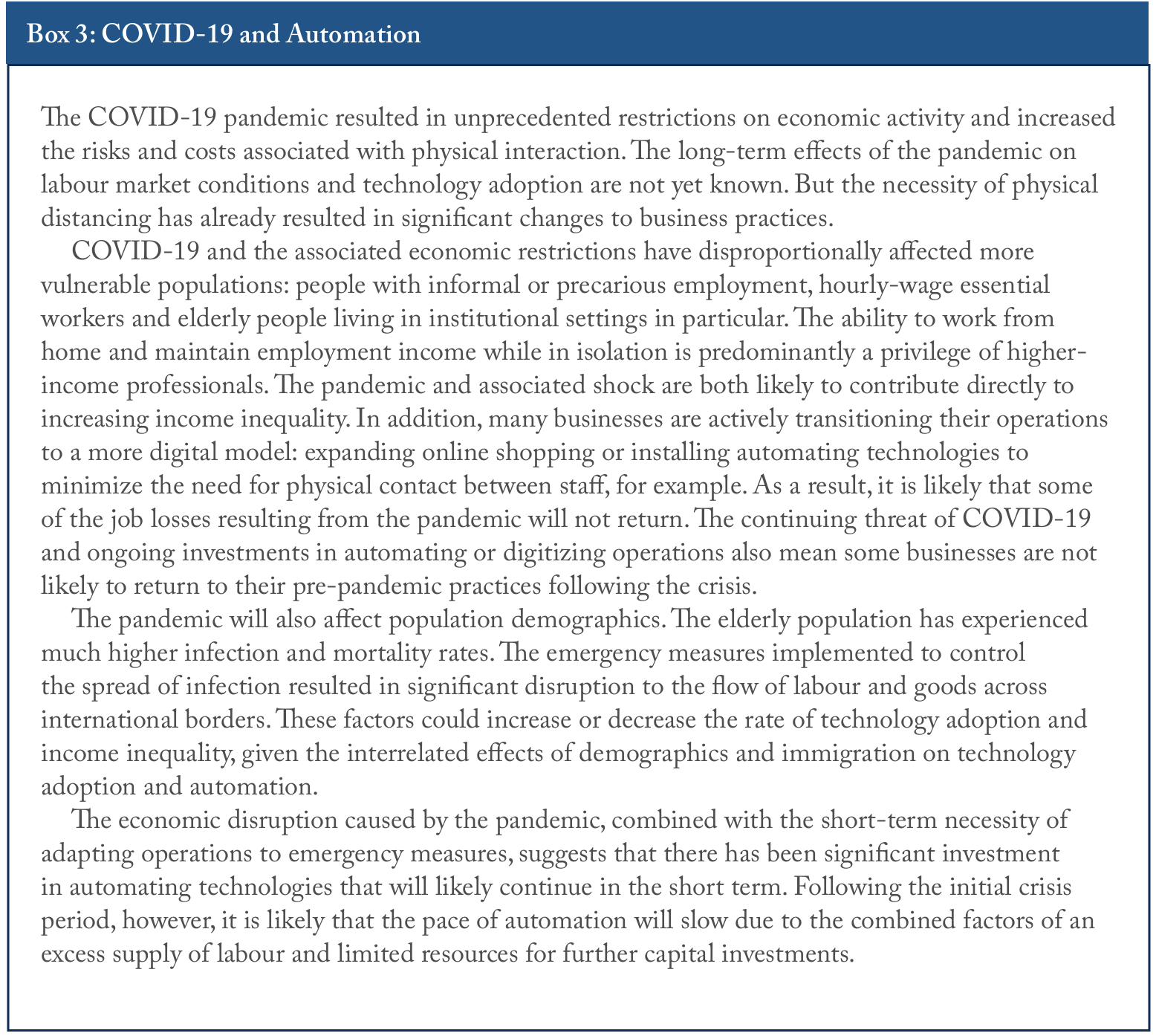
About one in five Canadian workers (22 percent) are employed in a job that could theoretically be automated. By 2028, projections indicate that employment in these occupations will decline by only about 90,000 jobs. Meanwhile, jobs that are only somewhat susceptible to automation (medium risk) make up about 40 percent of current employment. This proportion is projected to decline slightly to about 37 percent by 2028. These projections are within the range of estimates calculated in past research and indicate that the pace of technological change is unlikely to create significant technology-induced unemployment in the near future. Furthermore, they indicate that the labour market has been adapting to technological change over time and is likely to continue along a similar trajectory. The COVID-19 health crisis, however, has recently caused significant economic and labour market disruption due to the restrictions necessitated to combat the pandemic. This shock will also likely affect the dynamics of technology adoption and its associated labour market effects, at least in the short term (See Box 3).
The analysis of automation susceptibility by individual characteristics indicates that Black and Indigenous Canadians are employed in occupations that are highly susceptible to automation in higher proportions than the population average. Other research has found that Indigenous and visible minority individuals2626 Visible minority classification does not include Indigenous persons nor those who are not members of a visible minority group. Visible minority groups are: South Asian, Chinese, Black, Filipino, Latin American, Arab, Southeast Asian, West Asian, Korean, Japanese, multiple visible minorities and visible minorities not included elsewhere – for example “Tibetan”, “Guyanese”, “Polynesian”, etc. make lower wages than white male Canadians (Schirle and Sogaolu 2020). Indigenous individuals are already at a disadvantage as measured by skills and educational attainment, compared to non-Indigenous Canadians (Mahboubi 2019). It is likely that the relatively higher susceptibility to automation is related to the worse average employment outcomes of Black and Indigenous people relative to the Canadian average.
Men, women and immigrants, however, face a similar average risk from automation. Overall, the differences are not large enough to warrant targeted pre-emptive policies specifically to prevent technological unemployment for particular groups. Instead, the inequality effects of automation could be indirectly addressed through education and labour-market policies that target inequality more broadly. The higher risk of automation for Black and Indigenous Canadians is more likely related to prevailing labour market gaps than to automating technologies specifically. The results do, however, suggest that technological change is likely to affect Indigenous and Black employment, particularly those in sales, customer service, law, education, social, community and government service occupations.
Previous research has indicated that technology may be a driving factor in growing wage inequality. However, the risk of automation is not related to median wages in Canada. Still, there is some evidence that technological change could increase inequality through compositional changes to the labour market. These results suggest that education is a critical factor in addressing relative risk of being automated out of a job for more vulnerable population groups.
Overall, these findings indicate that Canada’s labour market is adapting to technological change over time and is likely to continue to do so in the future. It has been a few years since we heard predictions of mass technological unemployment within a decade. This analysis yields no evidence of accelerating technological change negatively affecting the labour market. Furthermore, the likelihood of mass technological unemployment in the near future remains low.
As a result, this analysis suggests that the appropriate role for government is moderating the negative effects of technological change for those that are affected in the short term. Existing policies that provide job training and income support for unemployed and low-income people provide a buffer against economic hardship (technology-induced or otherwise). However, with growth in non-standard employment, traditional job-support policies may not be available to all workers impacted by automation. The Canadian Emergency Support Benefit (CERB), an emergency income-support program for individuals affected by the COVID-19 pandemic was in part created to address coverage gaps in Employment Insurance. Following the current crisis, the government should analyze the effects of CERB and use insights from the unfortunately necessary natural experiment to modernize employment insurance and address income and employment-support gaps.
References
Acemoglu, Daron, and Pascual Restrepo. 2016. “The Race Between Machine and Man: Implications of Technology for Growth, Factor Shares, and Employment.” NBER Working Paper 22252. Cambridge, MA: National Bureau of Economic Research. May.
________. 2018. “Artificial Intelligence, Automation and Work.” NBER Working Paper 24196. Cambridge, MA: National Bureau of Economic Research. January.
________. 2019. “Demographics and Automation.” NBER Working Paper 24421. Cambridge, MA: National Bureau of Economic Research. March.
Andrews, Dan, Chiara Criscuolo, and Peter N. Gal. 2015. “Frontier firms, technology diffusion and public policy: micro evidence from OECD countries.” The Future of Productivity: Main Background Papers. OECD.
Arntz, Melanie, Terry Gregory, and Ulrich Zierahn. 2016. “The Risk of Automation for Jobs in OECD Countries: A Comparative Analysis.” OECD Social, Employment and Migration Working Papers No. 189. OECD: June.
Autor, David H., and David Dorn. 2013. “The Growth of Low-Skill Service Jobs and the Polarization of the US Labour Market.” American Economic Review. Vol. 103, No. 5, August, pp. 1553-97.
Autor, David, Frank Levy, and Richard Murnane. 2003. “The Skill-Content of Recent Technological Change: An Empirical Investigation.” Quarterly Journal of Economics. 118:1279-1333.
Autor, David, and Anna Salomons. 2018. “Is Automation Labor-Share Displacing: Productivity Growth, Employment, and the Labor Share.” Brookings Papers on Economic Activity. Spring: 1-63.
Bessen, James. 2018. “Automation and Jobs: When Technology Boosts Employment.” Law and Economics Paper No. 17-09. Boston University School of Law: March.
Brynjolfsson, Erik, and Andrew McAfee. 2014. The Second Machine Age: Work Progress and Prosperity in a Time of Brilliant Technologies. New York: W.W. Norton.
Bughin, Jacques, James Manyika, and Jonathan Woetzel. 2017. “Jobs lost, jobs gained: Workforce transitions in a time of automation.” McKinsey & Co. December. Available at: https://www.mckinsey.com/~/media/mckinsey/featured%20insights/Future%20of%20Organizations/What%20the%20future%20of%20work%20will%20mean%20for%20jobs%20skills%20and%20wages/MGI-Jobs-LostJobs-Gained-Report-December-6-2017.ashx.
Campa, Riccardo. 2014. “Technological Growth and Unemployment: A Global Scenario Analysis.” Journal of Evolution and Technology 24 (1): 86–103
Cheremukhin, Anton. 2014. “Middle-Skill Jobs Lost in U.S. Labor Market Polarization.” Dallas Fed Economic Letter 9 (5): 1–4.
Cowen, Tyler. 2013. “Who will prosper in the new world?” New York Times. August 31.
Frenette, Marc, and Kristyn Frank. 2017. “Do Postsecondary Graduates Land High-skilled Jobs?” Analytical Studies Branch Research Paper Series, no. 388. Ottawa: Statistics Canada.
________. 2018. “Are Canadian Jobs More or Less Skilled than American Jobs?” Analytical Studies Branch Research Paper Series, No. 406. Ottawa: Statistics Canada.
________. 2020. “The Demographics of Automation in Canada: Who’s at Risk?”. No. 77. IRPP: June.
Frey, Carl Benedikt, and Michael A. Osborne. 2013. “The Future of Employment: How Susceptible Are Jobs to Computerisation?” Oxford: Oxford University, Oxford Martin School. Programme on the Impacts of Future Technology. September.
Graetz, George, and Guy Michaels. 2015. “Robots at Work.” CEP Discussion Paper 1335 London: Centre for Economic Performance.
Green, David, and Benjamin Sand. 2015. “Has the Canadian Labour Market Polarized?” Canadian Journal of Economics. 48 (2): 612–46
Gresch, Darren (2020). Responding to Automation: How adaptable is Canada’s labour market? Issue Briefings, May 2020. The Conference Board of Canada.
Howitt, Peter. 2015. Mushrooms and Yeast: The Implications of Technological Progress for Canada’s Economic Growth. Commentary 433. Toronto: C.D. Howe Institute. September.
International Federation of Robotics. 2019. IFR Press Conference. Shanghai. September.
Jaimovich, Nir, and Henry Siu. 2017. “High-Skilled Immigration, STEM Employment, and NonRoutine-Biased Technical Change.” https://faculty.arts.ubc.ca/hsiu/pubs/immigration20170427.pdf.
Josten, Cecily, and Grace Lorden. 2019. “Robots at Work: Automatable and Non Automatable Jobs.” IZQ DP 12520. Bonn: IZA – Institute of Labor Economics. July.
Kaltenberg, Mary, and Neil Foster-McGregor. 2020. “The impact of automation on inequality across Europe.” (No. 009). UN University. Maastricht Economic and Social Research Institute on Innovation and Technology (MERIT).
Karatzoglou, Alexandros, Alex Smola, and Kurt Hornik. 2019. “Kernel-Based Machine Learning Lab. Version 0.9-29.” Comprehensive R Archive Network. Available at https://cran.r-project.org/package=kernlab.
Krugman, Paul. 2013. “Sympathy for the Luddites.” New York Times. June 14
Lamb, Creig. 2016. The Talented Mr. Robot: The Impact of Automation on Canada’s Workforce. Toronto: Brookfield Institute for Innovation + Entrepreneurship. June.
Levy, Frank, and Richard Murnane. 2004. The New Division of Labor: How Computers are Creating the Next Job Market. Princeton, NJ: Princeton University Press.
Lewis, Ethan. 2011. “Immigration, Skill Mix, and Capital Skill Complementarity.” The Quarterly Journal of Economics 126(2): 1029–1069.
Lindert, Peter, and Jeffrey Williamson. The Economic History Review New Series. Vol. 36, No. 1. February 1983. pp. 1-25. Available at: https://www.jstor.org/stable/2598895?seq=1.
Mahboubi, Parisa. 2019. Bad Fits: The Causes, Extent and Costs of Job Skills Mismatch in Canada. Commentary 552. Toronto: C.D. Howe Institute. September.
Mahboubi, Parisa, and Colin Busby. 2017. “Closing the Divide: Progress and Challenges in Adult Skills Development among Indigenous Peoples.” E-Brief. Toronto: C.D. Howe Institute. September.
OECD. 2019. “Productive Capital Stock, volume, annual, average growth.” Economic Outlook Number 106. Edition 2019(2). Available at: https://www.oecd-ilibrary.org/economics/data/oecd-economicoutlook-statistics-and-projections/oecd-economicoutlook-no-106-edition-2019-2_8aa5bebb-en?parentId=http%3A%2F%2Finstance.metastore.ingenta.com%2Fcontent%2Fcollection%2Feo-data-en.
OECD. 2020. Employment by activity (indicator). doi: 10.1787/a258bb52-en
Oschinski, Matthias, and Rosalie Wyonch. 2017. Future Shock? The Impact of Automation on Canada’s Labour Market. Commentary 472. Toronto: C.D. Howe Institute. March.
Rasmussen, Carl, and Christopher Williams. 2006. Gaussian Processes for Machine Learning. Cambridge, MA: MIT Press.
Schirle, Tammy, and Sogaolu Moyosoreoluwa. 2020. A Work in Progress: Measuring Wage Gaps for Women and Minorities in the Canadian Labour Market. Commentary 561. Toronto: C.D. Howe Institute. January.
Seeger, Matthias. 2004. “Gaussian Processes for Machine Learning.” International Journal of Neural Systems. 14 (2): 69-106.
Sirkin, Harold, Michael Zinser, and Douglas Hohner. 2011. “Made in America, Again: Why Manufacturing Will Return to the U.S.” Boston Consulting Group. August.
United Nations Industrial Development Organization. 2019. Industrial Development Report 2020: Industrializing in the digital age. UNIDO: Vienna.
Woirol, Gregory R. 1996. The Technological Unemployment and Structural Unemployment Debates. Westport, CT: Greenwood Press.