





by Joseph Nunes
- Workers participating in a defined-contribution pension plan have a few levers to provide for adequate income in retirement, including saving at a greater rate during their working years and/or postponing retirement until their savings (including government benefits) reach the necessary level. The purpose of this E-Brief is to quantify the relationship between saving more during a shorter work career versus saving less and working longer. It is not intended to instruct workers when they should retire.
- Given a 2019 salary of $50,000 at age 59 and assuming a baseline savings rate of 10 percent of salary retroactive to age 30, this E-Brief shows how saving an additional 1.5 percent of salary starting at age 30 is equivalent to postponing retirement by one year. Comparatively, at a 2019 salary of $100,000, a one-year postponement of retirement equates to a 1.0 percent increase in the career-long savings rate. These findings confirm the general intuition that working longer is an effective tool to make retirement affordable for those who cannot yet afford to retire.
- For their part, employers need to consider the total savings rate in their retirement savings programs and how that rate aligns with their expectations about the age at which employees will choose to retire.
- The federal government, in tandem with the provinces and territories, should modify the retirement savings system to allow private-sector workers to save in tax-deferred programs at a rate greater than the current Income Tax Act limit of 18 percent of salary.
- Canada’s governments should also modify the retirement system to allow for the deferral to age 75 of retirement income from tax-deferred vehicles, as well as from Old Age Security and the Canada Pension Plan.
The cost of saving for retirement has increased substantially over the past 30 years. While increases in longevity are a factor, the main cause of the increased cost of providing adequate retirement income is a persistent decline in yields on long-term bonds which has resulted in higher costs for life annuities, or a lower guaranteed income from invested assets for those choosing to self-manage their investments in lieu of a life annuity.
Saving for retirement is filled with great uncertainty due to unpredictable and volatile factors such as career wage changes, accumulated investment returns, retirement lifestyle desires, health conditions and longevity.
Workers whose pensions are provided through the traditional defined-benefit retirement system are fully, or at least partially, protected from the unpredictable costs of pensions since those costs are borne largely by the employers that fund their pension promises. In contrast, workers who rely on the defined-contribution pension system must, for the most part, bear responsibility for these unpredictable pension costs. Workers saving through Registered Retirement Savings Plans have the opportunity to have outcomes similar to workers in definedcontribution pension plans and it is assumed that the results presented in this paper apply to those workers as well.
A savings rate of 10 percent of salary is a common rule of thumb to generate an adequate retirement income. Individual circumstances vary widely and there cannot be a one-size-fits-all rate that suits all workers. However, a savings rate of 10 percent of salary has been adopted in this paper as a starting point for considering the interaction between savings rates and retirement ages.
The purpose of this E-Brief is not to precisely present a needed savings rate to create an adequate retirement income. Rather, the goal is to show that the impact of deferred retirement can be quantified as an equivalent increase in the career savings rate.
The primary metric used here is the replacement ratio. This is the ratio of retirement income to earnings immediately prior to retirement and is expressed as a percentage. While some readers might prefer to see the results presented in dollars, doing so can be distracting for others. The focus on replacement ratios is intended to highlight to readers the relationship between earnings and retirement income over a range of salaries.
Background
In Canada today, most individuals go through three phases of life. These are formation (education), work and retirement. While there is certainly overlap in these phases for many individuals, this E-Brief looks at a discrete model where the transition between phases is immediate.
In their working years, individuals need to provide for their daily needs, which at a minimum include food, shelter, and clothing and most often extend to discretionary expenditures such as travel and entertainment. In addition to funding current consumption, individuals in their working years often must pay off any debt accrued during their formative years, usually derived from education, and they must also save funds for retirement, which traditionally is expected to be a time in life where employment income ceases.
The Office of the Chief Actuary estimates that the life expectancy for men and women in Canada aged 65 increased by about seven years in the 50 years following the 1966 introduction of the Canada Pension Plan (OCA 2016). Over the same period, more Canadians pursued greater (and more costly) educations and, as a result, careers started later.
Later career starts, lower expected investment returns during working years and retirement, and longer life expectancies mean that retirement has become more costly to fund in terms of total dollars. Spreading these higher costs over a shorter work life compounds the savings challenge and, not surprisingly, people are working longer.
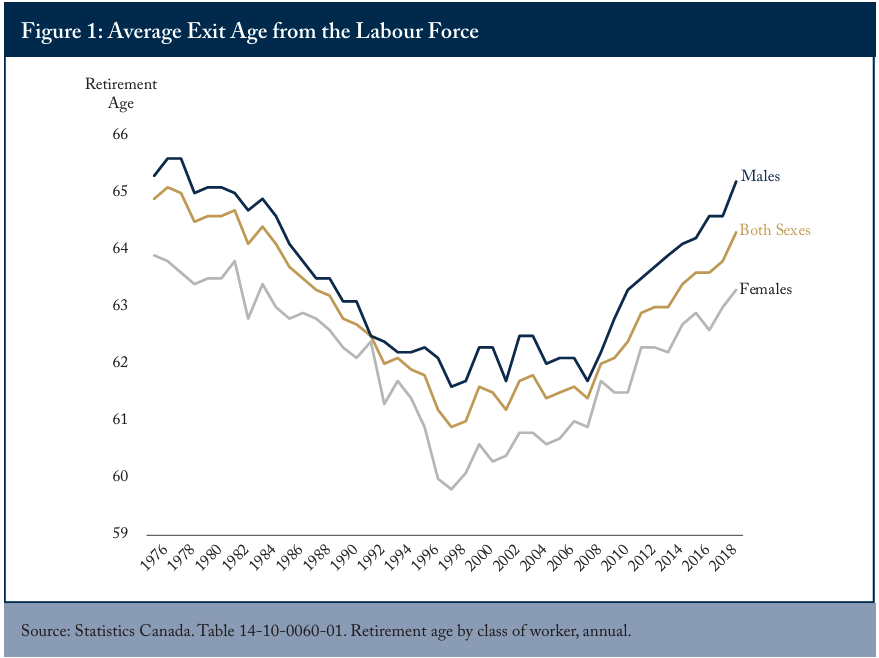
Figure 1 shows a persistent trend toward earlier retirement ages through the 1980s and 1990s, with the trend reversing around 2000.
Average retirement ages are an amalgamation of thousands of personal decisions. However, it is likely that the rising average retirement age over the two decades ending in 2018 is, at least in some part, a natural response to the increasing burden of saving for an adequate retirement income.
Savings Model
Financial planners have access to sophisticated software available to capture unique work, savings and spending patterns. The goal here is not to capture the unique circumstances of one individual but rather to show how deciding to increase or decrease the target retirement age by one or more years, as compared to increasing savings rates while working, impacts the retirement replacement ratio. To do so, several simplifying characteristics have been used, including:
- assuming workers save at a constant rate through to retirement;
- focusing on gross income before taxes;
- assuming Old Age Security (OAS) benefits can be accessed before age 65 – not possible currently – on a reduced basis; and
- assuming mortality is a blend of male and female mortality rates.
The model assumes a hypothetical worker is age 59 in 2019 and looks backward to a starting age of 30 with an annual savings rate of 10 percent of salary contributed to a defined-contribution account ending at retirement. The model also projects the benefits payable under OAS and the CPP but ignores the benefits that will be paid under the CPP’s Tier 2 that came into effect on Jan. 1, 2019, since the model focuses on retirements from 2020 to 2030 when the Tier 2 benefits will be quite modest.
To convert lump-sum savings at retirement into income, the income generated from the accumulated balance is calculated using an annuity factor. Although most defined-contribution plan participants do not purchase an annuity, using an annuity factor is the best proxy for identifying replacement ratios, which show the ratio of retirement income to pre-retirement income just prior to retirement.
Other Assumptions
Age 30 has been chosen as the starting point of a worker’s career. While many workers will start work before 30, deferring the start of saving for retirement to that age assumes that many younger workers will be repaying debt and saving for a first home. In addition, earnings before age 30 may be unstable for many workers, while a more predictable rate of wage increases would be expected after age 30. The assumed inflation rate is 2 percent per year and the assumed rate of annual wage increases is 3 percent per year – the Consumer Price Index (CPI) plus 1 percent. The model projects earnings back to age 30 in order to accumulate hypothetical savings to ultimate retirement.
The model also assumes that our hypothetical worker is now age 59 and retires at each integer age from 60 to 70. While age 65 is generally seen as the target retirement age, retiring as early as 60 when the CPP is first available is not uncommon, and postponing retirement to 70 is supported effectively by the CPP and OAS systems. Retirement before and after this range has not been considered, since looking at earlier and later retirement ages adds additional layers of complexity to the model and would be relevant only to a small minority of workers.
The annuity factor at retirement is based upon the 2014 Canadian Pensioners’ Mortality table with mortality improvement scale CPM-B, all blended 50/50 male/female This assumes that a 65-year-old is expected to live until 88.5 years of age. In real life, the average female will have a lower replacement ratio than the average male that accumulates the same nest egg, given women’s longer life expectancies.
Investments during the accumulation phase are assumed to earn an annual rate of 5 percent (CPI plus 3 percent). This assumption is intended to represent a reasonable long-term rate of return on investments while acknowledging that most retirement savings portfolios have a much greater volatility in year-to-year results. The price of a fixed annuity also assumes a 4 percent annual rate (CPI plus 2 percent). This rate of return assumes that, even in retirement, a modest level of investment risk will be taken and that greater risk taking might create a partially indexed income from private savings. It should be noted that these returns are lower than long-term historical averages and higher than current rates in the marketplace. The author considers them a reasonable starting point.
It is assumed CPP and OAS payments start on a reduced/increased basis at retirement. Although OAS is not available before age 65, for modelling purposes, estimated reductions are assumed to allow for its early start before that age. In practice, in order to create a level replacement ratio in retirement, workers retiring before age 65 need to draw down private savings faster before OAS commences in order to create a level replacement ratio.
Results – Replacement Ratios
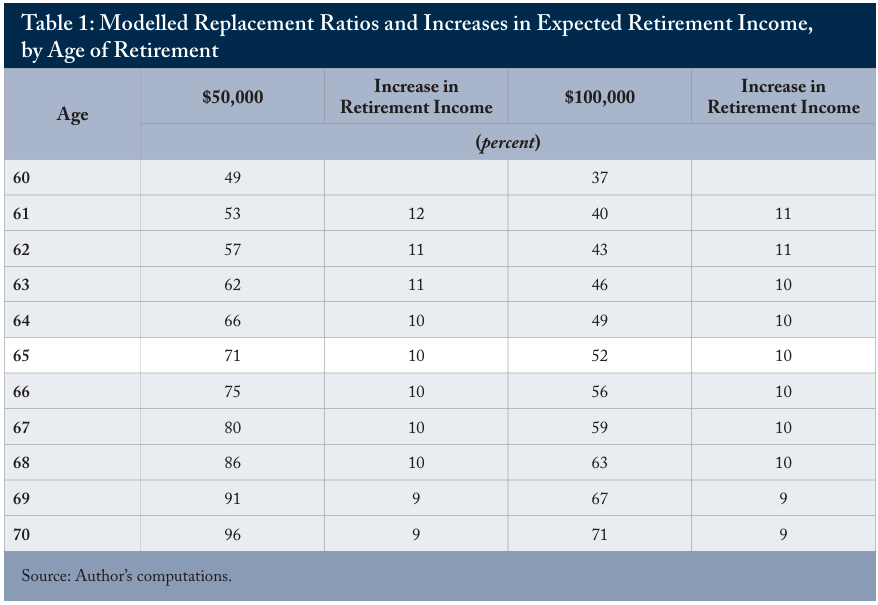
Assuming retirement at age 65, the model shows that workers earning $50,000 in 2019 would replace 71 percent of their final earnings from their savings combined with CPP and OAS (Table 1). The model further shows the significant reduction in the replacement ratio for each year of early retirement, as well as the significant benefit for each year of postponed retirement.
For a worker earning $100,000 in 2019, the power of postponed retirement is similar. However, the replacement ratio at age 65 at 52 percent is considerably lower than for the $50,000 worker.
The necessary replacement ratio to provide for a comfortable retirement will vary greatly by individual circumstances. Historically, defined-benefit pension plans were often designed around the goal of providing a replacement ratio for a career employee equal to 70 percent of earnings near retirement. While this replacement ratio is an interesting reference point, this E-Brief does not endorse a specific replacement-ratio target. Instead, it simply models the impact that working longer has on the replacement ratio.
What is important is the finding that each year of postponed retirement improves a worker’s replacement ratio by 3 percent to 5 percent of final salary, which corresponds to an annual increase in the total retirement income of approximately 10 percent.
For actuaries, these results are not surprising since each year of postponed retirement comes with an additional year of savings, an additional year of investment return on accumulated assets and a lower cost annuity for each year’s increase in age. In addition, the adjustment factors applied to CPP and OAS benefits exceed 7 percent per annum, which results in government benefits becoming a larger share of total retirement income for each year that retirement is postponed.
Results – Savings Rates
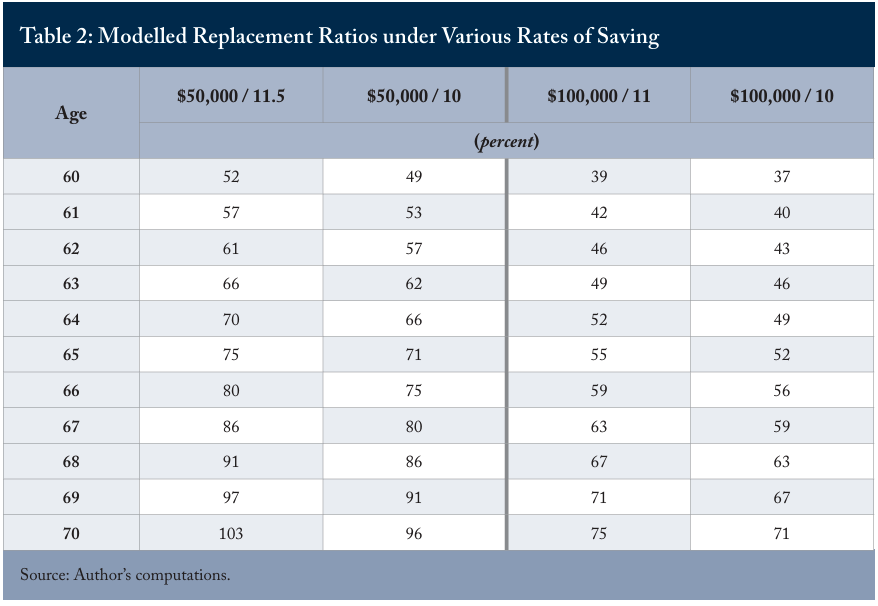
The key question is how much additional savings are required over a career to equal the impact that postponing retirement has on a worker’s replacement ratio. To examine this question, a revised model assumes total contribution rates of 11.5 percent for a worker earning $50,000 in 2019 and 11 percent for a worker earning $100,000 in 2019.
Table 2 shows that a 1.5 percent increase in the career-long savings rate for a worker earning $50,000 in 2019 has nearly the same impact on the replacement ratio as postponing retirement by one year. Meanwhile, for a worker earning $100,000 in 2019, a smaller increase of 1.0 percent in career-long savings would approximate the impact of deferring retirement by one year.
These results make sense since a higher wage earner will rely on private savings to a greater degree, thus mitigating the impact of the generous increases received from postponing CPP and OAS. In other words, postponing retirement by one year has a more powerful effect for lower than for higher wage earners, since the former rely more heavily on government programs.
While the combined effect of compound interest on private savings and the generous benefit increase rates for postponing CPP and OAS are not linear, the general conclusion of 1 percent-to-1.5 percent of additional savings to offset each year of early retirement is a good rule of thumb. That is, if a worker desires early retirement at age 60 then increasing the savings rate from 10 percent to between 15 percent and 17.5 percent of salary is a reasonable target.
Retirement before 60 is even more costly since there are no government benefits before that age – all retirement income must come from savings. While the model is not designed to consider retirement before age 60, general testing confirms that to match the age-65 replacement ratios at 55 that result from a career-long savings rate of 10 percent, the required savings rate would exceed the Income Tax Act’s 18 percent tax-deferred savings-rate limit. These results confirm earlier research (Pierlot 2008, Pierlot and Siddiqi 2011, Robson 2017) that finds that government employee pensions under current economic conditions cannot be practically replicated by private sector workers in defined-contribution plans.
Although this E-Brief has ignored the CPP’s second tier, introduced on Jan. 1, 2019, two general comments are offered. First, if increased CPP contributions are offset by decreasing private savings, then the overall impact will be limited. If, on the other hand, workers continue to save privately at the same rate as before the expanded CPP, we would expect somewhat higher replacement ratios at each age. However, the general rule that additional savings of 1 percent to 1.5 percent of salary equal an extra year of work would stay relatively unchanged.
Discussion
The main conclusion is that postponing retirement is a powerful tool for individuals that are unable to increase savings during their working career. It should be noted that individual circumstances vary considerably, and the model presented here is not intended to endorse a savings rate of 10 percent of salary as adequate for all workers.
In a defined-contribution environment, experience tells us that workers are unable to predict their retirement age until only a few months or perhaps up to a few years before their actual retirement. It is often true that retirees are only confident that their retirement income will be satisfactory one or two years after they retire, with some retirees returning to work to supplement their retirement income.
For their part, employers should consider the total savings rate in their retirement programs and how that rate aligns with their expectations for the timing of worker retirements. In an era where there is no mandatory retirement, employers should recognize that workers participating in modest savings arrangements would likely look to postpone retirement beyond age 65 and even beyond age 70 for some. Employers and employees should also understand that by planning to work to age 70 or later, there is an increased chance that disability or unemployment will cause such planning to fail.
The burden of failed retirement planning will fall in some proportion between employees and their employers, depending on the circumstances. While it is fair to argue that any one employer cannot be entirely responsible for the full retirement benefit of workers that only spend a portion of their career with them, it is reasonable to expect an employer to offer a pension plan delivering at least a reasonable retirement income to a worker that is with them for a full career. The design of a good pension plan should start from this premise.
This E-Brief does not study the increase in retirement benefits that workers and their employers can expect to achieve by taking greater investment risks beyond the assumed risks in the base model. Employers should understand that the more investment risk that workers are encouraged to take, the more unpredictable the affordability and, therefore, the more unpredictable the timing of actual retirements will become. If having an older workforce is not part of an employer’s business plan, then higher savings rates should be part of that employer’s retirement plan design.
Finally, the results of this study indicate three key policy changes that the federal government should undertake with respect to the current tax-assisted retirement savings system.
- First, in order to allow workers saving in a defined-contribution arrangement (most of the private sector) to accumulate sufficient savings to allow for retirement before age 65, Ottawa should raise the allowable contribution limits in the defined-contribution system to reflect the fact that retirement at age 60 requires a significant rate of savings during a much shorter working lifetime. If, in the alternative, the government wishes to discourage retirement before age 60, then the first step is the elimination of the generous early retirement benefits available to many public-sector workers before that age. Ultimately, the goal of equal outcomes in the defined-benefit and defined-contribution regimes should be restored, as was originally intended when the current tax-assisted retirement system was introduced in 1990.
- Second, recognizing that working past age 70 will become more common in the future, Ottawa should also raise the age at which workers must stop contributing to tax-deferred saving vehicles and start receiving income from them to age 75 from the current 71. In addition, the recent financial market crash erased a large chunk of workers and retirees retirement savings. Increasing the age threshold will be timely for savers looking to defer their retirement and rebuild their nest egg. It would also give some breathing room to retirees forced to sell stocks at a loss to meet mandatory minimum withdrawals of their tax-deferred savings (Laurin and Robson 2020).
- Finally, in support of longer work lives, the federal government, with cooperation from the provinces and territories, should amend OAS and the CPP to allow for the deferral of income from these programs to age 75, with appropriate rates of increase in the benefit rates. This change is especially important to workers past age 70 that would otherwise see some or all of their OAS benefit ‘clawed back’ under the current tax rules.
Conclusion
Canada’s private sector is migrating from a defined-benefit pension system to a defined-contribution pension system. Through this transition, retirement income for workers is becoming less predictable. However, workers participating in defined-contribution plans have a few levers to increase the chances of adequate income in retirement, including saving at a greater rate during their working years and/or postponing retirement until their savings (including government benefits) reach the desired level.
Starting with a salary of $50,000 and a baseline savings rate of 10 percent of salary, this E-Brief shows how saving an additional 1.5 percent of salary starting at age 30 is equivalent to postponing retirement by one year. Comparatively, at a starting salary of $100,000, a one-year postponement of retirement equates to only a 1.0 percent increase in the career-long rate of savings.
These findings confirm the general intuition that those who cannot afford to retire at a certain age can make retirement affordable by continuing to work. More importantly, the results start to quantify the relationship between saving more versus working longer.
This E-Brief concludes with two observations, one for employers and one for government.
First, employers need to consider the total savings rate in their retirement savings programs and how that rate aligns with their expectations around the age at which employees will choose to retire.
Second, the federal government should modify the retirement savings system in Canada, which includes taxdeferred savings vehicles as well as OAS and the CPP to allow private-sector workers to save at a rate greater than 18 percent of salary as well as allowing deferral of retirement income to age 75. These two changes would reflect the fact that some workers will choose to save more to afford to retire between ages 55 and 65, while other workers will choose to work past age 70 to make retirement affordable.
References
Brown, Robert L. and Shantel Aris. 2017. Greener Pastures: Resetting the Age of Eligibility for Social Security Based on Actuarial Science. Commentary 475. Toronto: C.D. Howe Institute. April.
Laurin, Alexandre, and William B.P. Robson. 2020. “Crisis Relief for Canadian Savers.” Intelligence Memo. Toronto: C.D. Howe Institute. March 16.
Office of the Chief Actuary. 2016. “27th Actuarial Report on the Canada Pension Plan, as at 31 December 2015.” Ottawa: Office of the Superintendent of Financial Institutions Canada.
Pierlot, James. 2008. A Pension in Every Pot: Better Pensions for More Canadians. Commentary 275. Toronto: C.D. Howe Institute. November.
Pierlot, James, with Faisal Siddiqi. 2011. Legal for Life: Why Canadians Need a Lifetime Retirement Saving Limit. Commentary 336. Toronto: C.D. Howe Institute. October.
Robson, William B.P. 2017. Rethinking Limits on Tax-Deferred Retirement Savings in Canada. Commentary 495. Toronto: C.D. Howe Institute. November.