





By: Ian Irvine
The Study In Brief
A growing segment of the nicotine consumption market in Canada comes from so-called alternative nicotine delivery systems (ANDS). This class includes electronic-cigarettes (e-cigs), heated tobacco sticks and oral tobacco products. Canada has no comprehensive taxation system for these products at present.
A critical feature of tobacco use is that morbidity and mortality spring primarily from the combustion process associated with traditional cigarettes (c-cigs). Nicotine, a chemical found in tobacco, is addictive and may not be safe in extreme doses but it, by itself, is not the source of harm from tobacco/smoking. As a result, policymakers must take this into account when considering tax rates for nicotine/tobacco-based products.
The harm-reduction approach taken in this Commentary recognizes that cigarettes kill and that if alternative nicotine systems are known with certainty to contain a small fraction of the toxins in cigarettes, this is sufficient to attempt to divert users away from the killer products toward the lower-risk ones, even with uncertainty surrounding the lifecycle health impacts of the latter.
Today, nicotine can be consumed in a form that is greatly less toxic than heretofore. We do not know the precise consequences of using each one of these new products over a protracted time period, despite knowing that their toxicity levels are one or two orders of magnitude less than combustible cigarettes. The central theme of this Commentary is that taxation of nicotine and tobacco products should reflect the risks associated with their use rather than the quantity of tobacco contained in them.
A harm-reduction approach suggests that society may tolerate the consumption of even substantial nicotine volumes if that consumption has modest rather than severe health consequences. The model here is Sweden where tobacco-related illnesses are a small fraction of the average levels experienced in the rest of Europe.
Since the consumption of nicotine is habit forming, in some cases to the point of addiction, and can have adverse effects, particularly on youth, its use should be taxed beyond the basic sales-tax rate, even if its delivery is separated from combustible tobacco.
My calculations suggest that, in addition to the standard harmonized sales tax, or the combined provincial sales tax and goods and services tax, the specific rates on products at the low-risk end of the spectrum should be in the neighborhood of 5 percent to 10 percent of the rate applicable to regular cigarettes.
At the top end of the spectrum, so-called very low nicotine cigarettes (VLNCs) should carry a tax rate below that on c-cigs, and the discount should be sufficient to indicate that VLNCs are slightly less risky than traditional c-cigs. Governments may also choose to tax at a higher rate if concerned about oligopolistic pricing behavior in some segments of the ANDS markets.
Most nicotine consumption in Canada comes from traditional tobacco products, primarily cigarettes and, secondarily, cigars, pipe tobacco and loose-leaf tobacco. A growing segment of the market comes in the form of new technology products called alternative nicotine delivery systems – ANDS.
This class includes electronic-cigarettes (e-cigs), heated tobacco sticks and oral tobacco products. Canada has no comprehensive taxation system for these products at present. Such a system is the focus of this Commentary.
Premature deaths from smoking in Canada amount to about 40,000 people who succumb to cancer (primarily lung cancer) heart disease and other cardiovascular diseases, including stroke (Breathe 2021). Smoking is acknowledged to be the single largest cause of avoidable morbidity and premature mortality in most of the developed world. It kills, on an annual basis, almost twice the number of Canadians who died from COVID-19 between March 2020 and March 2021.
A critical feature of tobacco use is that morbidity and mortality spring primarily from the combustion process. Nicotine, a chemical found in tobacco, is addictive and may not be safe in extreme doses but it, by itself, is not the source of harm from tobacco/smoking. As a result, policymakers must take this into account when considering tax rates for nicotine/tobacco-based products.
Since the 1963 US Surgeon General’s report alerted the world to the dangers of smoking, reducing tobacco use in Canada has been a stated goal of every government. Smoking rates in Canada peaked in the early 1960s at 50 percent and have declined slowly since then. Canada’s 2020 smoking rate stood at 15 percent, with two-thirds of this amount being daily smokers and one-third being occasional smokers.1The author thanks Alexandre Laurin, Benjamin Dachis, Rosalie Wyonch, Anindya Sen and anonymous reviewers for helpful comments on an earlier draft. The author retains responsibility for any errors and the views expressed. The author has worked as a consultant to the government of Canada in the fields of alcohol and tobacco and has also advised the private sector; he has no conflict of interest in relation to this publication. Prevalence rates vary across surveys. In Canada, The Canadian Community Health Survey consistently reports a slightly higher incidence of smoking than the Canadian Tobacco Alcohol and Drug Use Survey (which became the Canadian Tobacco and Nicotine Survey in 2019).
Declines in smoking prevalence and cigarette sales through the 2000 teens until 2018 were relatively small. The introduction in 2018 of new, compact high-nicotine delivery systems running at low temperatures (primarily Juul and Vuse) contributed to an unanticipated substantial decline in smoking in 2019.
As of early 2021, the federal government does not impose an excise tax on e-cigs nor do all of Canada’s provinces.2In its 2021 federal budget, the government announced its intention to introduce in 2022 a framework for taxing vaping products like e-cigarettes in coordination with the provinces and territories. Technically, the federal government levies excise taxes. Provincial governments also levy specific taxes on tobacco, alcohol and other products. When I use the term specific taxes, this denotes either a federal excise tax or a provincial tobacco tax. These levies are to be distinguished from sales taxes such as the goods and services tax, provincial sales taxes and the harmonized sales tax. Other ANDS, in particular heat-not-burn (HNB) products and modern oral tobacco pouches, are subject to federal excise tax rates that apply to loose-leaf tobacco. But the tax structure designed for traditional loose-leaf tobacco is poorly suited to the new generation of products. Meanwhile, very low-nicotine cigarettes (VLNCs) are subject to standard excise rates.
As well, the provinces as a whole have not yet designed a tax regime for the range of alternative nicotine delivery systems. Some have implemented product-specific taxes and regulations on e-cigs and heat-not-burn products (HNBs), for example British Columbia, Saskatchewan, Ontario and Nova Scotia.
My objective is to develop a set of guideposts for tax relativities for e-cigs, HNB tobacco sticks, modern oral tobacco/nicotine pouches and VLNCs. My starting point is to take taxes on cigarettes as a given, or a guidepost. I attempt to determine the relative health risks associated with the range of ANDS currently on the market and use these risks as guidelines for taxation. This is a tall order because it is not possible to know the product-specific risks with certainty, given that they have not all been in the market for a sufficiently long time to observe morbidity and mortality rates for users over the lifecycle.
Given this dilemma, we are forced to make informed estimates about the lifetime impact of these new products. Numerous scientific studies have evaluated the toxicity content of ANDS, and their findings on relative toxicity can serve as a guide. ANDS are sometimes defined as reduced-risk rather than reduced-harm products because the harm is not yet observable.
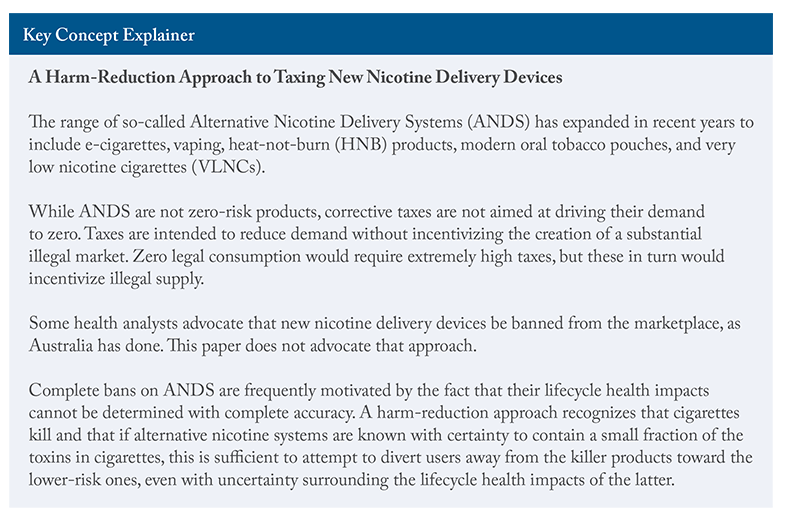
While ANDS are not zero-risk products, corrective taxes are not aimed at driving their demand to zero. Taxes are intended to reduce demand without incentivizing the creation of a substantial illegal market. Zero legal consumption would require extremely high taxes, but these in turn would incentivize illegal supply. Some health analysts advocate that new nicotine delivery devices be banned from the marketplace, as Australia has done. I do not advocate that approach.
Complete bans on ANDS are frequently motivated by the fact that their lifecycle health impacts cannot be determined with complete accuracy. A harm-reduction approach recognizes that cigarettes kill and that if alternative nicotine systems are known with certainty to contain a small fraction of the toxins in cigarettes, this is sufficient to attempt to divert users away from the killer products toward the lower-risk ones, even with uncertainty surrounding the lifecycle health impacts of the latter. The US Food and Drug Administration classifies ANDS into reduced-risk and reduced-harm categories. The latter requires longer-term observation, the former requires evidence of reduced content toxicity.
As a final introductory point, I aim to inform the debate on taxation by drawing upon what might, broadly, be termed the toxicology literature. I have limited expertise in chemistry, but since externalities and internalities are critical in determining tax rates, and the extent of these internalities and internalities are dependent upon the toxicity content of the products in question, economists should be informed by what the toxicologists have to say. It is important to emphasize that relative toxicity is but one component of a tax system, and I have not attempted to design a set of numerical tax values that might reflect something approaching “optimality.” Our knowledge of own-price and cross-price elasticity values (behavioural response) remains incomplete. We also have little experience of an ANDS illegal market and, therefore, no evidence to inform the question of what tax thresholds would initiate a black or grey market. Finally, some new products (particularly oral nicotine and HNB products) are supplied within an oligopolistic production structure, and if governments were to tax these products at rates that reflect their relative toxicity (very low relative to combustible cigarettes), then suppliers have an incentive to price their products higher. Consequently, an appropriate tax rate may be greater than what would be suggested by a relative toxicity measure.
A Philosophical Starting Point
Nicotine Addicts, Smoking Kills
Combusted tobacco is a severely toxic product; its regular use may reduce life expectancy by up to 10 years (Centers for Disease Control, 2021). However, if nicotine consumption can be separated from the nefarious impact of combusted tobacco on health, then nicotine consumption should be tolerated, with robust restrictions in place to prevent youth access, even if it is not perfectly safe.
Choice
Alternative nicotine delivery systems perform two functions: they act as a quitting device for smokers, and a reduced risk means of consuming a substance that is not particularly healthy but broadly provides satisfaction to the user.
Much of the antipathy to these systems comes from public health advocates who believe that the products do not provide an escape route from combustible cigarettes that is superior to, say, nicotine replacement therapy (NRT) or drugs. A second source of antipathy arises when e-cigarettes are seen either as a gateway to combustible cigarettes for youth in particular, or for continued longer-term use by youth.
Adults should be free to consume nicotine in a relatively low-toxicity form. Beer and wine are not judged on the basis of whether they induce the consumers of spirits to quit or not. Cannabis is a legal commodity in Canada, and its legality is not conditioned upon its being an escape route from cocaine or heroin. While the regular consumption of moderate amounts of these products may not be beneficial for health, their use is not, and should not be, prohibited.
Producers
Public discourse on tobacco policy is too frequently driven by an abhorrence of the tobacco industry. For several decades, the industry was less than forthcoming on the dangers of smoking. But policy today needs to focus upon the current tobacco-use landscape. Canada’s major tobacco producers all supply ANDS and, to varying degrees, they are committed to switching their combustible-cigarette (c-cig) users to these newer products.
A public policy that aims to transition smokers from c-cigs to ANDS will impact both tax revenues and corporate income. Canada’s major cigarette producers might see some of the decline in cigarette revenues (assuming the downward usage trend continues) partially offset by additional revenues from ANDS. ANDS are also supplied by hundreds of small vendors and producers in Canada. Euromonitor (2020) and the Canadian Tobacco and Nicotine Survey (CTNS 2019) indicate that almost 70 percent of expenditures on vaping products is directed to vape shops and online purchases, indicating that vaping is not heavily concentrated in the hands of a small number of large producers.
The Precautionary Principle
I explore below the scientific basis for supporting the use of ANDS as a means of exiting from dependence upon combustible tobacco products. I shall also address the use of e-cigs by minors. The context for the ensuing discussion is the “precautionary principle,” which states that options carrying a degree of uncertainty should not be ruled out of hand on account of that uncertainty (Juma 2016). Uncertainty should lead neither to paralysis nor rejection.
Vulnerable Communities
Several identifiable social groups experience high rates of tobacco use: individuals with poor mental health, First Nations and Indigenous Communities (FNICs), the homeless and individuals who identify as LGBTQ+. For many in these communities, tobacco is both a comfort and a burden: nicotine provides the comfort while the toxins debilitate the body and the mind (Glover 2020 provides an insightful survey).
With smoking at its lowest prevalence in about 70 years in Canada, the percentage of remaining smokers in these communities is higher than ever. Consequently, the objective of reducing smoking must become more keenly focused upon who is still smoking and why. If nicotine alone provides minimal health damage and at the same time provides satisfaction to users, then the “war on tobacco” needs to separate out combustion-related tobacco toxins from nicotine.
These high nicotine-use social groups also have lower average incomes than the population at large and, therefore, should not be denied access to less-expensive nicotine by limiting access to lower-priced ANDS.
Tobacco Use, Revenues, and Tax Structure: An Overview
As of early 2021, Health Canada has signalled its intention to place strict limits on the consumption of nicotine in the form of ANDS. In particular, it intends to place a nicotine concentration cap on e-cig liquid and to limit the range of flavours (Government of Canada 2020). These measures would/will undoubtedly reduce the e-cig market, limit the ability and willingness of smokers to transition to less risky products and give rise to both black and grey markets (Irvine 2021). Simultaneously, these measures would/will reduce the tax base associated with reduced-risk nicotine products. Despite these potential developments, whose ramifications require a separate study, tax policy and tax rates must be informed by the toxicity of the products being taxed.
Tax Revenues: A Preview
Physicians for a Smoke-Free Canada (PSFC 2019) estimate that federal and provincial specific taxes from cigarettes, cigars and other forms of tobacco amounted to $8.3 billion in 2019, with the lion’s share coming from cigarettes. In addition, sales taxes yielded approximately $2 billion, making for a total take of more than $10 billion. On the basis of PSFC calculations, I assume that cigarettes are responsible for $9 billion in tax revenue.
Clearly, tobacco taxes yield substantial revenues to both provinces and the federal government, and reductions in tobacco consumption are reflected in reduced tax revenues. Such losses are balanced by the benefits associated with reduced morbidity and mortality.
To the degree that cheaper reduced-harm products can substitute for c-cigs, and given that the specific tax rate on the former should be substantially lower than the latter, significant declines in specific taxes and sales taxes resulting from tobacco sales would attend a transition from c-cigs to ANDS.
Tobacco Consumption – Cigarettes
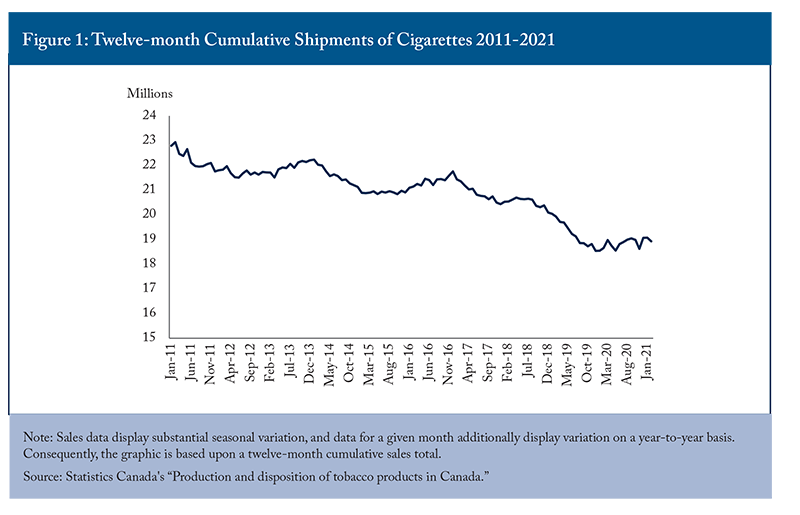
Figure 1 displays the pattern in monthly cigarette sales in millions of sticks from domestic producers in Canada from 2011 to 2021. Sales declined slowly between 2011 and 2018 and then rapidly in 2019. For the first seven years, the decline averaged about 1.5 percent, whereas in 2019 it was 7.5 percent. Much of this decline is due to the expansion of e-cig sales.
Other potential explanations for the decline are explored in Irvine (2021), but the case for this drop not being attributable to e-cigs is difficult to maintain, especially in light of Nugent (2020) who details the sharp increase in e-cig sales in 2019. The data on c-cig and e-cig sales for the period from the fall of 2019 to late 2020 are more difficult to interpret than for the preceding 12 months. Three specific events influenced sales patterns.
In the first instance, an outbreak of “e-cigarette or vaping-associated lung injury” (EVALI) inserted a major scare into the e-cig market in late summer 2019. Although no deaths from the outbreak occurred in Canada, 68 individuals died in the US as a result of consuming contaminated THC in illegal cannabis. The illegal product contained a suspension agent for the THC (Vitamin E Acetate) that is not permitted in legal products.
The event should have had little relevance for the consumption of nicotine-based products, but since the THC was being consumed through vaping devices, several public health agencies warned the public to avoid every form of vaping.3For example, the Quebec government, in a December 2020 regulatory document attributes e-cigarette and vaping-associated lung injury solely to vaping; but that description is misleading. In the document’s first page, it omits any reference to THC and disregards the known scientific findings that vitamin E acetate was responsible. The resulting decline in the sale of nicotine-based e-liquid coincided with a halt to the decline in smoking.
The second major event to perturb the market was the COVID-19 pandemic. With millions of Canadians working at home rather than in the workplace, many were no longer subject to workplace bans on smoking and, consequently, may have smoked more at home.
A third disruption to the market came from the closedown of First Nations’ production from mid-March to early June on account of COVID-19. This decreased the availability of what for some smokers was illegal product.4This is detailed in O’ Riordan (2020), and I am grateful to a reviewer for providing me with evidence on this issue.
Statistics Canada also provides data on cigarette production and inventories. In general, production and sales are closely correlated over time, but that pattern was disrupted in 2019 when inventory built up. That disruption suggests that producers did not anticipate a decline in sales, meaning that the decline was attributable to some factor outside the normal range of experiences, in this instance electronic cigarettes.
Tobacco Use – Youth Vaping
The elephant in the room that hovers over every vaping policy discussion is the growth in youth experimentation in the years 2017 to 2020.
Canada and the US have each experienced a tidal wave of commentary about the youth-vaping “epidemic.” This is a two-sided story. On the one hand, vaping has taken off among youth and, on the other hand, smoking and the use of other tobacco products by youth have declined enormously.
US patterns are almost identical to those in Canada. Both the National Youth Tobacco Survey and the Monitoring the Future surveys (MTF) indicate that daily, or high-frequency, vaping rates are in the 5 percent-to-10 percent range among high-school students (depending upon the grade level or levels observed), and daily smoking prevalence rates are a few percent. Vaping rates increased substantially in the years 2017, 2018 and 2019 in the US. The Centers for Disease Control report that past 30-day usage by 2019 had climbed to 27.5 percent of high-school students and 10.5 percent of middle-school students.
Those rates declined in 2020 to 19.6 percent and 4.7 percent, respectively. Almost 40 percent of high-school and 20 percent of middle-school students are high-frequency users (> 20 days/month). The decline may be due to the introduction of the federal ‘Tobacco-21” law in December 2019 that restricted access to those aged 21 and above. Even though most high-school youth were legally ineligible under the previous age-of-access law, many of these students had obtained their tobacco from slightly older friends or siblings, that source dried up somewhat with Tobacco-21. Cigarette use continued to decline (MTF Dec. 2020).
The Canadian Student Tobacco and Drugs Survey (CSTADS, Government of Canada) details steep increases in vaping among Canadian students and an accompanying decline in cigarette use for the 2017-2019 period. The 2 percent daily smoking rate (an average over Grades 10 to 12) is a result of smoking declines of one-fifth in each of the years 2018 and 2019. The Ontario Student Drug Use Surveys (OSDUS) and the MTF detail a similar pattern. Hammond (2021) also reports a substantial decline in youth vaping during 2020 in the US, Canada and England.
Policymakers must recognize the scale of the decline in youth smoking. It is ‘historic’, and remarkable, given that the declines came at a point when youth-smoking prevalence was already low.
The OSDUS illustrates that, beyond the dramatic and opposing movements in vaping and smoking rates, youth are increasingly conscious of safe behaviour. In addition to switching to a less toxic form of nicotine, major declines in alcohol abuse and drunkenness and other hazardous behaviours are also in evidence. For example, during the 2011-2019 period the Ontario survey points to a 50 percent decline in youth accepting a ride from a driver who has consumed alcohol or cannabis.
In other words, youth has dramatically restructured its “sin” patterns. If we see youth in this way, then some youth behaviour can be perceived as almost rational: a core of young people inclined toward risk taking has reoriented its choice of risky behaviours towards those with reduced danger. Yet, at the same time, youth who are less inclined to risk-taking have increased their experimentation with vaping, a new risk product. It may be difficult to deter the risk-takers from engaging in experimentation and use, but those youth less inclined to risk should be a prime target for reduction policies.
Despite the rise in vaping since 2017, youth dependence upon nicotine has not risen in the 2000-teens. Jackson, Brown and Jarvis (2021), using US data between 2011 and 2019, report that there has been no increase in nicotine dependence among all youth, as measured by the Fagerstrom test (use of nicotine product in the first 30 minutes of the day) or a “craving in the past 30 days” test on the part of the youth population. Furthermore, dependence is markedly lower among vapers than smokers.
The Current Tobacco Tax Structure
The taxation of tobacco is a shared federal/provincial jurisdiction. For cigarettes, the federal government levies an excise tax of $0.125 per stick, and provinces levy an additional tax that universally exceeds this levy. Several provinces (e.g., Manitoba, BC and Nova Scotia) have a rate neighboring $0.30 per stick. At the point of sale, most provinces also impose a sales tax. This may be a harmonized sales tax or a combination of the federal goods and services tax plus a provincial tax. Cigars, fine cut and pipe tobacco are subject to separate rules.
Vaping products are not currently subject to a federal excise tax. The federal government is expected to fill that void, while provinces are gradually implementing specific taxes without waiting for the federal government. A coherent and coordinated policy involving both levels of government would be preferable to a decentralized free-for-all in an area of joint jurisdiction.
For loose-leaf tobacco, the federal government levies an excise tax of $7.76 on amounts up to 50 grams. This restriction disincentivizes the production of small tobacco packs – packs that might appeal to potential underage users – and thus producers are incentivized to supply larger product packs than they otherwise might. This applies not only to traditional roll-your-own loose-leaf tobacco and pipe tobacco, but also to HNB products (with product names such as iQOS, Ploom and Glo) and to oral tobacco pouches (with product names such as Snus, Zyn or On!)
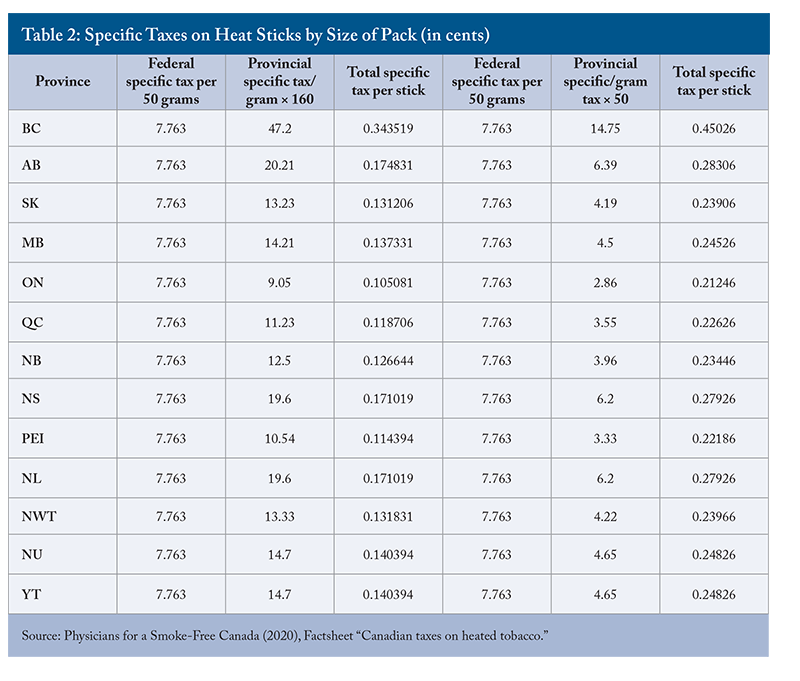
Consider the impact of the 50-gram standard on heat sticks that are consumed via a holding device that heats rather than burns the product. Twenty tobacco sticks weigh 6.2 grams, or 310 milligrams per stick (the weight of tobacco in a combustible cigarette is between 0.6 and 0.7 of a gram). In order to reduce the federal excise tax to the minimum amount per stick, the producer should supply packages containing 160 units (160 × 310 mg = 50 grams). Accordingly, IQOS, as an example, is marketed in two formats: a pack containing 160 units and another containing 50 units. In addition, provincial governments levy their own specific taxes on HNB products. As an example, in April 2021 Saskatchewan levied a tax on HNB products at a rate equal to 75 perent of the rate on combustible cigarettes.
Oral products have an extremely small market share in Canada – the 2019 CTNS survey indicates that just 0.4 percent of the population uses chewing tobacco – though they are rapidly increasing in market size in the US (Barclays 2020). Snus, a snuff-like nicotine-containing powder (usually derived from the tobacco leaf) comes in a moist pouch.5Snus-type products come in two varieties. One contains nicotine and processed tobacco leaf, the other contains nicotine and non-tobacco-leaf plant material. The latter category is defined in Canada as a natural herbal product and not subject to excise provided a given pouch contains no more than 4 mg of nicotine. Hence, when I refer to this category of products in the text, I am referring to the taxable variety. Tobacco is pasteurized to kill bacteria that can provide a breeding ground for carcinogens. Pouches are sold in containers of varying sizes. A common one is 20 units, intended to yield on average as much nicotine as a pack of cigarettes. The pouches normally weigh between 0.5 and two grams, they vary in nicotine strength and yield an amount of nicotine approximately equal to that of a combustible cigarette. The pouches are disposed of after being in the mouth (lodged between the cheek and gum) for normally between 15 minutes and 45 minutes. Nicotine in these products may be extracted from tobacco or synthesized. Clarke et al. (2019) provide a comprehensive review of the potential links between snus and a series of morbidities in Sweden and Norway. The EU does not permit the sale of snus, but Sweden has an exemption to the rule.
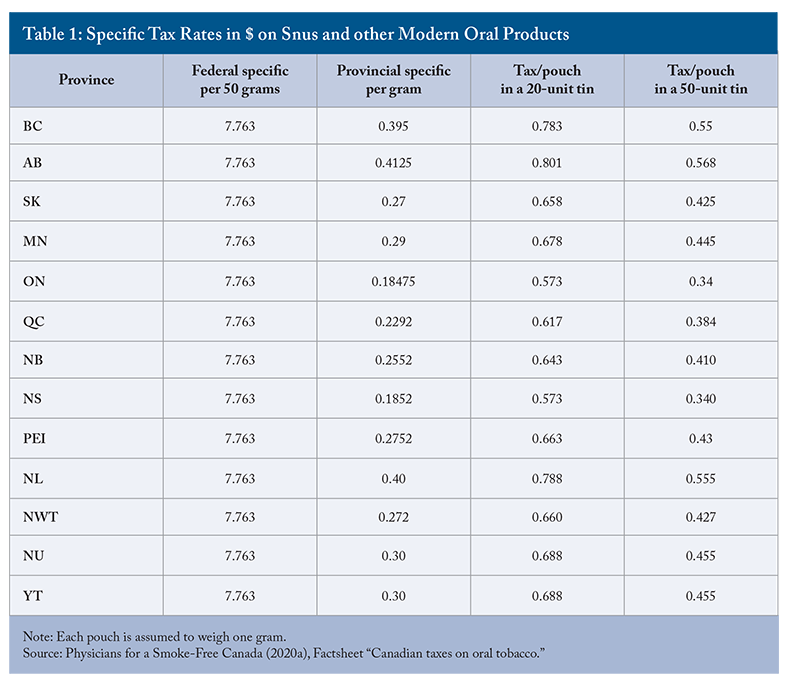
In Canada, these products are treated as loose-leaf tobacco and subject to the 50-gram minimum tax. Physicians for a Smoke-Free Canada (2020a, 2020b) has determined the impact of this tax structure on the retail price of HNB and oral tobacco products across Canada’s provinces. These are reproduced in Tables 1 and 2. If specific taxes should reflect the health risks associated with each product, then the tax rates on snus and modern oral products are much too high, and specific taxes on heat sticks are also too high, though to a lesser degree.
Taxes based upon the weight of tobacco in a product are no longer appropriate in determining relative tax rates. This is both because nicotine can be synthesized (and is, therefore, “tobacco free”), and a given nicotine intake can be obtained with vastly differing efficiency levels from various products. For example, a c-cig burns while not being inhaled and much of the nicotine is lost in the form of environmental waste (a.k.a. side-stream smoke). E-cigs emit zero side-stream vapour.
A Health-Risk Approach to Nicotine Taxation
Taxation, Exposure and Risk
In a world where individuals are fully aware of the consequences of smoking, society may choose to avoid punitive taxes on cigarettes. However, even if smokers are aware of the negative impacts on their own health, they still impose costs on society when health services are socialized. Smokers suffer higher rates of morbidity all through their lifecycle and, consequently, corrective taxes are in order.6Gruber and Koszeki (2004) have explored the consequences of time-inconsistent preferences.
Corrective taxes also emerge from a paternalistic approach to social wellbeing. In a paternalistic world, the government decides that individuals who smoke are not acting in their own best interests and, therefore, imposes additional taxes in an attempt to reduce smoking.
Differential taxation is also a means of conveying use-risk information. The full cost of a pack of cigarettes might be as high as $40 when evaluated in terms of life-years lost.7A curtailment of expected life by 10 years for a pack-per-day smoker over a period of 50 years is an accepted estimate in the literature. If a statistical life year is evaluated at $50,000, then the undiscounted cost of each pack is $500,000/(365 × 50) = $27.40, plus the monetary outlay, yielding a total of circa $40 per pack. If an AND system were to reduce expected life by just a single year, and given the monetary cost is at most one-half of the cost of cigarettes, the equivalent full cost per pack in AND form is less than $10.8From the previous footnote, the loss of one year of life would be $2.74/pack equivalent; if the cost of a pod is approximately $6 tax inclusive, this yields a full cost of $8.74. These calculations are approximate, but illustrate the scope for potential damage and cost reduction.
An analysis of tax rates can proceed either from the standpoint of seeking an optimal set of taxes, or from the standpoint of reforming existing taxes such that social wellbeing is improved. I adopt the latter focus, a.k.a. tax reform. I begin by analyzing the corrective tax component of the price of cigarettes and then use that as a reference point to determine a set of taxes for ANDS that would reflect relative risk. The canonical sources on relative risk for e-cigs are the series of Public Health England reports (e.g., McNeil et al. 2018) and the report from the Royal College of physicians (2016) that indicate e-cigs have approximately one-twentieth of the toxins of a c-cig. For HNB products, an informative source is the 2020 US Food and Drug Administration (FDA) scientific report. For modern oral tobacco, there exist numerous reports based upon Swedish data (e.g., Clarke et al. 2019). VLNCs are examined in depth in FDA (2019).
The reduction in health risk is not necessarily proportionate to the reduction in toxicity of any of the products; the function relating health risk to the quantity of toxins may be linear, concave or convex. Furthermore, if health damage is broken down into the major morbidity conditions (cancer, heart disease and stroke), the relationship between the quantity of toxins consumed and the probability of developing one condition may differ from the relationship between the quantity of toxins consumed and the probability of developing another.
The FDA distinguishes between toxin exposure and health risk. This distinction was central to how it ruled upon the application by the producers of IQOS, a tobacco-heating system that creates nicotine-flavoured vapour, to have their product defined as a modified-risk tobacco product. The FDA ruled that IQOS falls into the reduced exposure rather than the reduced (health) risk category. In contrast, it granted the producers of snus pouches the reduced-risk classification. In part this was due to there being decades worth of evidence from Sweden and Norway on snus use and (low) related health impacts.
As stated earlier, new so-called tobacco products in the marketplace need not necessarily contain tobacco, because the nicotine has been synthesized. But for the purposes of this analysis, we will treat nicotine-based products derived from tobacco in the same way as synthetic nicotine products.
Vaping Products
US state-level taxes do not provide a useful guidepost because of their high level of variability. Some 30 states now have an e-cig volume tax that varies from five cents/ml to 90 cents/ml. Other states impose a tax on the value of sales. The tax can fall on the e-liquid alone or on both the devices and liquid. Some states have a specific charge on volume combined with a sales tax.
The taxation of combustible tobacco consumed through a water or conventional pipe is rarely accompanied by a special levy on the pipes. Pipes are a form of stable capital in the sense that they are physical objects with a relatively long lifespan. In contrast, e-cig consumption involves rapidly depreciating pods filled with nicotine-flavoured e-juice, or e-liquid, inserted into the pipe. When e-juice is consumed, it must be done in conjunction with a vaping device, i.e. capital. A pod is a small container that is either prefilled and clipped into a vaping device or is refillable. Refillable pod systems are also termed open-pod systems. Each pipe’s refillable pod may be used about five times and a set of four in Canada costs around $15. Pods typically have a capacity between 0.7 ml and 2 ml. A pod containing roughly one ml of high-nicotine concentration generally suffices to satisfy the nicotine needs of a vaper who might otherwise smoke a pack per day.
The pods depreciate rapidly because the coil that heats the e-juice fatigues quickly and the mechanism also becomes congested. A reasonable estimate is that pod capital might cost $1 per day for a vaper consuming the equivalent of a pack of c-cigs per day.
A high-quality, open-pod device will cost in the neighborhood of $40 before tax and may last for three to four months. Devices with variable controls are more costly. Manufacturers may claim a longer lifetime, but devices also get lost. Depreciating this capital yields a daily device-capital cost of perhaps 25 cents.
E-juice of the salt-nicotine variety, a.k.a. salt nix, purchased in a 30 ml container costs between $25 and $30. Summing the vaping cost components yields a daily cost, on a pack-per-day equivalent basis, of $2.25 when purchased in a vape shop. The daily cost to a brand-name non-refillable pod system, such as Juul or Vuse or Logic, costs between $4 and $5 per day, pre-tax.
In contrast, e-juice that is freebase and at a lower nicotine concentration, typically costs about $15 for a 30 ml container in a vape shop. The price does not generally vary with the concentration level within the freebase class, or within the salt-nix class. A vaper using a low concentration, for example six or nine mg/ml, may use four or five ml per day to satisfy his nicotine requirements. Thus, vaping salt nix usually involves a lower outlay, and it also means there is no need to purchase an expensive device. Evidently, tastes are important: some vapers prefer salt nix, others prefer freebase, and the latter group generally incurs higher expenditures. Prices are slightly lower online.
The market is segmented in more than a single fashion. One fork pertains to retailing: big-brand, pod-style products are primarily sold in gas stations and convenience stores, whereas component systems are sold in vape shops and online. Vuse and Juul are the convenience-store market leaders (Nugent 2020) though other suppliers are springing up regionally in Canada (for example, Stealth in the Atlantic provinces). Pod systems are offered in convenience stores in starter packs that include a device and several pods.
The market for earlier-design, tank-based larger devices, known colloquially as cloud-chasing or mod systems, has shrunk since the arrival of pod systems. A high-quality system costs at least $100, a disincentive for starting vapers. They are designed as high-vapour volume, low-nicotine concentration systems and run at higher power usage and temperatures than pod devices.
Nicotine content typically varies between 3 mg/ml and 18 mg/ml in a freebase tank system, whereas it can reach 60mg/ml in salt-nix, pod-based form. Most salt nix is greater than 20 mg/ml concentration, but some suppliers make it as low as 10 mg/ml. Salts yield a smoother inhalation and are, therefore, used at higher nicotine concentration.
The distinction between free-base and salts systems is critical for taxation. Taxation of liquid can be on a volume basis, irrespective of nicotine concentration, on a volume basis with a nicotine concentration component, or simply on a value basis. A concentration basis for a tax would favour a tank system, even though users inhale a greater volume of liquid because the concentration is lower. The toxins associated with e-cigs relative to cigarettes are vastly reduced in either of the vaping systems, but the health risks are slightly higher for high-volume and high-temperature systems.
The analogy with so-called ‘light’ cigarettes is appropriate here. When these products were introduced in the 1970s, they were marketed as less dangerous to health. But smokers compensated strongly in their inhalation in order to obtain nicotine levels closer to regular-strength cigarettes. Paradoxically, then, the use of a tank-based system running on free-base liquid with a 6-mg or 9-mg concentration is not less risky than a pod system running on low power with a 50-mg-to-60 mg concentration.
The federal government, as of early 2021, plans to ban the sale of e-liquids with a nicotine concentration more than 20 mg/ml because it fears that high concentrations attract youth.
The years 2019 and 2020 have seen disposable e-cigs assume importance in the marketplace. E-cig devices, including the liquid container, are disposed after the e-juice supply is exhausted. They generally hold a nicotine content equal to two or four packs of cigarettes.9For example, the Allo Ultra system holds 3.8 ml of e-juice and would be equivalent to four packs of cigarettes. An Internet search indicates that this system sells for $14.99. A web search under “disposable e-cigarette brands” yields the names of dozens of makes. Their attraction arises because a segment of the e-cig market values the convenience of not having to refill the pods and maintain a more durable device and, importantly, they come in a wide array of flavours. Some jurisdictions have banned flavours in convenience stores but not in vape shops.
On a value basis, the price of a pack of cigarettes in Canada consists of approximately two-thirds taxation and one-third revenue to the supply side. This implies a taxation rate of 200 percent (2/3 divided by 1/3).10As stated above, Physicians for a Smoke-Free Canada indicate that between $8 billion and $8.3 billion is collected each year from excise taxes. Given the relatively small size of the cigar, pipe tobacco and loose-leaf tobacco segments, cigarettes account for approximately $7 billion of this excise total, with approximately a further $2 billion in sales taxes. If a pack sells on average for $14, then the component to the retailer/producer is in the neighbourhood of $5, and $9 goes to the government in the form of excise and sales taxes. The total taxation as a percent of the all-tax-inclusive price is 9/14 = 64 percent, which is almost 2/3 or 200 percent of the all-taxes-excluded price. Since Public Health England McNeill et al.) states that e-cigs are approximately 5 percent as toxic as c-cigs, then a corrective rate of 10 percent might be appropriate for e-cigs.
This tax could be levied on the retail price or as a percentage of the specific tax falling on cigarettes. I consider each in turn. Since e-cigs are now subject to a sales tax rate (either a harmonized rate or a combined PST plus GST) approaching 15 percent in most provinces, then moving from the current rate to 20 percent or 25 percent, for example, would raise the daily cost of an open-pod, salt-nix system by about 12 (24) cents to a user who consumes one ml per day (broadly a pack-per-day smoker) and 24 (48) cents to a Vuse or Juul or Logic pod user because they are priced at about twice the level of vape-shop products.
In contrast, if the additional tax on e-cigs is 5 percent of the specific tax on combustible cigarettes, then the price increase is greater. Assume then that the $9 tax take on a cigarette pack reflects a $7 corrective tax and a $2 general revenue tax. On this basis, if e-cigs are subject to an additional levy prior to the imposition of a sales tax of 15 percent, and the specific levy reflects risk differentials between e-cigs and c-cigs, then 5 percent of the $7 average specific tax on a pack of cigarettes amounts to 35 cents per pod (or ml). If the sales tax is cumulated, the total price amounts to approximately $2.25 + $0.35 × 1.15 = $2.99 rather than the current assumed price of $2.59 × 1.15). For the convenience store products, the price would rise from $5.75 currently ($5 retail price plus 15 percent sales tax) to $6.15 with a 35 cents levy (= $5.35 × 1.15).
As for second-hand aerosol emissions from e-cigs, they contain about the toxins of second-hand smoke. The Canadian Centre for Occupational Health and Safety states that 85 percent of environmental or second-hand smoke is in the form of side-stream smoke and 15 percent in the form of exhaled smoke. In the case of e-cigs, there is no side-stream aerosol and the toxicity of exhaled aerosol is about one order of magnitude less than the toxicity of exhaled smoke. This suggests that the second-hand toxins from e-cigs are about 1 percent of the toxins from c-cigs, which indicates that second-hand considerations need not be a factor in the choice of a specific tax rate for e-cigs.
Vapers of freebase liquid consume a greater volume than salt-nix users. Therefore, if we were to impose a 35-cent tax on each ml, a freebase user would incur a tax charge that is four or five times higher than a salt-nix user, and the freebase user might ingest less nicotine than the salt-nix user.
A further complication is that higher-temperature vaporization is generally associated with higher levels of some toxins. A large scientific literature explores the relationship between nicotine and carbonyls produced, on the one hand, and device characteristics on the other. Wattage, wick type and size, along with air passage all play important roles in generating heat and aerosols. User puffer behaviour is equally important. Ultimately there is no simple relationship between nicotine liquid concentration and the amount of nicotine that is either produced by a device or consumed by a vaper. We do know that higher temperatures, usually associated with lower concentrations, provide slightly higher risk (Kosminder et al. 2020, Son et al. April 2020 and May 2020, Farsalinos and Gillman 2017, Voos et al. 2019).
Where do these issues point when it comes to taxation? A nicotine basis is not ideal because it will encourage vapers to migrate to higher-temperature devices. A volume basis is not ideal because it penalizes users of low-concentration liquids who consume more liquid than high-concentration users, even if both are former pack-per-day smokers. While it might be possible to write down some mathematical equations that would embody a vaping policy goal, the overriding issue is that the toxins in e-cigs are a small fraction of the toxins in c-cigs, despite variations within each product class. Accordingly, a second-best approach suggests itself: tax the value of the product at a rate of x percent, in addition to the existing PST and GST, keeping in mind Public Health England’s 5 percent toxicity rule of thumb.
As a final observation: When the federal government imposes a 20 percent cap on nicotine concentration, vapers will consume greater volumes of lower-concentration e-juices. Therefore, a volume tax might increase tax revenue, unless the illegal market becomes a major player.
Snus and Modern Oral Products
The specific tax levied on HNB and snus-type products has been described above (Table 1). The tax structure that was designed for loose-leaf tobacco currently applies to these new ANDS, even though their toxicity levels would appear to be at least an order of magnitude less than loose-leaf tobacco – consumed either as chewing tobacco or in self-roll format.11Self-rolled cigarettes may be even more toxic than c-cigs because they lack a filter.
Snus-type products currently play a minute role in the Canadian market, much smaller than in the US. However, all alternative nicotine delivery systems are seen by tobacco manufacturers as vehicles for both maintaining revenues and as means of switching their customers to reduced-risk products. This form of nicotine has been widely used in Sweden since the 1990s. Smoking rates in Sweden are the lowest in Europe at 5 percent, and tobacco-related morbidity and mortality are also the lowest in Europe (Shapiro 2018). Norway is following in Sweden’s footsteps. Clarke et al. (2019) provide an in-depth review of the scientific literature on the potential relationship between tobacco use in various forms and about 10 different morbidities that are historically associated with combustible tobacco.
Fisher et al. (2019), using longitudinal data, examine mortality rates for different tobacco-related diseases for several categories of tobacco/nicotine users. Their prime focus is upon relative odds of death for smokers, never smokers, smokeless tobacco (SLT) users and combinations of these groups (e.g., former smokers who quit completely, former smokers turned current SLT users, etc.). They caution that SLT comes in various forms and that the one in the marketplace since the 1990s differs from what preceded it. Consequently, the evolution of the product could give rise to different health outcomes. Their principal finding is that SLT users experience an all-cause mortality rate that is not significantly above the rate experienced by individuals who never used any tobacco-based product. Simultaneously, they find elevated mortality odds for dual SLT-cigarette users and similar odds for former smokers-turned-SLT-users as for former smokers who quit entirely.12These recent results may appear to be at odds with advice given, as one example, by the Mayo clinic. It cautions that SLT comes in a variety of forms, both across and within nations.
In North America, the most popular SLT product historically has been chewing tobacco. This differs from snus and other modern oral SLT products, as detailed earlier, and tax rates should reflect this difference. Accordingly, and in the face of some uncertainty, I place chewing tobacco in a higher-risk category than snus or other modern oral products.
Snus and other modern oral products, like e-liquid, vary in their nicotine content. In addressing whether the strength of an e-liquid should enter the determination of the appropriate specific tax, I argued earlier that a lower rate for lower-nicotine products would not necessarily reflect relative toxin exposure. Furthermore, most suppliers differentiate very little in their pricing structure between lower and higher nicotine concentrations.13Among modern oral products, ON! is sold in concentrations from two milligrams to 12 milligrams (extra strong) per pouch, but the manufacturer charges the same price regardless of the concentration.
Canada’s specific tax on combustible cigarette sticks does not vary with the nicotine content of a brand. This suggests that if we follow established practice, a uniform specific tax per pouch would be appropriate, regardless of the nicotine content. Given that the risk associated with any nicotine-strength snus pouch is minor compared with combustible products, a uniform rate within the snus/modern oral categories would not distort decisions in any serious way.
Current specific rates on these products do not reflect the principle of proportionate risk. Table 1 illustrates that the federal excise tax per pouch of snus in Canada varies between $0.57 and $0.80 when purchased in a container of 20 units and between $0.34 and $0.57 when purchased in a container of 50 units, which minimizes the federal tax per unit. These rates are higher on average than on cigarette sticks, but the risk associated with snus is possibly two orders of magnitude less than that associated with cigarettes. Consequently, the current rates on snus and other modern oral products should be reduced substantially.
Heat-not-burn Products
In July 2020 the US FDA approved the application of Altria/Philip Morris for its HNB product, IQOS, to be considered as a reduced-exposure product. However, it denied the company’s request that IQOS be considered a reduced-risk product, citing the absence of long-term studies relating health to use.14According to Businesswire (July 2020), “On March 31, 2017, PMI submitted Pre-market Tobacco Product Applications (PMTA) for IQOS to the FDA to authorize commercialization in the U.S. as a new tobacco product. The FDA authorized the IQOS PMTAs on April 30, 2019. With the PMTA authorization, Philip Morris USA is responsible for marketing and sales of IQOS (version 2.4) in the US.” It is important to recognize what reduced exposure means under US law.
“With respect to the exposure modification order request, the applicant has demonstrated that the products sold or distributed with the proposed modified risk information meet the standard under section 911(g)(2) of the FD&C Act, including that a measurable and substantial reduction in morbidity or mortality among individual tobacco users is reasonably likely in subsequent studies, and issuance of an order is expected to benefit the health of the population as a whole taking into account both users of tobacco products and persons who do not currently use tobacco products.”
The scope of this statement is notable, not only because it anticipates that health benefits will accrue to the whole population but because it implies that some new users may adopt the IQOS.
The FDA analysis took three years to complete and was based upon some two million pages of evidence (Bates 2020). It would be impossible to summarize the scholarship that went into this effort on the part of independent scientists, the FDA and scientists involved in product development. That said, the report indicates that while some harmful and potentially harmful compounds appear in exhaled aerosol from IQOS, they are at least an order of magnitude lower than c-cig compounds (FDA Report, Table 2).
The scientists surveyed and verified a literature that details comparisons between c-cigs and IQOS primarily, and involving e-cigs in some cases, using a variety of different methodologies, including in vitro and in vivo studies. In the human behavioural studies, where biomarkers were observed in participants for periods of several months, the report’s authors were reluctant to conclude beyond a reasonable doubt that the long-term effects of IQOS use could be sufficiently well predicted, even if the results were encouraging. As a result, the FDA ruled that the IQOS be defined as a reduced-exposure rather than a reduced-risk product.
An extensive analysis of HNB products is also presented in McNeill et al. (2018). That research summarizes the findings of several studies from the standpoint of toxicity levels in mainstream, side-stream and environmental inhalations and exhalations. Again, it is difficult to do justice to the enormous amount of scholarship in the several reports commissioned by Public Health England and researched by McNeill and others. This research indicates that while HNBs (heat-not-burn products) may produce slightly higher toxin levels than liquid-based e-cigs, they are close neighbours of the latter. In turn, this implies that HNBs should be subject to a specific levy closer to e-cigs than c-cigs, and much lower than the current rates shown in Table 2.
Very Low Nicotine Cigarettes (VLNCs)
Very low nicotine level products contain less than 5 percent of the nicotine level of a regular strength cigarette. A detailed discussion of VLNCs is contained in the FDA’s ruling on the Premarket Tobacco Product Application (PMTA) of the corporation 22nd Century for its proposed new VLNC products (FDA 2019).
Since VLNCs are sticks of tobacco, they are subject to the same specific taxes as regular-strength cigarettes in Canada. Some public-health analysts (e.g., Hatsukama et al. 2018) see them as a potentially productive means of transitioning smokers away from c-cigs.
There are three factors to consider about VLNCS. First, as with e-cigs, the public is ill-informed on the relative risks of VLNCs versus regular nicotine products (FDA 2019); it is combustion rather than nicotine that causes early death and increased morbidity among smokers. Consequently, when the public sees an announcement on packaging that VLNCs carry 95 percent less nicotine, and much of the public is unaware that combustion is the prime danger, it largely misperceives the attendant health risk.
Second, behavioural trials indicate that if smokers succeed in substituting VLNC products for a significant part of their regular cigarette intake, they may become less addicted to tobacco and, therefore, reduce the total number of cigarettes that they smoke. They may even quit.
Third, these products, unlike vaping, seem to carry little attraction for non-smokers or youth and, therefore, there is little danger of increasing the number of smokers as a result of bringing them to market.
To conclude: VLNCs are much less addictive than c-cigs but are equally toxic, generally, and this is not well understood by the public. VLNCs and e-cigs operate through different channels. VLNCs are aimed at reducing nicotine dependence while delivering high toxicity; e-cigs continue to supply nicotine with dramatically reduced toxicity.
One sinew of the debate comes in the form of possibly banning all regular-strength cigarettes and permitting only those cigarettes that contain very low nicotine levels. Such a measure would lead some smokers to adopt ANDS, but it would likely lead others to seek out regular-strength cigarettes in the illegal market. That would reduce tax revenue without reducing the consumption levels of smokers who choose to go that route. While e-cigs and HNB products would become more attractive in a world where the nicotine strength of regular cigarettes was reduced, banning regular-strength cigarettes completely is a draconian measure. A superior approach would be to more actively direct smokers to reduced-risk products.
Pharmaceutical Products
In contrast to ANDS, pharmaceutical nicotine delivery systems are intended to promote quitting rather than to (perhaps) sustain a nicotine dependence or habit at a reduced-risk level. The principal delivery types are gum, lozenges, patches, nasal sprays and oral sprays. They operate most closely to snus and other modern oral products where nicotine is consumed through the buccal membrane. The sprays are not designed to operate through the lungs, though some of the spray finds its way to the brain via that route. The patch works trans-dermally. Such products are made available either over the counter, from behind the counter without prescription or with prescription (usually sprays). Like e-cigs, HNB sticks and snus, they come in flavours, and flavours are a heavily advertised trait.15For example, Johnson and Johnson markets their Nicorette sprays in fresh mint and cool berry.
In sum, the major differences between approved ANDS on the one hand and pharmaceutical nicotine-delivery systems on the other are that: (i) the objective may differ; (ii) ANDS do not require a prescription from a medical practitioner, whereas some specific pharma products (primarily nasal and buccal sprays) do and (iii) most AND products deliver nicotine through the lungs.
A Specific Tax Hierarchy
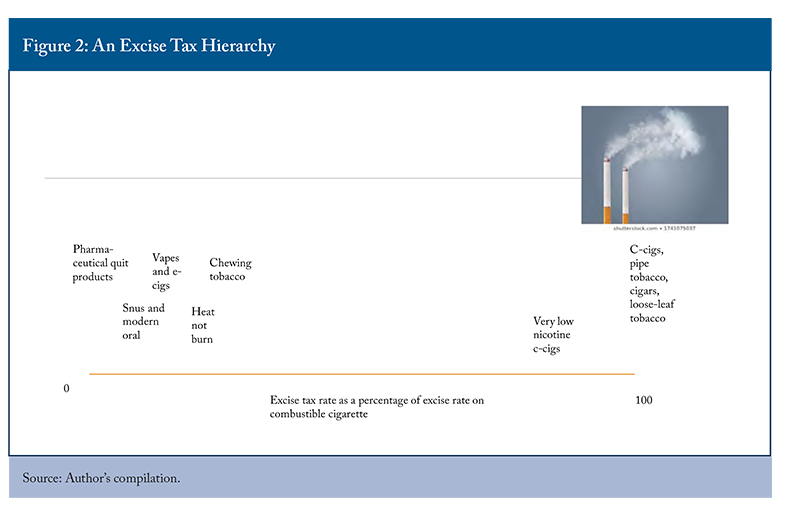
We can now examine each category of alternative products with respect to nicotine content and potential health-related harm in order to gauge what their relative tax burden could be relative to conventional cigarettes. Figure 2 presents my ordinal ranking of taxes for alternative nicotine delivery products.
The spacing between the several products at the low end and VLNCs and c-cigs at the upper end indicates that the tax difference between the AND group and VLNC/c-cig pair should be large, and that the tax rate for VLNCs should be closer to c-cigs than ANDS. Furthermore, the tax differences within the AND group should be small relative to the tax gap between those products and combustible ones.
Elasticities
The health damage associated with mispricing ANDS depends upon the degree to which taxes impact behaviour. As a result, it is important that users respond to the tax policy if health is to be improved through a judicious array of tax rates. In technical terms, this boils down to the size of behavioural response-rate (elasticity) estimates: if the demand elasticity for alternative delivery is large, then users respond more vigorously than if it is small. Finally, it is important to know something about the pass-through rate of specific taxation; that is, whether a given tax levy is more than passed on to the consumer in the final price. Most studies find that ANDS and c-cigs are substitute goods – if the price of one increases, then its quantity demanded declines, and the quantity demanded of the other good increases (Saffer et al. 2019). It also appears that the increase in the retail price of these products in response to a tax increase is greater than the tax. This literature is summarized comprehensively in Cotti et al. (2020).
If ANDS products are elastically demanded and are substitutes for c-cigs, then it is important that taxes on ANDS products not be too high; otherwise, users may allocate their expenditures to c-cigs.
A slightly unsettling aspect of this literature is the degree to which estimates vary. Cotti et al. (2020) emphasize this. Yet in their meticulous study involving a massive US data set, they find cross-price elasticities that are extremely high and difficult to comprehend. This area is a work in progress.
Conclusions
Technological developments in the delivery of nicotine in the most recent two decades have been enormous. While the basic knowledge required to produce specific ANDS and VLNCs has existed for many decades, it is just in the last several years that they have begun to assume a significant degree of importance in the marketplace. The refinement of these products has resulted from research and development on the part of both traditional tobacco corporations and individual-level entrepreneurs.
Today, nicotine can be consumed in a form that is greatly less toxic than heretofore. We do not know the precise consequences of using each one of these ANDS over a protracted time period, despite knowing that their toxicity levels are one or two orders of magnitude less than combustible cigarettes. The central theme of this Commentary is that taxation of nicotine and tobacco products should reflect the risks associated with their use rather than the quantity of tobacco contained in them.
The current environment demands that we ask if nicotine consumption per se is tolerable if the toxin-exposure risks of combustible tobacco can be reduced substantially. This question is frequently ignored in public policy formation. A harm-reduction approach suggests that society may tolerate the consumption of even substantial nicotine volumes if that consumption has modest rather than severe health consequences. The model here is Sweden where tobacco-related illnesses are a small fraction of the average levels experienced in the rest of Europe.
In this framework, relative tax rates should reflect our best understanding of the health risks associated with each nicotine- or tobacco-based product. While our knowledge may be incomplete, it would be imprudent to pretend that it is insufficient to rank the risks in the ANDS spectrum. A review of the literature indicates that snus, other modern oral products and e-cigs should have the lowest rates of specific taxes. HNB products and chewing tobacco should carry a specific tax rate slightly above the rate applicable to e-cigs. In contrast, since cigarettes containing very low nicotine still contain most of the toxins in c-cigs, the specific tax rate on these products should be substantially above the rates on e-cigs and HNB products. But, given that there is evidence that the lower nicotine content may ultimately reduce regular-strength cigarette consumption, the rate should be lower than the rate on c-cigs.
The current array of taxes does not adequately reflect embodied risk. The reformulation of tax rates is made complicated by the flexible relationship between nicotine on the one hand and tobacco on the other: nicotine can be synthesized and, therefore, effectively supplied independent of the tobacco leaf.
Since the consumption of nicotine is habit forming, in some cases to the point of addiction, and can have adverse effects, particularly on youth, its use should be taxed beyond the basic sales-tax rate, even if its delivery is separated from combustible tobacco.
I have sidestepped the issue of exactly what the specific tax rate should be on each individual ANDS product. But my calculations suggest that, in addition to the standard harmonized sales tax, or the combined provincial sales tax and goods and services tax, the specific rates on products at the low-risk end of the spectrum should be in the neighborhood of 5 percent to 10 percent of the rate applicable to c-cigs if relative risk were the sole criterion. At the top end of the spectrum, VLNCs should carry a tax rate below that on c-cigs, and the discount should be sufficient to indicate that VLNCs are slightly less risky than traditional c-cigs. In addition to relative risk considerations, governments have revenue needs and if we ultimately find that elasticities are such that slightly higher tax rates would not deter the use of reduced-risk products by smokers then the tax rates could reflect that. Governments may also choose to tax at a higher rate if concerned about oligopolistic pricing behavior in some segments of the ANDS markets.
Sin taxes are a shared jurisdiction between federal and provincial governments, and coordination is required to achieve a rational set of taxes on reduced-risk products. Provincial specific rates on c-cigs currently average about twice the federal rate and that could be a starting point for coordination.
Tax rates serve several functions. First, the chosen rate will determine tax revenue. Second, relative tax rates influence the decisions of consumers as to which product they will purchase. Third, relative tax rates send a signal to consumers on the associated relative health risks.
Canada, since the early 1990s, has experienced elevated levels of illegal market activity. At first, the illegal activity took the form of Canada-produced cigarettes being exported free of duty and reimported illegally. In the 2000s, and up to the present day, cigarettes manufactured on tax-free First Nations lands account for a sizable proportion of the total tobacco market (O’ Riordan 2020). It is important that the combined federal and provincial government tax rates on ANDS not be so high as to encourage illegal activity. If smokers who are currently facing high prices for legal c-cigs and who use the illegal market for their c-cig supplies could be convinced to switch to a legal product that in some form is about one-quarter of the price of a pack of cigarettes, then illegal activity would be dealt a severe blow.
The precautionary principle, adopted in an excessive form, could lead to a choice of specific taxes on low-risk products that are excessive, on account of the uncertainty about the very long-run effects of ANDS’ use. But an excess of precaution can lead to a rate that may encourage nicotine users to stay with c-cigs – an outcome that will be lethal for some.
The ranking of nicotine products given in Figure 2 contains as much of the state of current knowledge that I have been able to assimilate. As knowledge accumulates with time, we may find bigger or smaller differences in the risks associated with the various ANDS, and that graphic will require adjustment. It is equally possible that other analysts and scientists may interpret the extant scientific literature differently and, as a result, may order the products in an alternative manner or place them closer or further from the two poles that I have chosen. But imperfect knowledge can still be used to improve on the current setup, and uncertainties as to what we may discover in the future should not form an obstacle to improving the present.
A wholesale switch to ANDS would reduce specific revenues substantially because the rate on ANDS should be lower. But the loss of some tax revenue that is corrective in nature is not a social loss if the underlying condition for the correction is moderated.
The health benefits accruing from a major switch to ANDS would primarily benefit low-income households in addition to those groups that have inordinately high smoking rates – individuals with mental health conditions, members of the LGBTQ+ community and FNICs. Smoking rates are twice as high in the lowest-income quintile as in the highest quintile and are three or more times higher among the homeless. Consequently, lower priced/taxed ANDS, once adopted by these groups, could increase their disposable income substantially.
By way of conclusion, we cannot disregard the role of a nicotine concentration cap and a wide-ranging flavour ban on e-cigarettes, both of which were being considered as of early 2021. If implemented, these measures would dramatically reduce the market for reduced-harm products and boost the market for cigarettes, even though Health Canada may believe it is operating in the best interests of youth. In this not-so-brave new world, a well-structured set of taxes may not be sufficient to encourage smokers to switch to reduced-risk products.
References
Barclays. 2020. “Global Tobacco: US Nicotine Industry Model 2020.” Equity research. November.
Bates, C. 2020. “There is nothing confusing about FDA’s modified-risk orders for the IQOS heated tobacco product.” British Medical Journal 370:m3528 September.
Benowitz N. et al. 1983. “Smokers of low-yield cigarettes do not consume less nicotine.” New England Journal of Medicine, 309(3), 139-42.
Breathe – The Lung Association. 2021. Available at: https://www.lung.ca/lung-health/lung-info/lung-statistics/smoking-and-tobacco-statistics#:~:text=Tobacco%20continues%20to%20be%20the,cent%20of%20Canadians%20currently%20smoke.
Canadian Centre for Occupational Health and Safety. “Environmental Tobacco Smoke (ETS): General Information and Health Effects.” Available at: https://www.ccohs.ca/oshanswers/psychosocial/ets_health.html
Canadian Tobacco and Nicotine Survey. 2020. Statistics Canada, Ottawa.
Centers for Disease Control. 2021. Tobacco Related Mortality. Available at: https://www.cdc.gov/tobacco/data_statistics/fact_sheets/health_effects/tobacco_related_mortality/index.htm#:~:text=Cigarette%20smoking%20causes%20premature%20death,years%20shorter%20than%20for%20nonsmokers.&text=Quitting%20smoking%20before%20the%20age,related%20disease%20by%20about%2090%25.
Clarke, E., et al. 2019. “Snus: a compelling harm reduction alternative to cigarettes.” Harm Reduction Journal 16(62). https://harmreductionjournal.biomedcentral.com/articles/10.1186/s12954-019-0335-1.
Cotti, C., et al. 2020. “The effects of e-cigarette taxes on e-cigarette prices and tobacco product sales: evidence from retail panel data.” NBER, 26724.
Cummings, K., M., S. Ballin and D. Sweanor. 2020. “The past is not the future in tobacco control.” Preventive Medicine. Available at: https://doi.org/10/1016/j.ypmed.2020.106183.
El-Hellani, A., et al. 2018. “Nicotine and carbonyl emissions from popular electronic products: correlation to liquid composition and design characteristics.” Nicotine and Tobacco Research, 215-223; doi: 10.1093/ntr/ntw280.
El-Hellani, A., et al. 2019. “Carbon monoxide and small hydrocarbon emissions from sub-ohm electronic cigarettes.” Chemical Research in Toxicology, doi: 10. 1021/acs.chemrestox.8b00324.
Euromonitor Consulting. 2020. “Study of the market size, characteristics, and growth trends of the vaping products market in Canada.” A custom report compiled by Euromonitor International for Health Canada. Ottawa.
Farsalinos, K., and G. Gillman. 2017. “Carbonyl emissions in e-cigarette aerosol: A systematic review and methodological considerations.” Frontiers in Physiology, 8(1119). doi: 10.3389/fphys.2017.01119.
FDA. 2019. “PMTA Scientific Review: Technical Project Lead (TPL).” Available at: https://www.fda.gov/media/133633/download (22nd Century Application).
____. “Scientific Review of Modified Risk Tobacco Product Application (MRTPA) Under Section 911(d) of the FD&C Act -Technical Project Lead.” Available at: https://www.fda.gov/media/139796/download (IQOS)
Fisher, M., et al. 2019. “Smokeless tobacco mortality risks: an analysis of two contemporary nationally representative longitudinal mortality studies.” Harm Reduction Journal, 16:27. https://doi.org/10.1186/sl 2954-019-0294-6.
Glover, M., Patwardhan, P. and K. Selket. 2020. “Tobacco smoking in three left-behind subgroups: indigenous, the rainbow community and those with mental health conditions.” Drugs and Alcohol Today, 20(3).
Government of Canada. 2020. “Concentration of Nicotine in Vaping Products Regulations.” Canada Gazette, Part I, Volume 154, Number 51. Ottawa.
Government of Canada. “Canadian Student Tobacco, Alcohol and Drugs Survey.” Various years, Ottawa.
Hajek, P., et al. 2019. “A Randomized trial of e-cigarettes versus nicotine-replacement therapy.” The New England Journal of Medicine, February 2019. Available at: https://www.nejm.org/doi/10.1056/NEJMoa1808779.
Hammond, D. 2021. “The Impact of Vaping Policies on Youth Vaping: Findings from the ITC Youth Surveys in Canada, England, and the US, 2017-2020”. TOPS seminar, February 2021. Available at: https://www.tobaccopolicy.org/seminars.html.
Hatsukama, D. K., et al. 2018. “Effect of immediate versus gradual reduction in nicotine content of cigarettes on biomarkers of smoke exposure: A randomized clinical trial.” Journal of the American Medical Association 320, 880-891.
Health Canada. 2020. Available at: https://healthycanadians.gc.ca/recall-alert-rappel-avis/hc-sc/2020/74249a-eng.php#:~:text=nicotine%20buccal%20pouches.-,Issue,for%20safety%2C%20efficacy%20and%20quality.
Huang, Jidong, et al. “A comprehensive examination of own-and cross-price elasticities of tobacco and nicotine replacement products in the US.” Preventive Medicine 117, (December): 107-114.
Irvine, I. 2021. “Concentration of nicotine in vaping products regulations: A commentary from an economics perspective.” Available at: https://papers.ssrn.com/sol3/papers.cfm?abstract_id=3798634.
Jackson, S., J. Brown, and M. Jarvis. 2020. “Dependence on nicotine in US high-school students in the context of changing patterns of tobacco product use.” Doi:10.1111/add.15403.
Juma, C., 2016. Innovation and its Enemies: Why People Resist New Technologies. Oxford University Press.
Kenkel, Donald S. 2005. “Are alcohol tax hikes fully passed through to prices? Evidence from Alaska.” American Economic Review, 95 (2):273-277.
Kosminder, L., S. Cox, M. Zaciera, J. Kurek, M. Goniewicz, H. McRobbie, C. Kimber, and L. Dawkins. “Daily exposure to formaldehyde and acetaldehyde and potential health risk associated with use of high and low nicotine e-liquid concentrations.” Scientific Reports. 10:6546 Https://doi.org/10.1038/s41598-020-63292-1
Ministère de la Santé et des Services sociaux, Gouvernement du Québec. « Loi concernant la lutte contre le tabagisme, rapport de mise en ceuvre, 2015-2020. » November.
McNeill, A., et al. 2018. “Evidence review of e-cigarettes and heated tobacco products.” A report commissioned by Public Health England. PHE publications, gateway number: 2018769.
Nugent, R. 2020. Presentation to Canadian Public Health Association Tobacco and Vaping Forum Conference, September 2020.
O’Riordan, F. 2020. “The impact of COVID-19 on contraband tobacco and provincial tax revenues in Canada: March August 2020.” Report commissioned from Ernst and Young by the Convenience Industry Council of Canada.
Physicians for a Smoke-Free Canada. 2011. “Estimating the volume of contraband sales of tobacco in Canada: 2006-2010.” Ottawa, Ontario.
____. 2019. “Canadian government revenues from tobacco taxes: an update.” Available at: http://smoke-free-canada.blogspot.com/2019/12/canadian-government-revenues-from.html#:~:text=Sunday%2C%2015%20December%202019&text=Time%20for%20an%20update%20on%20tobacco%20tax%20revenues!&text=Total%20tobacco%20tax%20revenue%20received,collectively%20received%20by%20the%20provinces
____. 2020a. “Taxes on oral tobacco in Canadian jurisdictions.” August.
____. 2020b. “Taxes on heat-not-burn cigarettes in Canadian jurisdictions.” August.
Public Safety Canada. 2009. “Report on the status of the contraband tobacco situation in Canada.” Ottawa.
Royal College of Physicians. 2016. “Nicotine Without Smoke: Tobacco Harm Reduction.” London: Royal College of Physicians.
Saffer, H., et al. 2019. “E-cigarettes and adult smoking: evidence from Minnesota.” NBER working paper 26589. https://www.nber.org/papers/w26589
Shapiro, H. 2018. “No Fire, No Smoke: The Global State of Tobacco Harm Reduction 2018.” Knowledge-Action-Change. London.
Smets, J., et al. 2019. “When less is more: vaping low-nicotine vs. high-nicotine e-liquid is compensated by increased wattage and higher liquid consumption.” International Journal of Environmental Research and Public Health, 16, 723; doi:10.3390/ijerph16050723.
Son, Y., et al. 2020. “Carbonyls and Carbon Monoxide emissions from electronic cigarettes affected by device type and use patterns.” International Journal of Environmental Research and Public Health, 17, 2767; doi:10.3390/ijerph17082767
Son, Y., et al. 2020. ”The impact of device settings, use patterns, and flavorings on carbonyl emissions from electronic cigarettes.” International Journal of Environmental Research and Public Health. August 2020, vol. 17. Doi:10.3390/ijerph17165650.
Voos, N., M. Goniewicz, and T. Eissenberg. 2019. “What is the nicotine profile of electronic cigarettes?” Expert Opin Drug Deliv. 16(11):1193-1203 doi: 10.1080/17425247.2019.1665647. Epub 2019 Sep 13.
Walker, N., et al. 2013. “Nicotine patches used in combination with e-cigarettes (with and without nicotine) for smoking cessation: a pragmatic, randomised trial.” The Lancet, Respiratory Medicine. https://doi.org/10.1016/S2213-2600(19)30269-3