






The Study In Brief
Alberta should open its doors to job seekers with labour mobility reforms that will boost its economic fortunes post-COVID. The province has a unique opportunity to promote economic revival and longterm economic growth by ensuring that it is the most welcoming jurisdiction to talented workers and entrepreneurs from across Canada.
The gains from easing labour mobility restrictions are large. In this report, we find that for each 1,000 additional workers that move into Alberta in response to lower migration costs we estimate Alberta’s economy grows by $141 million. And if migration costs fall by 1 percent across the board, we estimate gains of nearly $9 billion. Better enabling Canadians to make this choice could provide a crucial support for Alberta’s economy at a time of transition.
Though other provinces would benefit from similarly reducing barriers to potential movers, both Alberta and Canada as a whole can gain from unilateral moves by the province to lower the costs for Canadians who might contemplate plying their trade, exercising their profession, or operating their business from Alberta.
Greater interprovincial mobility under a succession of regional and internal trade agreements has been beneficial and deepened the pool of workers available to Alberta. But obstacles remain for trades people and professionals who would come to Alberta. In particular, there are sometimes significant challenges to having their designation, training, or experience from other provinces seamlessly recognized. Recognizing those credentials, limiting the paperwork required of potential movers, and a more widespread recognition of national certifications and designations, such as those occurring under the Red Seal program, would enhance such mobility.
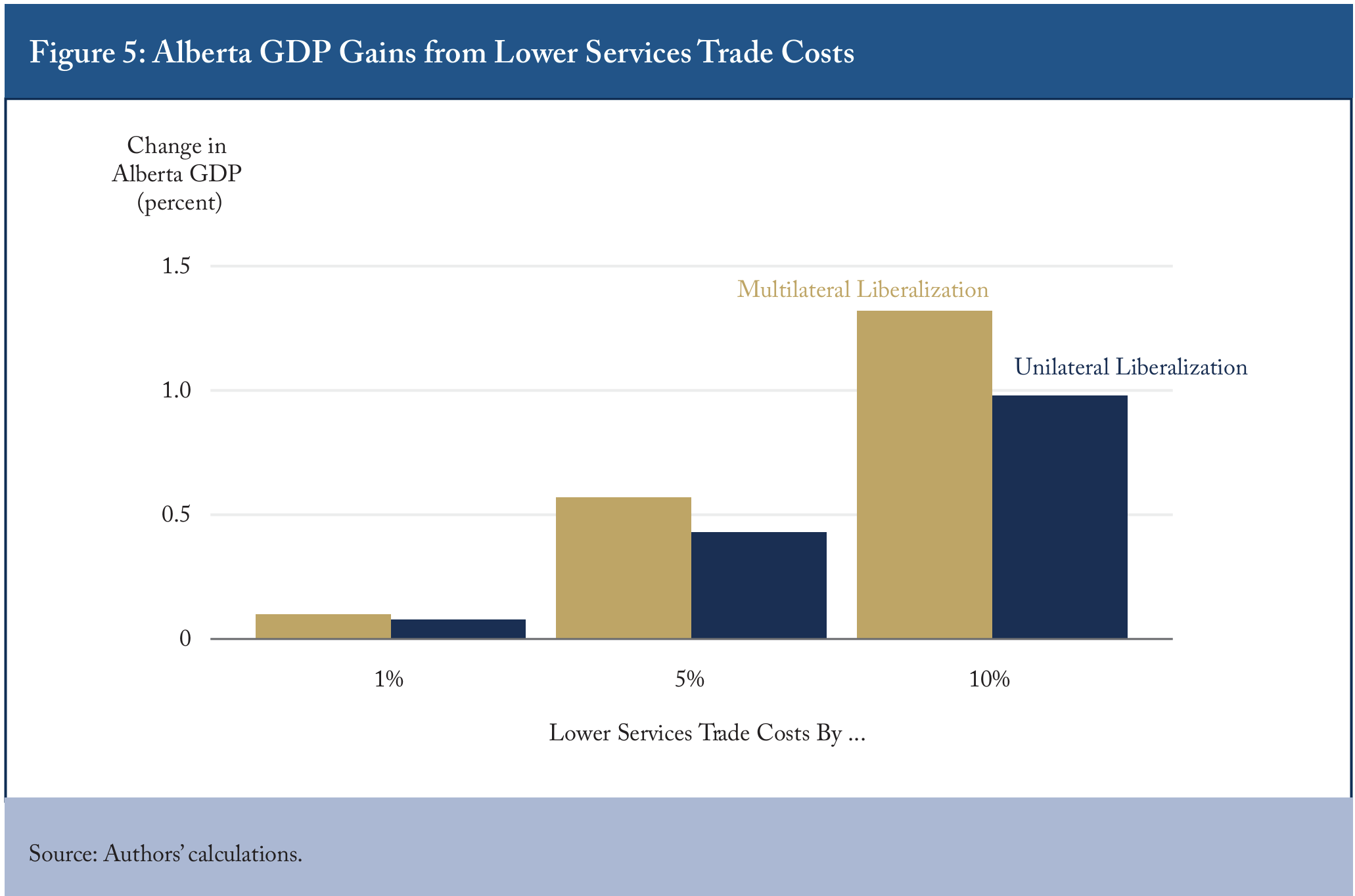
In addition, the study shows that there is a close connection between fostering increased labour mobility and lower barriers to trade in services. For each 1 percent reduction in the cost of importing services from other provinces, we find Alberta’s economy grows by nearly 0.1 percent. For a 10 percent reduction in services-trade costs, GDP gains approach 1 percent – equivalent to nearly $3.5 billion per year.
The reforms we propose would facilitate mobility for employees and entrepreneurs alike. In short, when Canadians can move from one province to another with minimal barriers, the country as a whole benefits.
Introduction
The COVID-19 pandemic is the most severe global economic shock since the Second World War. Even worse, its effects are not uniformly distributed.
Some sectors – namely those where physical proximity is a necessity such as food service, retail, education and so on – are hit harder than others. And because slower global economic activity lowers fuel demand and, therefore, energy prices, regions where commodities are an important driver of economic activity – such as Alberta – potentially face a more challenging recovery.
Meanwhile, labour mobility across occupations, sectors and regions is an important way in which economies can respond to shocks. Therefore, flexible labour markets and policies easing potential barriers to mobility are an important consideration for governments as we gradually recover from the pandemic and associated lockdown. This is particularly important for resource-rich Alberta.
Migration into and out of Alberta is particularly sensitive to economic conditions, but also subject to provincial policy. Using Statistics Canada data on inter-provincial migration flows, which we illustrate in Figure 1, we find that the number of workers moving to Alberta rises and falls with employment opportunities in the province and is ultimately strongly correlated with oil prices. When oil prices fall, such as they did in the mid-1980s, during the 2008/09 financial crisis and the more recent 2015/16 recession, Alberta in-migration markedly declines. Today, migration inflows have gradually recovered to nearly 20,000 in the first quarter of 2020 or over 2,500 more than outflows that quarter. This represents a recovery from net outflows of nearly 3,500 three years prior, driven largely from increases in the number of people moving into Alberta rather than decreases in the number of Albertans leaving.
In fact, we find that more than 75 percent of the variation in net interprovincial migration into Alberta (in-migration less out-migration) is accounted for by changes in the volume of the in-migration component.11 This is inferred from a regression of net inflows on in-migration, which finds a coefficient on inflows that is not statistically different from one and an R2 of 0.7585. In other words, while swings in the Alberta economy lead to strong changes in the number of people moving into Alberta from other provinces, the number of people leaving the province is less responsive to those swings. This suggests that Alberta might want to consider easing the ability of workers to move into the province as a policy option to mitigate the kind of net outflows that occur when economic conditions are relatively weak. Migration decisions, after all, are like most decisions: incentives matter. High income earning opportunities and high quality of life matters, as it increases the benefits of moving in. But the costs of making a move will matter too, and lower costs can affect the cost/ benefit trade-off that individual workers make when contemplating a move.
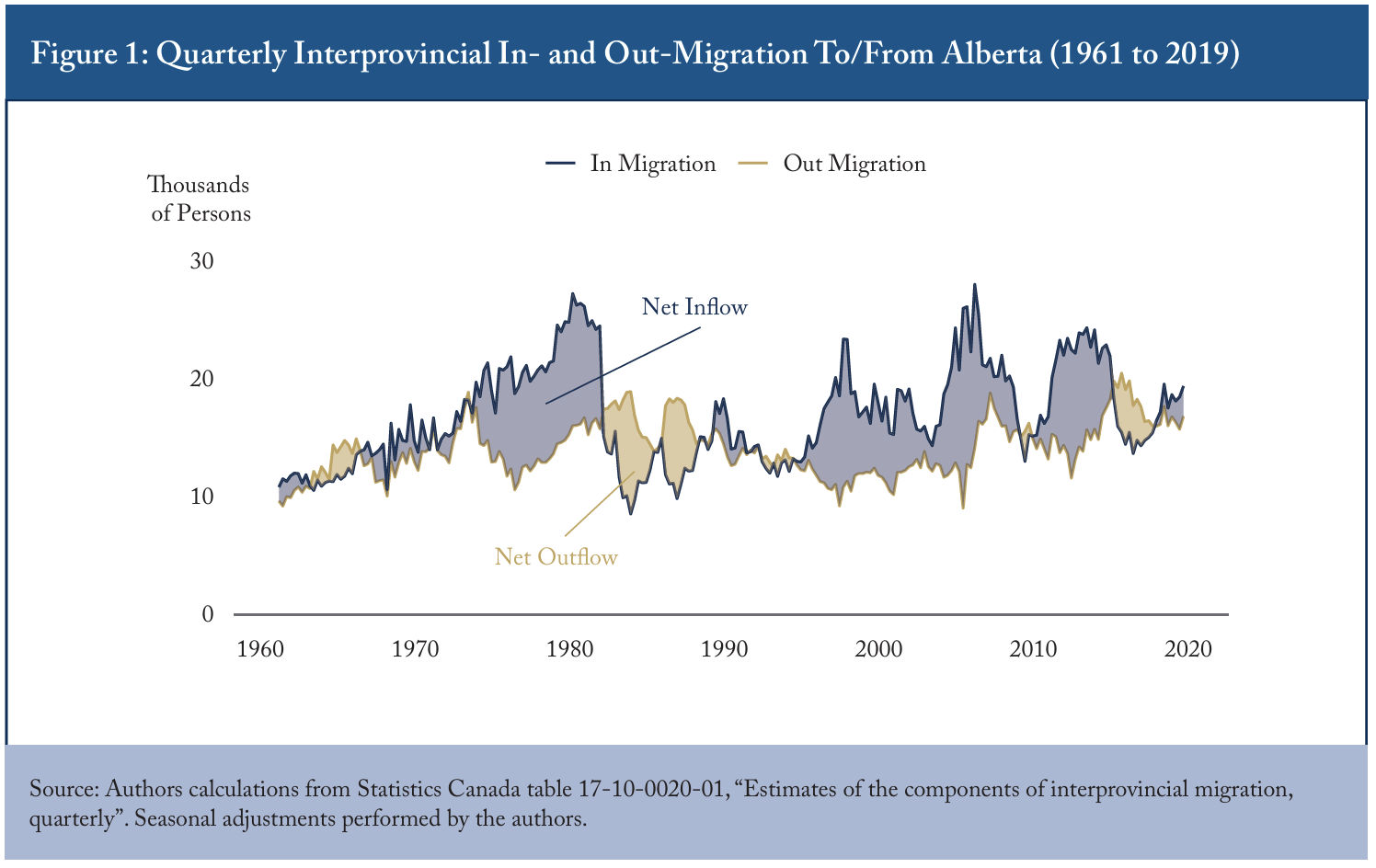
As Alberta comes out of the COVID-19 pandemic and economic lockdown, policies that make it easier for workers to move into the province could mitigate the potential for net outflows if its economic recovery lags other provinces. To the extent that global energy markets might remain sluggish for some time to come, this is an important consideration for the provincial government, particularly as international migration has slowed as a result of the pandemic.
Alberta, in short, can promote economic revival and long-term economic growth by ensuring that it is the most welcoming jurisdiction to talented workers and entrepreneurs from across Canada. There are two strands to such a strategy: the first is to ensure that Alberta residents can make the best of economic opportunities from within the province, which includes opening trade to and from the rest of Canada and the world. This productive use of talent ensures higher incomes, which attracts more talent.
The second measure is to address obstacles that other Canadians might face in moving to the province. As we will see, there is a link between these two strands, particularly when it comes to trade in services.
Below we quantify the potential gains in terms of economic activity derived from more workers moving into Alberta. We show that these gains can be large and that they can be induced by reductions in moving costs equivalent to as little as a few percentage points of an individual’s annual income. Specifically, for each 1,000 additional workers that move into Alberta in response to lower migration costs we estimate Alberta’s economy grows by $141 million. And if migration costs fall by 1 percent across the board, we estimate gains of nearly $9 billion. We also suggest other measures that could reduce the obstacles to them potentially making such a move. In particular, Alberta could do more to simplify the recognition of credentials held by potential movers from other provinces, by unilaterally recognizing such credentials or equivalent experience, or expanding the use of mutually recognized designations with other provinces to professions as well as to trades. It could help make the economics of moving to Alberta more attractive, notably by promoting easier trade in services. As we will demonstrate, the additional gains from services trade liberalization from such reforms are also large. For each 1 percent reduction in the cost of importing services from other provinces, we find Alberta’s economy grows by nearly 0.1 percent. For a 10 percent reduction in services-trade costs, GDP gains approach 1 percent – equivalent to nearly $3.5 billion per year. Finally, the costs of moving between provinces often extend beyond pure occupational or financial considerations, to include the difficulty of moving away from one’s community or facing linguistic barriers. The government should consider lowcost measures to help individuals feel at home in Alberta while maintaining connections with their communities of origin as part of a plan to attract out-of-province workers and entrepreneurs.
We begin our analysis by establishing the potentially large gains from such actions – both unilaterally and multilaterally. Specifically, we first document the current pattern of interprovincial migration observed in the data. Second, we provide some intuition around our main quantitative model of the Canadian economy that is used to estimate gains from labour mobility. Third, we discuss our resulting estimates of the gains from lower migration costs in terms of overall economic activity, the composition of activity, and the potential additional gains from inevitable services- trade cost reductions that may result from policy reforms that recognize out-of-province credentials. Having established the potentially significant gains from interprovincial migration, we conclude our report by a detailed discussion of policy options available to Alberta and, indeed, to all provincial governments as well as Ottawa.
Economic Gains from Lower Migration Costs
Our quantitative analysis is separated into two exercises. First, we ask what potential effect eased labour mobility costs have on economic activity in Alberta and throughout Canada. Labour mobility has been an important part of economic development in Western Canada since before Confederation. Labour is an important factor of production, and the knowledge and skills workers bring with them are a potentially important contributor to productivity growth.
Second, we examine how policy reforms that ease labour migration often also make simpler the hiring of out-of-province suppliers. Government reforms to ease regulations on provincial professional certifications and standards, or recognizing credentials issued by other provincial governments, not only makes moving into a province easier but can also allow Alberta businesses and consumers to access service providers in another province. We quantify these gains by estimating potential economic implications of lower services-trade costs.
In this section, we provide a high-level summary of labour migration patterns in Canada, a description of the quantitative model we deploy and discuss the results of various policy experiments. We begin with a brief overview of inter-provincial migration patterns.
Inter-Provincial Migration Patterns
Migration is central to Canada’s economic development, especially in the West. International immigration, especially around the turn of the 20th century, created the early conditions for Alberta and Saskatchewan to thrive soon after entering Confederation together in 1905. Interprovincial migration was no less important. Between 1901 and 1911, the number of Canadians living outside of their province of birth nearly doubled, increasing from 5.3 percent to nearly 10 percent (Statistics Canada 2018). By that time, more than half (54 percent) of Canadian-born Albertans were born in another province. In Saskatchewan, this share was nearly 58 percent. Over a century later, Alberta remains a primary destination for Canadians. Today, roughly one in three Canadian-born Albertans was born elsewhere. There is a similarly large share in BC. And nationally, 15 percent of Canadian-born individuals live in a different province from the one of their birth (Statistics Canada 2018).
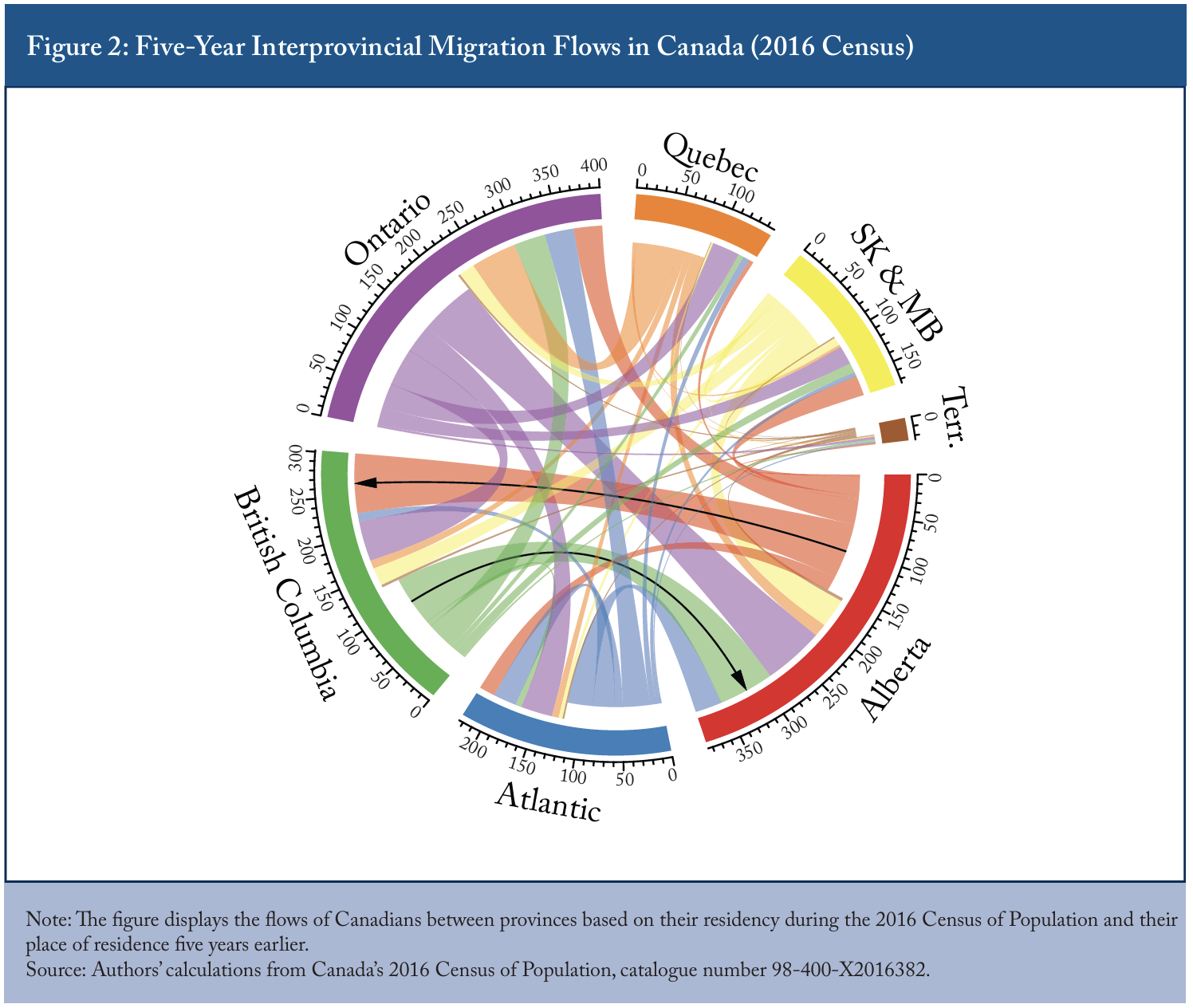
In recent years, the Census of Population provides rich data to illustrate the complex migration flows between Canada’s provinces. Each year, according to the latest data, some 270,000 Canadians move from one province to another. Three provinces – Ontario, BC and Alberta – account for two-thirds of the chosen destinations, with Alberta proving the top destination in the five years to 2016. We illustrate these interprovincial flows over five years in Figure 2, and these data form the basis of the quantitative analysis to come.
As noted, flows between provinces disproportionately involve three provinces: Ontario, Alberta and BC. (Despite its size, Quebec accounts for very little in inflows and outflows, which illustrates that language and cultural differences are an important barrier to interprovincial mobility.) Alberta also noticeably stands out in terms of how much inflows exceed outflows. Between 2011 and 2016, some 67,000 more individuals moved into the province than out to other provinces. This was nearly twice the net inflow as BC, the second largest net inflow province.
Importantly, migrants are also disproportionately young people. Approximately half of interprovincial migrants between 2016 and 2011 were between 20-to-40 years of age. This is roughly double the share of the total population accounted for by this age group. Such individuals are vital contributors to provincial economic activity. Primarily, more labour will disproportionately increase output in labour-intensive sectors, such as service-producing industries. This is not a new finding in our report and reflects a well established result in the international trade literature found in a variety of models. In addition, more workers in a province will also mean that it tends to become a larger supplier of goods and services to buyers both at home and abroad. Clearly, understanding the costs these workers face and the potential economic gains from lowering these costs is an important policy issue.
However, estimating migration costs is challenging. Various factors affect individual decisions about where to live and work. The goal of our research is not to measure or identify the potential magnitude of migration cost changes that may be feasible, but to quantify the potential gains from various degrees of migration liberalization. But, as we demonstrate, the observed data on migration flows serve as a sufficient measurement of many important (but often unobservable) factors. Our quantitative model is flexible enough to accommodate whatever migration costs might exist and provide insight into potential GDP and employment gains from lowering the interprovincial moving costs. Our focus will be on Alberta, where the scope and willingness for policy reforms is greatest, though we will identify the potential gains from both unilateral reductions in migration costs and gains from all provinces working together. But first, a little detail on the model is necessary.
Gains from Lower Migration Costs
Before proceeding to our main model results, some simple intuition of a key driver of the economic gains from migration may be helpful. In a simple world where all output was produced using only labour according to a simple and linear production technology Yi = Ai Li , then each additional worker would increase total output in province i by Ai . That is, each migrant increases GDP by the marginal product of labour. In Alberta, nominal labour productivity measured as GDP per worker is nearly $150,000 per year. Therefore, a simple estimate of the GDP gains from migration would be $150,000 per year per migrant. But this is an overestimate. In a model that includes trade flows, such as the one we use here, there are some diminishing returns. More workers will increase the variety of goods and services produced, and slightly lower productivity as producers will begin to operate at the margin. This will consequently lower the average per-worker productivity somewhat and partially (but not fully) offset some of the gains from migration. Our model accounts for these indirect effects of migration.
Using our quantitative model of Canada’s economy and interprovincial trade and labour mobility, we estimate the gains from lower migration costs. Though our results vary somewhat across different ranges of migration cost reductions, we estimate that lower migration costs increase Alberta’s GDP by more than $141 million per 1,000 additional workers that move in. These permigrant gains are roughly stable over a wide range of migration-cost changes and migration-volume responses. It is, therefore, a convenient rule of thumb for policy purposes.
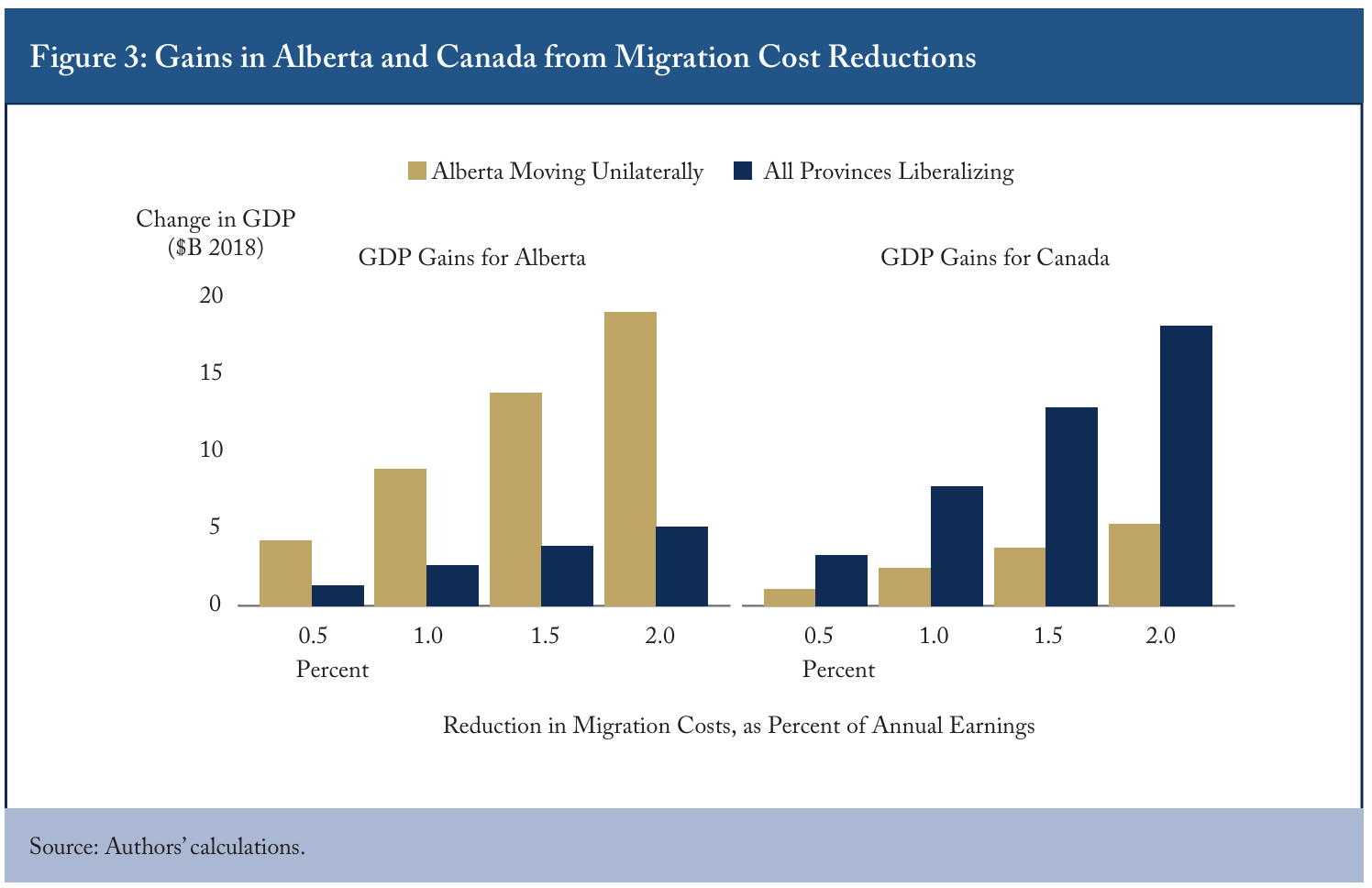
If the cost of moving to Alberta declines by one-third of 1 percent (the equivalent of $500 per year) then we estimate roughly 20,000 additional workers will migrate to the province and the overall provincial GDP would increase by $2.8 billion – or just more than 0.8 percent. This is large. If migration costs decline by the equivalent of 1 percent of annual income, then the province’s GDP increases by nearly 2.6 percent or nearly $9 billion. And the gains increase from there. We illustrate a variety of scenarios in Figure 3.
While some of Alberta’s economic growth due to migration inflows comes at the expense of other provincial economies – after all, workers moving to Alberta are no longer working elsewhere – there are aggregate gains for Canada as a whole. Economic activity is not merely shifted between provinces, but aggregate national productivity increases as well. We estimate that national productivity gains amount to 0.26 percent for each percentage point of national employment that migrates between provinces. If migration costs into Alberta fall by the equivalent of 1 percent of annual earnings, then national GDP gains approach $2.5 billion or just more than 0.1 percent. And while there are aggregate reductions elsewhere from having fewer workers, the per-worker GDP increases (very modestly) in the rest of the country.
Such a beggar-thy-neighbour effect from a single province unilaterally easing in-migration costs can be mitigated by all provinces reducing these costs together. In this case, Alberta still sees significant gains – though substantially smaller than if it moves on its own. This is due to fewer workers moving into Alberta if the cost of moving into other provinces also falls. For reductions in migration costs equivalent to 1 percent of earnings (relative to earnings in each destination province individually), we estimate Alberta GDP gains 0.8 percent ($1.3 billion) and national GDP gains 0.4 percent ($3.3 billion). In the right panel of Figure 3, we illustrate a range of national GDP gains across a variety of migration cost-reduction scenarios.
The gains in well-being are not necessarily fully captured by changes in real GDP statistics – indeed with lower barriers to moving, people have the added benefit of being able to live where they want, as distinct from the benefits of the GDP or income they generate. Though much more sensitive to modelling assumptions than our real GDP estimates, we follow existing methods published in the recent research literature to estimate this overall gain in well-being. We estimate aggregate welfare gains of 0.03 percent for each 1 percent reduction in migration costs nationally. For reductions equivalent to $500 per year in migration costs, we estimate 0.5 percent national gains compared to 0.07 percent if only Alberta were to liberalize. The 0.5 percent gains are equivalent to nearly $12 billion in aggregate real household consumption while 0.07 percent gains are equivalent to more than $1.5 billion. Though both are meaningful increases in well-being, the large difference between the welfare effects of national liberalization relative to a single province’s unilateral moves stems from individuals being better able to live where they prefer. These are distinct gains from aggregate changes in real GDP and economic activity.
Effect on the Composition of Economic Activity
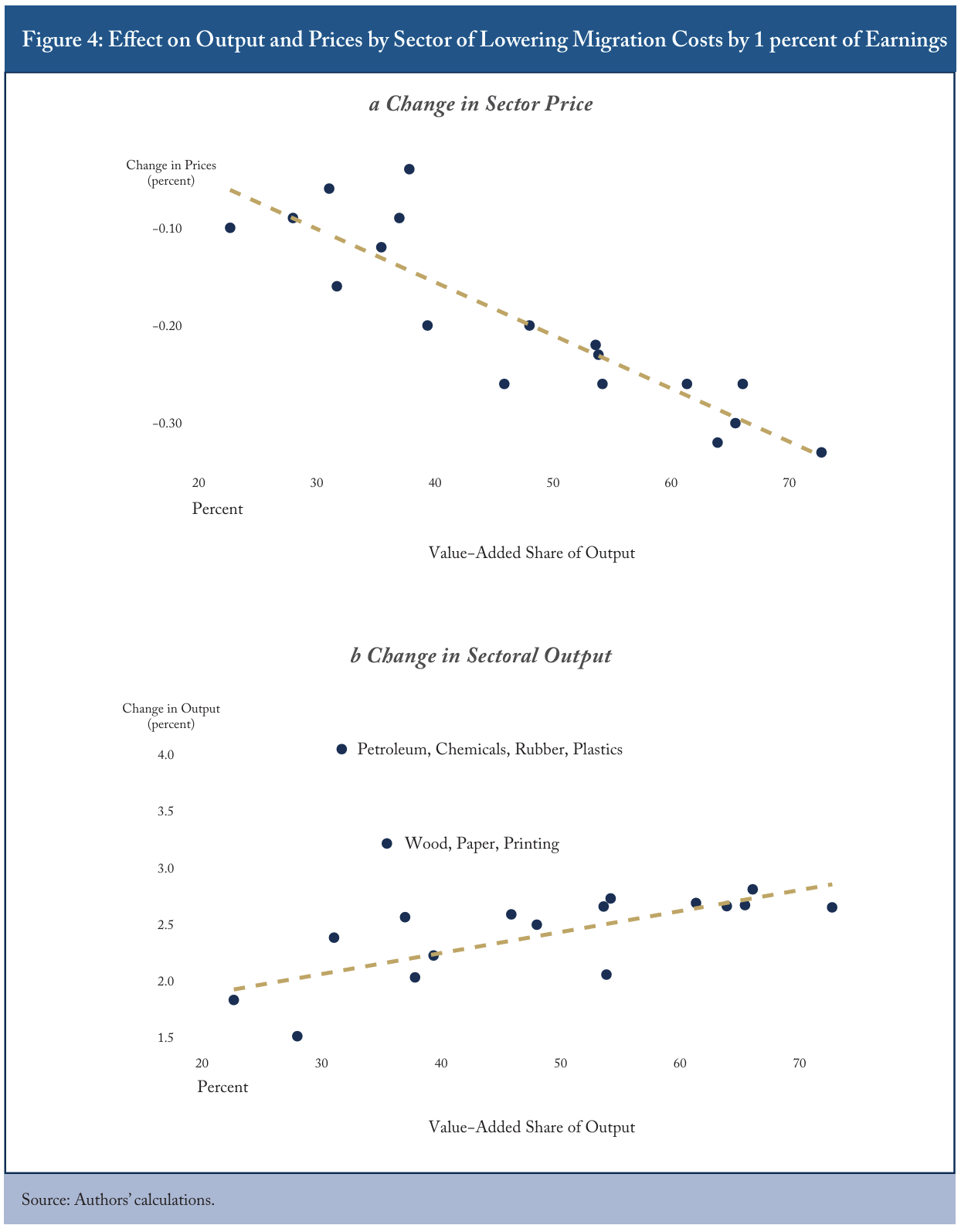
Finally, we find that provincial migration-cost changes can have important implications for the composition of economic activity within that province. An increase in a region’s total labour supply will, after all, affect different sectors differently. Those sectors that tend to use more primary factors, and labour in particular, will experience a greater decrease in production costs than sectors that do not. This cost reduction will lower prices disproportionately among sectors with high value-added shares of output (that is, using relatively fewer intermediate inputs as a share of output), as illustrated in Figure 4 (a). These cost reductions are largest among service-producing sectors. Among those, prices fall on average by nearly 0.3 percent if Alberta lowers migration costs by the equivalent of 1 percent of earnings. Among goods-producing sectors, the average price reduction is roughly one-third lower, averaging just more than a 0.1 percent reduction.
Lower production costs and prices lead to increased output. Both exports and within-province sales increase. This effect is larger in serviceproducing sectors, but also for petrochemicals, plastics, rubber, wood product manufacturing and other energy intensive sectors, which are driven by larger exports. Not only does the additional labour in Alberta increase these goods-producing sector’s competitiveness to buyers elsewhere, they produce fairly homogeneous products and therefore trade flows are more sensitive to such changes than many other sectors. Put another way, the elasticity of trade for these sectors is high, and therefore changes in price have a larger effect on trade flows.
Gains from Lower Services-Trade Costs
Easing regulatory barriers to the movement of people not only makes moving into a province easier, it also helps businesses in that province access suppliers located elsewhere. International trade agreements – such as the CUSMA as successor to the NAFTA in this respect, or the CPTPP – increasingly include provisions to facilitate the ability of workers to travel temporarily and perform services across borders. Accessing certain skills or specialized knowledge often requires the ability to hire service providers elsewhere. And, more generally, certain service providers in other regions may have a comparative advantage that local businesses would benefit from accessing, in that accessing these complementary skills would make them more competitive. And movements that are temporary at first can turn into permanent migration.
The scope of services-trade liberalization is large. Trade costs in services tend to be larger than for goods. Recent work by Albrecht and Tombe (2016) estimates trade costs between provinces and separately reports estimates by province and sector. This analysis finds that costs attributable to services-trade policy barriers average between 12 percent and 47 percent, depending on the estimation method.22 While relatively high tariff-equivalent internal trade costs, these estimates do not imply that trade costs have not been falling. Technological change, such as e-commerce and modern telecommunications, makes services trade easier. Estimates in the literature attempt to identify policy-relevant barriers by controlling (albeit imperfectly) for more fundamental determinants of trade costs. In a separate analysis, Alvarez et al. (2019) find that trade barriers that are unrelated to geographic factors (such as distance, which is clearly important in Canada) range between 35 percent to 74 percent across various service sectors. These barriers not only raise business costs but also lower productivity throughout Canada.
To quantify the gains from increased services trade, we use the same model as Alvarez et al. (2019). (This model also drives our estimates of labour-mobility gains.) In brief, the model features firms that maximize their profits in the face of frictions around their ability to purchase input from suppliers located elsewhere. Costs to trade across provincial or international borders induce firms to purchase a larger share of inputs from local suppliers, even if those suppliers are not the ideal choice were it not for the trade costs. Regions differ in their comparative advantage, so trade costs that favour local suppliers might inhibit provincial economies from expanding more in areas where they have relative strength and shifting resources out of areas where they do not.
We simulate the effect of changes in trade costs by solving for the counterfactual trade flows, production, prices, wages, employment and so on, given an exogenous change in trade costs between regions. Specifically, we quantify the effect of lowering the cost of importing services into Alberta by 1 percent, 5 percent, and 10 percent. These are modest trade-cost reductions, well below the cited estimates of current policy-relevant trade costs. These cost changes have implications not only for Alberta’s GDP but also affect worker-migration decisions – potentially attracting workers. After all, as productivity increases from liberalized services trade, so too will real wages and, therefore, the attractiveness of Alberta for individuals currently residing elsewhere.
We find significant economic gains from liberalizing services trade, both through unilateral moves by Alberta and multilateral moves with provinces acting together. We illustrate a range of scenarios in Figure 5. For each 1 percent reduction in the cost of importing services from other provinces, Alberta’s economy grows by nearly 0.1 percent. For a 10 percent reduction in services-trade costs, GDP gains approach 1 percent – equivalent to nearly $3.5 billion per year. When all provinces liberalize, the gains are somewhat larger. Gains to Alberta’s GDP when all provinces lower services-trade costs by 10 percent are roughly 1.3 percent. Therefore, unilateral action yields roughly three-quarters of the available gains from services-trade liberalization.
To be sure, these are uniform reductions in services-trade costs. For completeness, we also estimate the gains by lowering specific servicestrade costs by 10 percent of the Alvarez et al. (2019) measurement. This results in different degrees of liberalization across provincial trading pairs and across sectors. We find that under this method unilateral liberalization by Alberta increases its provincial GDP by 0.25 percent (or nearly $1 billion per year) and the national economy by 0.08 percent. If all provinces liberalize services trade, Alberta’s GDP gains increase to 0.4 percent and national gains equal 0.5 percent.
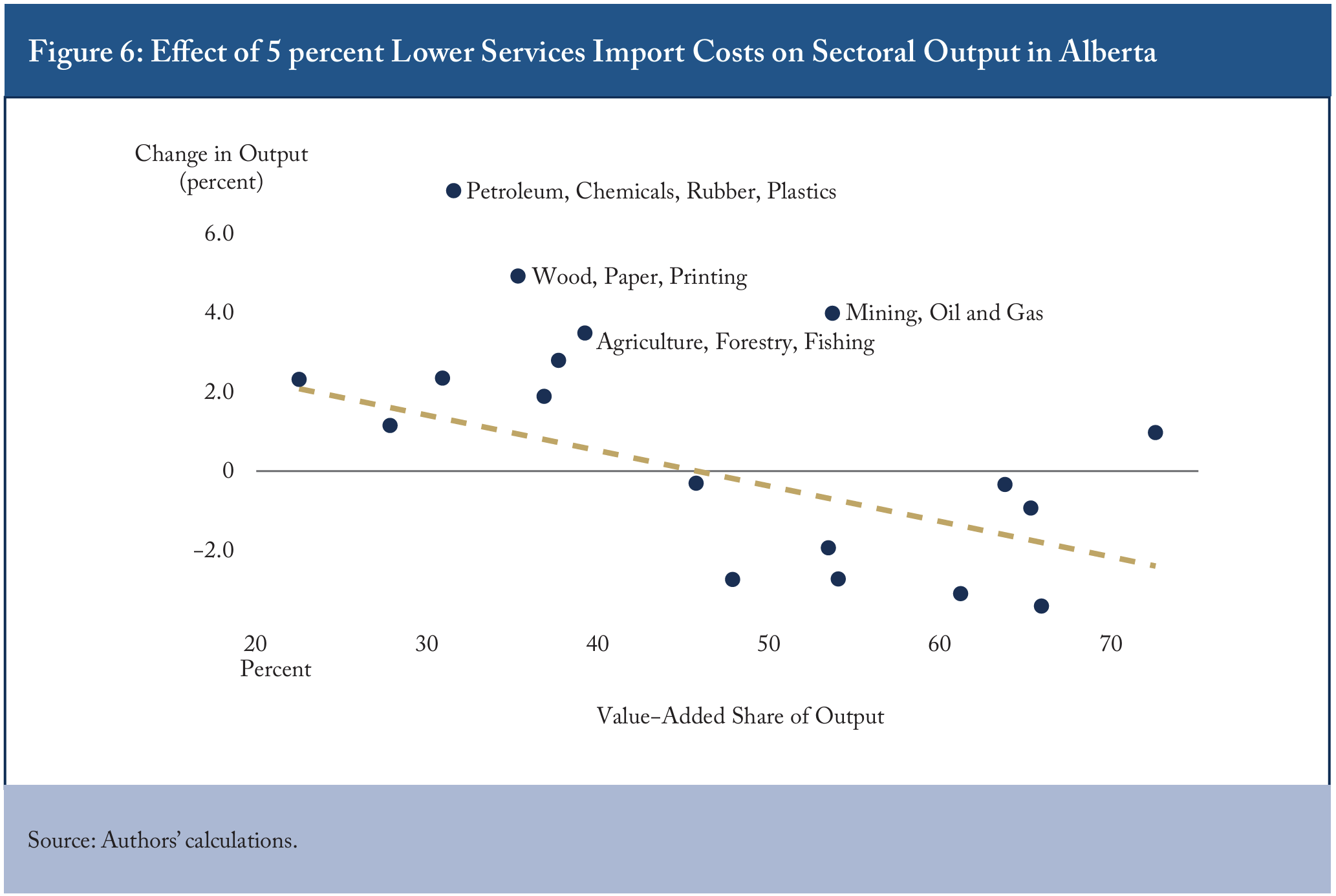
There are also differential effects across sectors from lowering services-trade costs. Sectors that use few intermediate inputs (most service sectors) gain less than sectors that use more. Lower-priced access to services inputs, after all, benefits those who buy more services initially. As those sectors expand, they also attract workers and capital from other sectors. As a result, there is a shift in economic activity away from services and toward goods-producing sectors. More specifically, there is a shift away from sectors with high value-added-to-output ratios toward sectors with low value-added to output. We display this effect in Figure 6.
Liberalizing services trade may also affect labour migration. Lower-cost access to services inputs can lower prices and increase productivity, making Alberta a more attractive destination. The model captures some of this reallocation of labour and employment. We estimate that lowering Alberta’s services-trade costs by 10 percent increases employment by more than 2,500. Though a modest change, it is nonetheless a potential consequence of services-trade liberalization that policymakers should consider when evaluating the costs and benefits of reform.
Achieving Lower Migration Costs
As we saw, mobility allows workers to earn more and, as a result, become more productively employed. When a worker moves within Canada for this reason, there is also value for Canada’s economy as a whole. Of course, as with most policy changes, the gains are not evenly distributed and some provinces may even lose. Those who benefit from job-qualification protection and lower labourmarket competition, for example, may naturally be inclined to prevent others for vying for a similar job and, therefore, may resist reforms that would ease barriers to migration.
Still, to be sure, some regulations that may hamper mobility serve legitimate public-policy objectives, such as safety or consumer protection. Differences in standards and regulations across jurisdictions may, for example, reflect different objective circumstances or degrees of risk tolerance But they may also simply reflect idiosyncratic design choices and historical path dependency, rather than consciously distinct policy objectives. Thus, trade agreements (such as Canadian Free Trade Agreeent (CFTA)) include mechanisms that allow parties to the agreement to challenge the basis on which another party introduces or maintain standards or regulations that are different than those more those commonly accepted among their trading partners, or to pro-actively examine a suite of differences between them regarding a type of standard or regulation, to eliminate those not required by objective circumstances or different risk tolerance. In trade parlance, the goal is to get rid of differences that are really disguised trade restrictions. Barriers to mobility in some occupations that have anti-competitive effects, favouring incumbents at the expense of potential new entrants, ultimately do not benefit overall the jurisdictions imposing them. Such obstacles make it harder for any Canadian to ply their profession, trade, practice or business within Alberta, or vice-versa for Albertans in the rest of Canada.
To be clear, increased labour mobility is not a good in and of itself. It is, if you will, a means to an end. Its value lies in the potential it offers for individuals, businesses and societies to improve their economic situation and in the gains such moves may have for economies overall. On the contrary, policies that force interprovincial trade and migration may produce greater flows but may minimize the potential economic gains. Similarly, reduced people flows may also be entirely appropriate if they result from more balanced economic opportunities between regions, or from better job-market information resulting in fewer unsuccessful migrations.33 Another corollary is that policies that discourage workers in a high-unemployment region from moving to where there are more opportunities run counter to the goal of promoting higher incomes across Canada, and are also obviously detrimental to jurisdictions that would otherwise receive more internal migrants. In contrast, policies that successfully promote economic development in a high unemployment region are a good thing for the country, even if they have the incidental effect of lowering mobility out of that region.
Indeed, Kaplan and Schulhofer-Wohl (2015) suggest that the recent decline in internal migratory flows, a phenomenon observed in Canada and in comparator jurisdictions such as the US, Australia or the European Union, can be explained by these two factors – balanced economic opportunities and better job-market information – and not by new barriers or by factors such as population ageing and the greater prevalence of working spouses, explanations favoured in other studies they review
Consider, also, that the growth in digital trade (including e-commerce) and the greater ease of telecommuting, which have come to the fore during the COVID-19 global pandemic, or of offering services from an out-of-province location such as “fly-in-fly-out” work arrangements, may result in more out-of-province workers being able to work for employers in a province without moving there permanently. These trends mean that capturing the benefits of worker mobility, that of skilled services workers in particular, require looking beyond rules and regulations that affect physical movements, to how they can affect the remote provision of outof-province services (both by workers residing in Alberta able to offer services in other jurisdictions, and workers in other jurisdictions able to offer value to Alberta customers).
In general, services-trade liberalization has a positive impact on living standards partly because it helps to rationalize services offerings across provincial borders, lowering costs while raising incomes. Such services liberalization may attract workers to a province when it is more economical to offer a service across a region or the entire country from that province. It will likely also mean some other services would be more rationally offered from outside the province – in which case the positive impact would be indirect through lowering costs for those using the service within a province, fostering growth and attracting workers to other sectors in that province.
In short, the focus should be on policies that artificially distort migration decisions away from what would otherwise have been beneficial moves.
The existing research literature that attempts to estimate barriers’ impact on mobility has used the difference between mobility predicted by broad factors such as differences in average incomes between provinces and the distance between them, and actual mobility. Analysts then seek to explain the difference between actual and predicted mobility44 Including, in some studies such as Amirault et. al 2013, after carefully controlling for different mobility propensities within each province. in terms of various barriers. The literature suggests that these barriers are of four broad types (see, for example, Alvarez et al. 2019, Amirault et al. 2013, Australia 2014, Baas et al. 2014):
- policies that make it difficult for a person from outside a jurisdiction to ply their trade inside that jurisdiction, even though they have the right and would choose to move there;
- monetary costs of moving, for an individual or family, that can be straightforwardly weighed against the monetary benefits of doing so; • sociolinguistic factors that make people prefer to be close to their community of origin, or impede their integration in a destination community;
- regionally differentiated national income support policies or hiring practices that discourage the movement of individuals toward regions where they might be more productively employed, or conversely require them to leave those regions.
The first two are barriers that make it difficult for workers to move who otherwise would have, while the last two can be considered factors that attach people to their home province even though it might be good for them to leave for job-related reasons.
An Alberta strategy to encourage in-migration should begin with the first two. It could first address formal, policy-supported barriers that impede the ability of in-bound qualified individuals from exercising a trade or profession. Many of the most egregious barriers have already been removed in the past 25 years or so. As we will see, the work that remains in this category is occupation or industryspecific. If not done as part of a national standardsetting effort, progress here may involve unilaterally aligning occupational and related (e.g., safety) standards with those elsewhere.
An effective strategy would also include policies that can improve the benefit/cost ratio for potential movers (the second factor). To accomplish this, a complementary strategy of services liberalization would help – not only, as alluded to, by fostering a more efficient allocation of skills and stimulating exports, but also by potentially changing the economic calculus for individuals contemplating a move, in favour of mobility. This would be the case, for example, if trucking transportation rules and their application were harmonized across the country, decreasing the physical moving costs.
More generally, removing barriers to competition in transportation and communications industries, or barriers to housing supply, would help lower the financial cost of moving or of keeping connected with one’s community of origin – this speaks to the third factor, whose analysis runs well beyond the scope of this paper and the focus on formal barriers, but nevertheless represents such a deep reservoir of potential movers that Alberta should contemplate these and other possible approaches discussed below, to tap into it.
The fourth factor, while certainly important in many contexts and for many individuals, is also beyond the scope of our formal analysis, although we will suggest below that the impact of public programs on Alberta employment be looked at more systematically. We will note here that easing the disincentive to move to place of higher economic opportunities may involve reforms to broad national income support and transfer programs that currently lean against mobility. For example, Busby and Gray (2011) find that differentiated Employment Insurance benefits in different regions likely militate against unemployed workers in a high unemployment region upskilling or moving to higher employment regions. Tombe and Winter (2020) find similar effects across the whole range of fiscal transfers in Canada.
With this broad context in mind, we now turn to current efforts to facilitate labour mobility and what remains to be done.
Eliminating Formal Barriers: The State of Play
While Canadians’ mobility rights are enshrined in Section 6 of the Canadian Charter of Rights and Freedoms, they do not override provincial legislation regarding occupational licensing or trades. With provinces exercising or delegating their regulatory authority over who can or cannot practice a number of professions or trades within their borders and the recognition of occupational designations, a mishmash of occupational standards, credentials and licensing regimes has evolved across Canada. For example, Alberta regulates (or in a few cases plans to regulate) 36 health, education and legal professionals, along with 21 other professions. As well, it requires certification of those working in 18 different trades and occupations and provides optional certification in 29 other trades and occupations.55 Certificates for distinct specialization are either required or offered for a number of these, for a total of 65 distinct certificates. Across Canada, there were as of 2017 over 600 different regulatory organizations overseeing more than 200 regulated professions and over 300 skilled trades (Canada 2017, p. 5). This situation had resulted in material obstacles to mobility, notably, the need to retrain or take duplicate courses or exams when moving between provinces, affecting many professions and trades alike.
Momentous international trade agreements entered into by Canada such as the NAFTA (concluded in 1992, which was replaced by the CUSMA concluded in 2018) and the Uruguay Round of GATT negotiations which created the WTO (concluded in 1993), highlighted that these professional barriers and other obstacles to internal trade limited Canada’s ability to compete – to earn high incomes – in this era of increased global integration. Accordingly, Canadian governments, including the federal government, were spurred to launch into negotiations to remove these barriers.
These negotiations resulted over time in several intergovernmental agreements and programs aimed at reducing formal mobility barriers. The main overarching one is the Canadian Free Trade Agreement (CFTA), which came into effect on July 1, 2017, succeeding the Agreement on Internal Trade (AIT) that had come into effect on July 1, 1995. The CFTA was preceded by a key regional intergovernmental agreement, the New West Partnership Trade Agreement (NWPTA) among Alberta, BC and Saskatchewan, which came into effect on July 1, 2010, with Manitoba joining effective January 1, 2017.
The NWPTA, in turn, partly built on the pioneering 2006 Trade, Investment and Labour Mobility Agreement (TILMA) among the same two provinces plus Saskatchewan. The TILMA aimed to reconcile occupational standards or, if not, then mutually recognize them so that workers did not need to “go through material examinations or training to practice their chosen occupation.”
Nationally, while some progress on labour mobility had been made under the AIT, it suffered from some major defects, notably its positive list approach – open trade only in sectors or for activities explicitly listed – and a weak dispute settlement mechanism.66 In contrast, the TILMA and NWPTA, and subsequently the CFTA, adopted a more comprehensive so-called “negative list” approach – rules such as non-discrimination governing open access to each of the signatories’ markets must apply, except in cases explicitly listed in the agreement – and access to stronger dispute settlement mechanisms must be available (on the latter see Manucha 2020). Still, with respect to labour mobility, the AIT spelled out multiple obligations for provinces to mutually recognize professional and occupational standards – including by seeking compliance from self-regulating professional bodies to which provinces delegated their authority. The question was more whether these obligations were followed up upon. While patchy, the AIT mutual recognition process bore some significant fruits. As well, many Canadians started invoking, with respect to labour mobility, the AIT’s general dispute settlement mechanisms (Grady and Macmillan 2007).77 This includes the infamous dispute between the then-Certified General Accountants of Canada and Chartered Public Accountants (CGA), centered around scope of practice, with Manitoba supporting the CGA and Ontario supporting the exclusive ability of the CPA to sign audited financial statements. Tellingly, perhaps, for the future of mobility in Canada, the dispute was ultimately resolved by the two organizations merging.
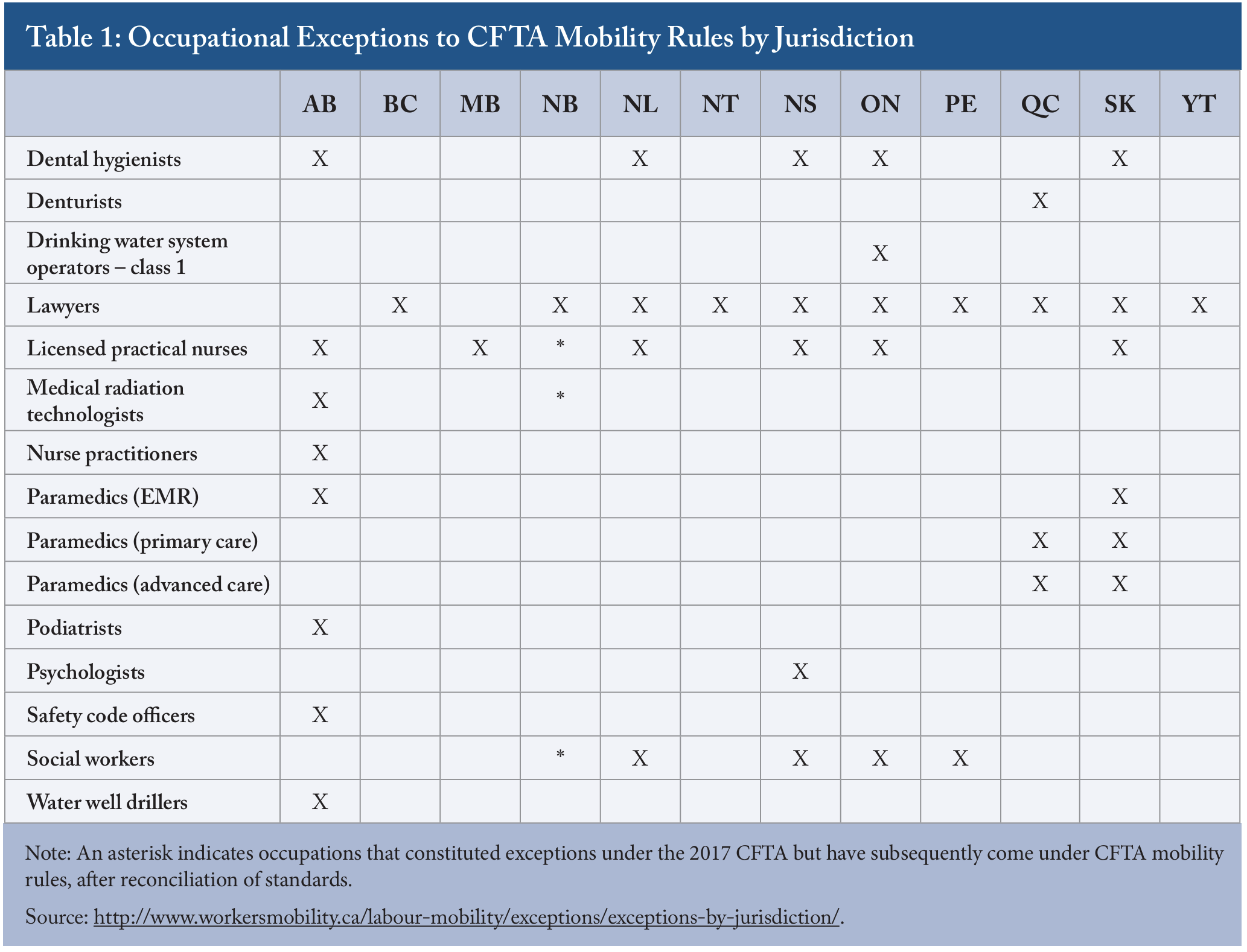
Spurred by the TILMA’s fundamental new approach, the Forum of Labour Market Ministers (FLMM), which promotes cooperation among federal, provincial and territorial labour ministers, developed a plan to improve on the AIT’s labour mobility chapter (Grady and Macmillan 2007). These improvements, which like the TILMA, came into effect in 2009 “guaranteed that workers certified for a regulated occupation in one [province or territory] will, upon application, be certified for that occupation anywhere in Canada.” (Canada 2017) This guarantee was essentially carried into the CFTA, which holds that certified workers in regulated occupations can work anywhere in Canada without further training, testing or assessment. Under the “negative list” principle, this rule applies except for a small number of occupations where there are significant variations in occupational standards between some provinces and territories (Table 1).88 The table is drawn from the list of exceptions maintained by the Mobility and Qualification Recognition Working Group (MQRWG) established under the CFTA. These exceptions can be maintained when the differences in certification requirements or occupational standards are significant and justified by a legitimate public policy objective. See: http://workersmobility.ca/labour-mobility/exceptions/. They are therefore not technically exceptions to the CFTA itself, and indeed the table shows that previously claimed exceptions to the overall mobility rules can be dropped following the reconciliation or mutual recognition between provinces of relevant requirements or standards, which is an ongoing exercise.
In other words, the rules governing labour mobility across Canada have since 2009 been similar to those under the TILMA and NWPTA with respect to trades and regulated occupations certified in both the receiving jurisdiction and jurisdiction of origin of a worker moving between provinces. In addition, the Red Seal program, under the aegis of the Canadian Council of Directors of Apprenticeships, provides for common and immediate recognition of credentials for outof-province workers who have the Red Seal designation. In Alberta, for example, it is possible to obtain this pan-Canadian Red Seal designation for 46 of 65 certified trades and occupations.
While neither CFTA nor NWPTA rules cover apprentices, the Red Seal program helps provinces develop their apprenticeship and training programs and since 2015 has strengthened industry participation in the development of these training programs “to encourage greater consistency between them.” As well, since 2015, a provincial-territorial Apprentice Mobility Protocol aims at the “mutual recognition of off-the-job training, work experience and associated examination results” for apprentices across Canadian jurisdictions, an attempt to lower this important barrier to mobility identified by Brydon and Dachis (2013). Indeed, Alberta also straightforwardly recognizes many certificates of apprenticeship issued by BC and Saskatchewan, which does not seem to be the case between Alberta and other provinces according to the comprehensive “Tradesecrets” web site maintained by Alberta’s Ministry of Advanced Education . In general much work remains to do in this area as a number of provinces do not always give credit to apprentices returning home for the time spent as an apprentice in Alberta, which impedes labour mobility.
Did this liberalization work? We suggest that it did. Alberta’s annual reports (2012-2018) on trends in in-bound labour mobility of certified workers (defined as those whose occupations are governed by legislation in Alberta) show that the labour mobility rate into Alberta for certified individuals is substantial: out-of-province certified applicants represented between 17 percent and 24 percent of the total number of applicants in these professions, trades or occupations. That number is higher in 2018 (21 percent) than in 2012 (19 percent) despite a more sluggish economy in 2018 (Alberta 2014, Alberta 2020). Indeed, relative to Alberta’s economic performance vis-à-vis the rest of Canada, migration from other provinces to Alberta increased after the AIT and subsequent agreements improving labour mobility: in the 1985-1995 period, Alberta annually attracted the equivalent of 0.18 percent of Canada’s population. This rose to 0.22 percent (a difference of over 20,000 migrants per year) in the 1995-2018 period, even though Alberta’s GDP growth slowed down slightly, relative to Canada’s as a whole, in the latter period.
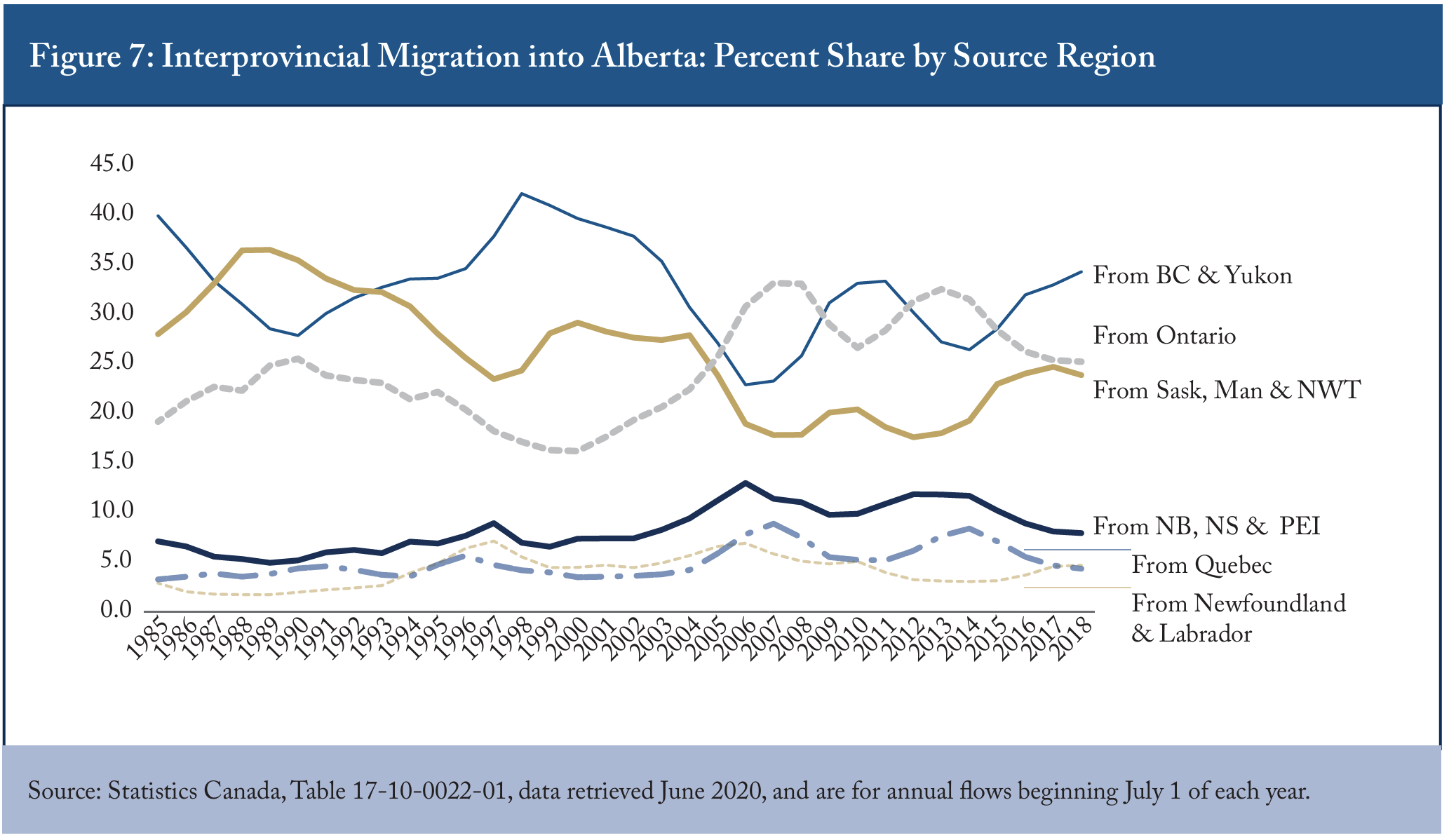
Just as significantly, as interprovincial barriers fell, Alberta’s sources of migration shifted from BC and Saskatchewan to provinces further afield, especially Ontario and the Atlantic provinces (Figure 7), through the ups and downs of the business cycle that continues to be the main driver of migration to Alberta. With BC’s population rising more rapidly than that of these Eastern source provinces, the shift toward the latter as a source of migration is not due to shifting demographic weights within Canada, although economic push factors such as slightly slower income growth per capita in Ontario than in BC, would likely have played a part in this shift. Overall, these regional shifts are consistent with the idea that the gradual but significant move toward mutual recognition of trades and professional certificates across Canada between 1995 and 2009 started compensating for geographical and social distance that impede mobility.
Zaman (2020) finds that regional trade agreements have no impact on mobility. However, his results need to be interpreted in light of the push for greater mobility at the national level that was simultaneous with these regional agreements. As we have seen, greater mobility across Canada as a whole shifted the source of migration into Alberta from its immediate neighbours, even as it was integrating more closely with them in general. And to the extent regional integration agreements, such as the NWPTA, also liberalized trade in services, it may have lowered the incentives to move within the liberalizing region, since, as we have seen, more open trade in services can substitute for labour mobility.
In short, efforts to reduce barriers to labour mobility in Canada have yielded positive results – certainly from the perspective of Alberta – giving us confidence that further measures along that path would also be beneficial, although it is almost impossible to disentangle the impact of specific liberalization measures.
Fostering Mobility – What Remains to Be Done
We can envisage the next wave of mobility-barrier reductions by recalling the four barrier types listed earlier and asking what can reasonably be done to lower them.
Reducing Alberta’s Occupational Barriers
Despite the progress noted earlier, there remain challenges within provincially regulated occupations. A recent federal report puts it clearly: “[t]he [provincial and territorial] licensing of regulated occupations remains a consistent systemic barrier to inter-provincial labour mobility (Canada 2017, 2).”
The most egregious, discriminatory mobility barriers have, indeed, been removed under the CFTA and the NWPTA among Western provinces, and by the TILMA before them between BC and Alberta. Governments need to continue to remove or circumscribe the departures from overarching labour mobility commitments, listed in Table 1 above, of which Alberta has the greatest absolute number, when they are able to do so without jeopardizing the legitimate policy objectives that justify these departures. Apart from these, mobility is relatively straightforward for occupations that are similarly classified and regulated between Alberta and other provinces. they are not, as the CFTA puts it, subject to “material” impediments. In most cases, there would still be costs for the individual willing to move; e.g., the cost of applying for mutual recognition by the relevant body of the receiving province. Still, it typically takes only a few days to get this recognition granted in Alberta, and the percentage of those gaining recognition is high in proportion to those who apply for it.
However, under the agreements just mentioned, there remain many occupations that are regulated in Alberta but not in other provinces, and vice-versa.99 As an illustration, a list of such occupations was produced for TILMA: Occupations regulated only in Alberta and Occupations regulated only in British Columbia. Potential entrants among these occupations must obtain a certification in Alberta, which they did not need in their home province to perform similar work. With respect to these potential entrants, two steps should be taken by Alberta:
- ensure there exists a process for straightforwardly recognizing as equivalent to Alberta certification experience in another province that does not require such certification;1010 The European Union standard among member states in similar circumstances is two years of experience. As one example of the application of this principle, one might ask why getting a private investigator licence in Alberta requires Albertaapproved training if one has practised successfully in another province – naturally subject to police, financial and character check references, all of which are not considered barriers under mobility agreements. and
- review reasons why Alberta requires certification when individuals can practice their occupation without such certification in other provinces, with a view to reducing interprovincial discrepancies in occupations requiring certification.”1111 It should go without saying that there will remain cases where a certification standard in one jurisdiction will be considered unacceptably low by the public in other jurisdictions. For example, in Quebec, New Brunswick and Yukon one can be an early childhood educator without formal college-level training. In other Canadian jurisdiction, this is not the case, and there are likely objective reasons for these differences. The intent is not to create a race to the bottom in occupational standards, but a strive for mutually accepting or a common standard or floor when public objectives, risk tolerance and occupational training and education are similar across jurisdictions.
For similarly regulated trades and occupations, Alberta should facilitate the expansion of the Red Seal program, the crown jewel of Canadian occupational mobility, to the maximum number of regulated trades (the majority are already covered). It should continue to harmonize as many occupational standards as possible with those of most other provinces.
While the cost for professionals securing mutual recognition may not be high, one must ask why the authority to recognize education, training and experience, as distinct from conduct matters, should be limited to associations within a specific provincial border. Indeed, an explicit cooperative mechanism involving employers and certification bodies, a sort of Red Seal program for professionals across Canada, should be envisaged. Such a process would readily permit individuals recognized by one jurisdiction to have the right to be registered automatically to exercise their profession, or partake in the exclusive right to use a certain designation, with the relevant association in another.1212 As with the Red Seal program, this exercise would be performed in consultation with employer groups, as well as with professional associations, such as the Canadian Nurses Association, that already provide opportunities for nurses to obtain national certification after rigorous examinations. The object of the “Seal” would be to immediately enable employers in every province to hire the person having obtained it, and enable automatic use of relevant protected designations and membership in the relevant provincial associations (subject to character check), without the candidate further having to demonstrate their qualifications.
As with the existing Red Seal program, this dynamic would be underpinned by a gradual collaborative convergence of education and training criteria. For a start, Alberta should require its certificate-issuing bodies to explain why its training, education or experience criteria differ from those of other major provinces and, if the difference is not justified, automatically require that the criteria in these other provinces be recognized by the relevant Alberta bodies. This test should also be extended to those undergoing apprenticeships or internships in order to facilitate interprovincial recognition and portability of on-the-job training.
Reducing Barriers that Distort the Costs and Benefits of Moving
In Canada, about 15 percent of jobs are covered by the type of formal occupational licensing that gives rise to the barriers just discussed (Mysicka et al. 2020). The labour mobility provisions of interprovincial trade agreements apply to these certified workers, and not to “uncertified workers such as apprentices, interns or students or occupations for which there is no certification or licensing requirements.” (Alberta 2020).
Beyond what is covered by internal trade agreements, reducing barriers other than those related to occupational regulations would have a beneficial impact on Alberta. As discussed in the section on gains from lower services costs, it would do that partly by reducing the costs of living and moving to Alberta and partly by empowering those who are employed in Alberta – including the self-employed – to do business more easily from an Alberta base.
One such obvious type of barrier pertains to trucking regulations. For landlocked provinces such as Alberta, ease of interprovincial transportation is vital, both as a seller and buyer of products, and for the ability to attract employers and the self-employed. To their credit, Canadian governments have formed a Task Force on Trucking Harmonization. It has identified barriers ranging from lack of harmonization on legal weights and dimensions to varying weight allowances or requirements for registration, weight limits, driver qualifications and training, and many others (Task Force on Trucking Harmonization 2018). These barriers effectively prevent the emergence of an effective national transportation corridor, raising the cost of moving goods – and of simply moving – across Canada. It is time to accelerate the reduction of barriers identified by the Task Force.
Many occupational health and safety rules have now been reconciled between provinces thanks the efforts of the Regulatory Reconciliation and Cooperation Table established under the CFTA. Alberta should encourage the continued harmonization of workplace rules such as safety regulations, that incidentally have an impact on the ability of workers to ply their trade across provincial boundaries. Again, we must emphasize that the intent is not to lower the standards necessary for the safety and protection of the public, but rather to get rid of minute but costly differences that reduce the ability to move people or provide services across provincial borders.
Another long-standing barrier has been the requirement that corporations, including incorporated individuals, register in each province they want to do business in. While the NWPTA offered seamless registration to firms, it was inefficient and costly at the back end, as registrars now have to determine how the separate sets of rules for each NWPTA province apply the businesses that register with them. Happily, the four provinces belonging to the NWPTA implemented in June 2020 the multi-jurisdictional registry access service, an online hub allowing corporate information sharing between provinces and hence facilitating corporate registration beyond a business’ home province. This system goes a significant way toward one-stop registration across Canada recommended by Schwanen and Chatur (2014), and cuts the cost of expanding a businesses across provincial borders and hence will facilitate attracting entrepreneurs to Alberta.1313 For details, see: https://www.alberta.ca/release.cfm?xID=727110A3FD74E-A7C6-D731-4D087BBAD7B7338C. Other provinces should be urged to join the hub.
To some extent, geographic mobility reflects the ability of individuals to move between employers. Portability of benefits such as pensions between employers would be important to interprovincial mobility.
The general point is that the easier it is for businesses and the self-employed to conduct commerce across the country, the more the cost/ benefit ratio of moving in general and to Alberta specifically will appeal to potential movers. Whether regarding trucking regulations, the compatibility and application of safety standards, ease of registering to conduct business activities across the country, or the portability of benefits, Alberta should look to facilitate the development of solutions appropriate for the post-COVID-19 era and that would facilitate beneficial mobility across the country.
Reducing Barriers in Hiring and Program Location Decisions
The size and reach of government has increased in Canada over the decades, meaning that government hiring criteria and decisions, and government programs generally, have a greater potential to affect the movement of workers. This can potentially mean that workers that might be best placed to offer a public service in or from Alberta are not doing so.
As mentioned, some broad national income and transfer programs already encourage workers to stay put, even when it would be more beneficial to their job prospects and for Canadians’ incomes as a whole for them to move where permanent opportunities may be greater. Alberta could continue to encourage a national discussion on the potentially deleterious effects of these programs.
The Alberta government could also look to its hiring practices and those of its agencies and other bodies, such as municipalities, as well as certain designations recognized by the province, to assess whether they impose unnecessary barriers against out-of-province applicants. For example, does Alberta really need separate designations for local government managers that have studied in and have experience working in Alberta and those that do not?1414 Requirements for the use of the Certified Local Government Manager designation in Alberta, as described on the Alberta government’s Alis web site: https://alis.alberta.ca/occinfo/certifications-in-alberta/local-government-manager/ accessed September 18, 2020.
Governments and employers everywhere are implementing new analytical lenses to evaluate how their policies and programs, including hiring practices, affect different groups. Alberta should conduct a similarly systematic assessment of whether hiring policies and employee location decisions by Canadian public entities interacting with and financed by Albertans discourage employment in the province, and determine what potential reforms, such as facilitating teleworking or decentralization of certain services, could reduce any such negative effect.
Addressing Sociocultural Barriers
From Australia (see, e.g. Australia 2014) to the European Union and Canada, studies have noted that the biggest obstacle to individuals’ willingness to move relates to their family and community attachments. As noted, migration out of Quebec is lower than out-migration from other provinces, even given similar economic incentives. If migration from Quebec to Alberta was the same per capita as that from Ontario, Alberta would have already achieved the impact that we calculate a 1 percent overall mobility cost reduction would have realized.
The observation is certainly not limited to Quebec: for example, attachments to one’s home region generally account for most of the immobility of unemployed workers across Canada (Statistics Canada 2017). That being said, mobility factors applying to unemployed workers may not apply to others who are employed, to students or those not currently in the labour market.
The experience of mobility within the European Union shows that the economic pull of one region can partially offset linguistic and cultural barriers to mobility (Baas et al. 2014, Stráský 2016). Emphasizing the ability of Canadians from across the country to retain links or even partake in their community of origin after moving to Alberta is likely to be a winner, given the huge pool of potential movers for whom severing these links would represent an important challenge. The province could take signalling initiatives in this regard, perhaps working with self-identified communities of Canadian migrants within Alberta supported by government grants, challenging them to do some outreach to their communities of origin. The Alberta government could provide awards enabling new migrants bringing skills in short supply to travel to their province of origin during their early years in Alberta, again to signal its interest in attracting such workers.
Alberta should also finish translating relevant portions of its Alis web site (https://alis.alberta.ca/) to help would-be francophone entrants navigate their options into the provincial labour market. Indeed, it could consider other low-cost initiatives that could provide useful information in French to potential francophone entrants (such as how to trade in their out-of-province drivers’ license for an Alberta license). Alberta government offices that have been contemplated for Montreal (see for example White 2020) and other Canadian locations could also be tasked with promoting the province to potential migrants, in addition to seeking to attract investors and foster cooperation in other economic matters.
A more targeted approach may also make sense for workers with specific characteristics. Initiatives such as supporting spousal hiring (or retraining) on the part of Alberta companies and institutions, targeting experienced workers perhaps on the lookout for a second or third career, or others with a propensity to move, such as recent immigrants to Canada, might help Alberta tap more easily into specific pools of workers that would benefit its economy.
Conclusion
Mobility allows Canadians to better realize their potential by enabling them to ply their trade, expand their businesses or acquire valuable goods and services that may not be available locally, or that are more expensive to acquire locally, across provincial boundaries. Not everyone will want or need to move from one province to another in order to realize this potential, but when they can do so with a minimum of barriers, the country as a whole benefits.
Greater mobility would help propel Canada successfully into the post-COVID-19 economy: strengthening internal supply chains, facilitating business across the country including that conducted remotely and helping firms, governments and individuals adapt to the shift in the types of jobs and skills that will be more in demand in the future.
Genuine progress has been made in the past 25 years toward removing the most egregious and discriminatory barriers to labour mobility in Canada. While the results have been positive for Alberta and for Canada, removing barriers to mobility remains an unfinished business – and a business that would be beneficial for Alberta to conclude successfully.
Indeed, the analysis here shows that reducing the cost (or enhancing the value) of moving to Alberta would materially benefit the province. Work that remains to be done in this respect includes further streamlining the recognition of the credentials and training obtained in other Canadian jurisdictions, eliminating non-occupational barriers to trade that explicitly make it costlier for potential new entrants to move, work or conduct their business from an Alberta base, removing biases in public hiring or program location decisions and helping potential movers navigate the sociocultural factors that influence any decision to move from one province to another.
References
Alberta. 2020a. “Mobility Survey Report 2018.” Alberta: labour mobility survey. January.
______. 2020b. “Labour Mobility for Workers.” Available at: https://www.alberta.ca/labourmobility-workers.aspx.
______. 2014. “Alberta Labour Mobility Survey 2012.” Alberta: labour mobility survey. Available at: xxxxxx xxxxx.
Albrecht, Lukas, and Trevor Tombe. 2016. “Internal Trade, Productivity, and Interconnected Industries: A Quantitative Analysis.” Canadian Journal of Economics 49 (1): 237-263.
Alvarez, Jorge, Ivo Krznar, and Trevor Tombe. 2019. “Internal Trade in Canada: The Case for Liberalization.” IMF Working Paper 19/158.
Amirault, David, Daniel de Munnick, and Sarah Miller. 2013. “Explaining Canada’s Regional Migration Patterns”, Bank of Canada Review, Spring, p. 16-28.
Australia. 2014. Research Report on Geographic Labour Mobility. Australian Government: Productivity Commission. April.
Baas, Timo, Mikkel Barslund, Matthias Busse et al. 2014. Labour Mobility in the EU: Dynamics, Patterns and Policies. Intereconomics, Vol. 49, Number 3, 116-158.
Brydon, Robbie, and Ben Dachis. 2013. Access Denied: The Effect of Apprenticeship Restrictions in Skilled Trades. Commentary 380. Toronto: C.D. Howe Institute. May.
Busby, Colin, and David Gray. 2011. Mending Canada’s Employment Insurance Quilt. Backgrounder 144. Toronto: C.D. Howe Institute. November.
Canada. 2017. “Labour Mobility and Occupational Licensing in Canada.” Ottawa: Employment and Social Development Canada. Presentation to National Employment Meeting – Military Family Services. January 26.
Caliendo, Lorenzo, and Fernando Parro. 2015. “Estimates of the Trade and Welfare Effects of NAFTA,” Review of Economic Studies 82: 1-44.
Eaton, Jonathan, and Sam Kortum. 2002. “Technology, Geography, and Trade.” Econometrica 70 (5): 17411779.
Fajgelbaum, Pablo, Eduardo Morales, Juan Carlos Suarez Serrato, and Owen Zidar. 2019. “State taxes and spatial misallocation.” The Review of Economic Studies 86(1): 333-376.
Grady, Patrick, and Kathleen Macmillan. 2007. “Interprovincial barriers to Labour Mobility in Canada: Policy, Knowledge Gaps and Research Issues.” Industry Canada. Working Paper. 2007-10.
Helliwell, John. 1996. “Convergence and migration among provinces.” The Canadian Journal of Economics 29(1): S324-S330.
Kaplan, Greg and Sam Schulhofer-Wohl. 2015. “Understanding the Long-Run Decline in Interstate Migration.” Federal Reserve Bank of Minneapolis. Working Paper 697.
Manucha, Ryan. 2020. Internal Trade in Focus: Ten Ways to Improve the Canadian Free Trade Agreement. Commentary 573. Toronto: C.D. Howe Institute. July.
Mysicka, Robert, Robert Cutler, and Tingting Zhan. 2020. Licence to Capture: The Cost Consequences to Consumers of Occupational Regulation in Canada. Commentary 575. Toronto: C.D. Howe Institute. July.
Schwanen, Daniel, and Omar Chatur. 2014. “Registering in Harmony: The Case for Pan-Canadian Corporate Registration.” E-brief. Toronto: C.D. Howe Institute. February.
Statistics Canada. 2018. “From east to west: 140 years of interprovincial migration.” Available at https://www150.statcan.gc.ca/n1/pub/11-630-x/11-630x2017002-eng.htm.
_____________. 2017. “Barriers to Labour Mobility in Canada: Survey-based Evidence.” Ottawa: Statistics Canada. November.
Stráský. Jan. 2016. Priorities for Completing the European Union Single Market. Working Paper No. 1315, OECD Economics Department.
Task Force on Trucking Harmonization. 2018. Supporting the Efficient Movement of Trucks Across Canada: Suggested Approaches by the Task Force on Trucking Harmonization. Retrieved at: https://www.gov.mb.ca/asset_library/en/proactive/2019_2020/mi_trucking_hrmonization_tf_2019.pdf
Tombe, Trevor, and Jennifer Winter. 2020. “Fiscal Integration with Internal Trade: Quantifying the Effects of Equalizing Transfers.” Canadian Journal of Economics. Forthcoming.
Tombe, Trevor, and Xiaodong Zhu. 2019. “Trade, Migration and Productivity: A Quantitative Analysis of China.” American Economic Review. 109 (5): 1843-1872.
White, Cindy. 2020. Alberta to Open an Office in Quebec to Promote Energy. CTV News Edmonton, retrieved at: https://edmonton.citynews.ca/2020/02/05/albertato-open-office-in-quebec-to-promote-energy/
Zaman, Mustafa Rafat. 2020. “Do Subnational Agreements Induce Interprovincial Migration? Empirical Evidence from Canada’s Aggregate Migration Patterns.” Canadian Public Policy. 46(2): 279-290. June.