





Executive Summary
With a number of formal quantifications of the multi-named new trade agreement for North America (USCMA in the United States, CUSMA in Canada and T-MEC in Mexico) now in hand, this note compares the estimates and draws conclusions about the sign (positive or negative) and scale (order of magnitude) of the likely impacts. The published estimates feature headline figures that vary from negative impacts to major gains. These apparent inconsistencies reflect differences across the studies in terms of the factors taken into account and how they report their impacts. This note reviews the sources of differences of four studies, including the official studies released by the United States and Canada. It demonstrates that the impact of the new agreement relative to the status quo is negative when evaluated in conventional terms. However, there are many sources of uncertainty that at present do not lend themselves to a robust quantification. The known knowns promise to be negative on balance; as for the known unknowns, time will tell.
Introduction
The replacement for the North American Free Trade Agreement (NAFTA) is about to come into effect on July 1, 2020, but in a very different context than when the negotiations were finally concluded. The new Agreement, which is called the United States-Mexico-Canada Agreement (USMCA) in the United States, the Canada-United States-Mexico Agreement (CUSMA) in Canada, and the Tratado entre México, Estados Unidos y Canadá (T-MEC) in Mexico, was finalized in Mexico City in December 2019 with amendments to take account of issues raised in the US Congressional review. Even as the parties were signing the Agreement, the coronavirus that would unleash the global pandemic in 2020 was already silently spreading in China, and possibly elsewhere.
Both the direct economic effects of the pandemic on the global economy, which resulted in the deepest downturn since the 1930s Great Depression, and the indirect impacts of the demand, supply and supply-chain shocks on the behaviour of governments, corporations and households, will have longer-term impacts on the economy. The structure of economies will change as many businesses that shut their doors during the lockdowns will never re-open; in particular, the retail “apocalypse” forecast by some has likely seen years of future gradual decline telescoped into a precipitous collapse (Peterson 2020). Meanwhile e-commerce businesses have seen their stock soar (e.g., Vlastelica 2020).
Governments have committed to new industrial policies to address perceived strategic risks. Industries are reviewing the organization of supply chains to address newly identified risks and ensure greater robustness and resilience. In many ways, the pandemic has accelerated the adoption of digitally enabled business and social practices that might otherwise have taken a decade to fully take hold (Helmer 2020). Face-to-face interaction will gradually resume as measures to suppress the pandemic show results; this resumption will likely be seen first in areas that hold the greatest advantages in terms of exchange of tacit information and the capture of social value. But the new patterns created during the pandemic will likely persist where there are cost and efficiency gains from doing so. Natural experiments are underway in living without globalization (e.g., New Zealand and Australia are emerging from lockdown but with closed borders (Heath 2020)). These patterns might persist for some time given the uneven response to the pandemic and become a new normal. For instance, logistics have been adjusted to take account of the reduction in passenger air travel, in turn affecting about 50 percent of all air freight.
All these developments have implications for the patterns of international trade – including digital and digitally enabled trade, which have likely been advantaged by the pandemic. Accordingly, it is a legitimate question to ask whether the assessments of the new tripartite Agreement, which were conducted against very different baseline conditions, remain valid.
To some extent, this question can be asked about all model simulations that make projections of the economy to serve as a baseline for evaluating policy shocks – in this case the CUSMA shock. Such projections largely maintain the historical structure of economies (including their internal supply chain linkages as reflected in the input-output tables that map inter-industry flows of inputs). The international trade patterns reflect history, including the commodity price structures in the base year data. Technology’s role in the future is frozen at the base year of the model’s dataset (for the CUSMA simulations, this is 2014). Accordingly, new products that are being developed are not reflected in the production and trade numbers, while products that have been phased out continue to count towards industry totals.
While all these considerations warrant caution in interpreting results – especially small results – economic structures tend to be recognizably similar over the lengths of time for which projections are made. More importantly, the marginal impacts of a policy shock tend to have the same sign and to be of the same order of magnitude when applied to two different baselines – small differences again aside. Accordingly, while the levels or dollar values reported in simulations of the CUSMA may require adjustment to reflect the new levels of economic activity once the pandemic effects have passed, the percentage changes are likely to have information value about the impact of the Agreement.
Bearing these considerations in mind, this note examines the main published estimates of the economic impact of the CUSMA to see how they compare. As will be seen, these evaluations vary widely in many respects, including what elements of the negotiated settlement they take into account, which version of the Agreement they assess, and how the impacts are presented (in terms of the counterfactual against which the quantitative impacts are measured), and also the countries for which impacts are reported. Four studies are considered:
- The International Monetary Fund published an early study, Burfisher et al. (2019), with estimates for all three countries. This study incorporates the Section 232 tariffs on aluminum and steel and partner retaliation in the baseline and reports both the marginal effect of the Agreement and the effect of removing the Section 232 tariffs within North America.
- The United States International Trade Commission (USITC 2019) issued a major review of the Agreement as originally concluded in April 2019, but only for the United States. It reports the marginal impact of the Agreement.
- Ciuriak et al. (2019) presented a study of the Agreement at the 2019 Annual Meeting of the Global Trade Analysis Project (GTAP) in June in Warsaw; this was subsequently published by the C.D. Howe Institute as a Working Paper, and re-issued in revised form in February 2020 to take account of the Protocol of Amendment. Estimates are provided for all three countries.
- Global Affairs Canada (2020) published an assessment for Canada solely on the basis of the Agreement as amended by the Protocol of Amendment. The counterfactual is NAFTA lapsing and the US Section 232 tariffs on aluminum and steel being in place; the marginal effect of the Agreement relative to the status quo is not reported.
A particular focus of this Working Paper is on how their differences can be reconciled. The next section reviews issue coverage at a high level. Section 3 considers model differences and modelling protocols. Section 4 presents a reconciled set of numbers. Section 5 comments on the extent to which the various studies agree or disagree on the impact of the Agreement.
Coverage of the Agreement’s Measures
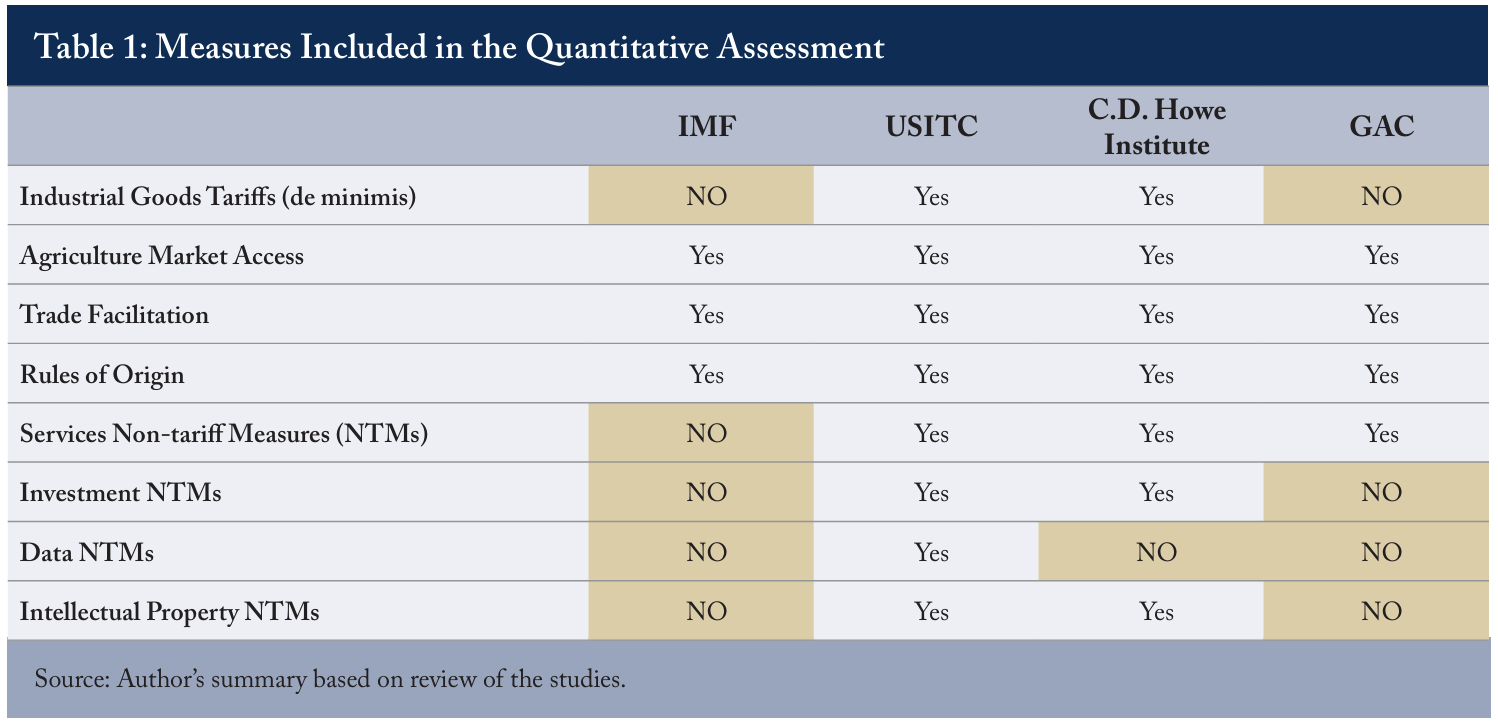
Table 1 summarizes the general areas covered by the various studies. A key first observation is that there is a varying degree of coverage of the text. Of the areas for which quantitative impacts are calculated the USITC is the most comprehensive – and the most detailed in terms of the underlying analysis. The GAC study was conducted in light of the USITC results and so could draw on that analysis to the extent the researchers thought appropriate. The C.D. Howe Institute and IMF studies relied on independent analyses of the text.
In addition to general coverage of issues, the studies vary in how policy shocks are constructed – this reflects the fluid and evolving state of the art in measuring non-tariff measures (NTMs) and rules of origin impacts. The studies discuss numerous other chapters qualitatively, but the quantitative impacts of these are considered too speculative or lacking in empirical basis to include in the analysis. Two issues in particular are missing in the estimated impacts of the change from NAFTA to the new Agreement:
- The failure of the Agreement to restrict the application of US protectionist measures such as Section 232 in the context of an overt push from the US Administration to drive investment into the United States (“weaponizing uncertainty” (Crowley and Ciuriak, (2018)).
- The implications of the data provisions for the capture of value in the data-driven economy that is emerging with the digital transformation.
The USITC study addresses uncertainty, but in a narrower context, namely the effect of binding commitments on data, services and IP, which pre-empt future protectionist measures and thus reduce trade costs. These uncertainty reductions (which mostly can be attributed to the data NTMs) thus work to boost trade in all goods and services. The C.D. Howe Institute study also takes this uncertainty effect into account for services and investment, but not for data or IP. However, the uncertainty generated by the Trump Administration’s threats to use instruments such as Section 232 to restrict imports by identifying national security with “economic security” is not addressed by any of the studies, although this threat casts a long shadow over North American economic integration.
As reflected in the rise in the share of intangible assets in the valuation of companies, data as a whole has become the most valuable asset in the modern economy. Yet, it is not for the most part included in the national economic accounts and the flows of data across borders are not accompanied by invoices and receipts that would allow a tally of trade balances. By the same token, data is not included in trade models. None of the studies of the USMCA address this issue.
Model Structure and Modelling Protocols
From the documentation of the studies, there are many sources of differences that could explain different results, even with identical policy shocks.
A detailed assessment of the implications of the different modelling approaches for the results is not possible because of the differences in reporting across the studies. A few observations can be made however.
First, the overall scale of the impacts when reported in value terms is affected by the baseline. The IMF study is based on 2014 levels of GDP, the USITC study is based on 2017 levels, while the C.D. Howe Institute and GAC studies project the economies of the region forward to 2025 and report the impacts on the economy scaled to that year. An additional scaling difference is in the price level: the IMF and GAC studies report the impacts in USD at 2014 prices (the price level in the GTAP 10 database); the USITC study scales the price level up to 2017 (see note to Table ES.1); the C.D. Howe Institute study scales the price level to USD at 2019 prices. These scale differences affect the estimates of economic welfare and of the impact on the North American economies as a group.
Second, the scale of impact on real economic activity depends on whether the model incorporates endowment effects. These effects can come from changes in capital through a dynamic investment response or from changes in employment through a labour supply response. An endowment effect increases a positive response to trade liberalization but also tends to exacerbate a negative response to trade protectionism. Three of the four studies feature endowment effects through a labour market response, capital responses or both. The IMF study does not appear to incorporate such effects; not surprisingly, it has the smallest measured impacts in real terms.
Third, modelling frameworks that channel more of the adjustment to a trade policy shock into the real side of the economy (e.g., through endowment effects) reduce, by the same token, the extent to which the impact affects relative prices. In the GTAP framework, the price index of a country’s factors of production (labour, capital and land) relative to the global average represents its real exchange rate. The IMF study, which does not have endowment effects, shows no real GDP effects for the rules of origin changes (which are the main drivers of negative real GDP impacts in the other studies); at the same time, it shows a real exchange rate appreciation for Canada, a depreciation for Mexico and no change for the United States. Accordingly, the modelling framework appears to be a decisive factor in the differences in qualitatively different outcomes in the IMF report compared to the other studies.
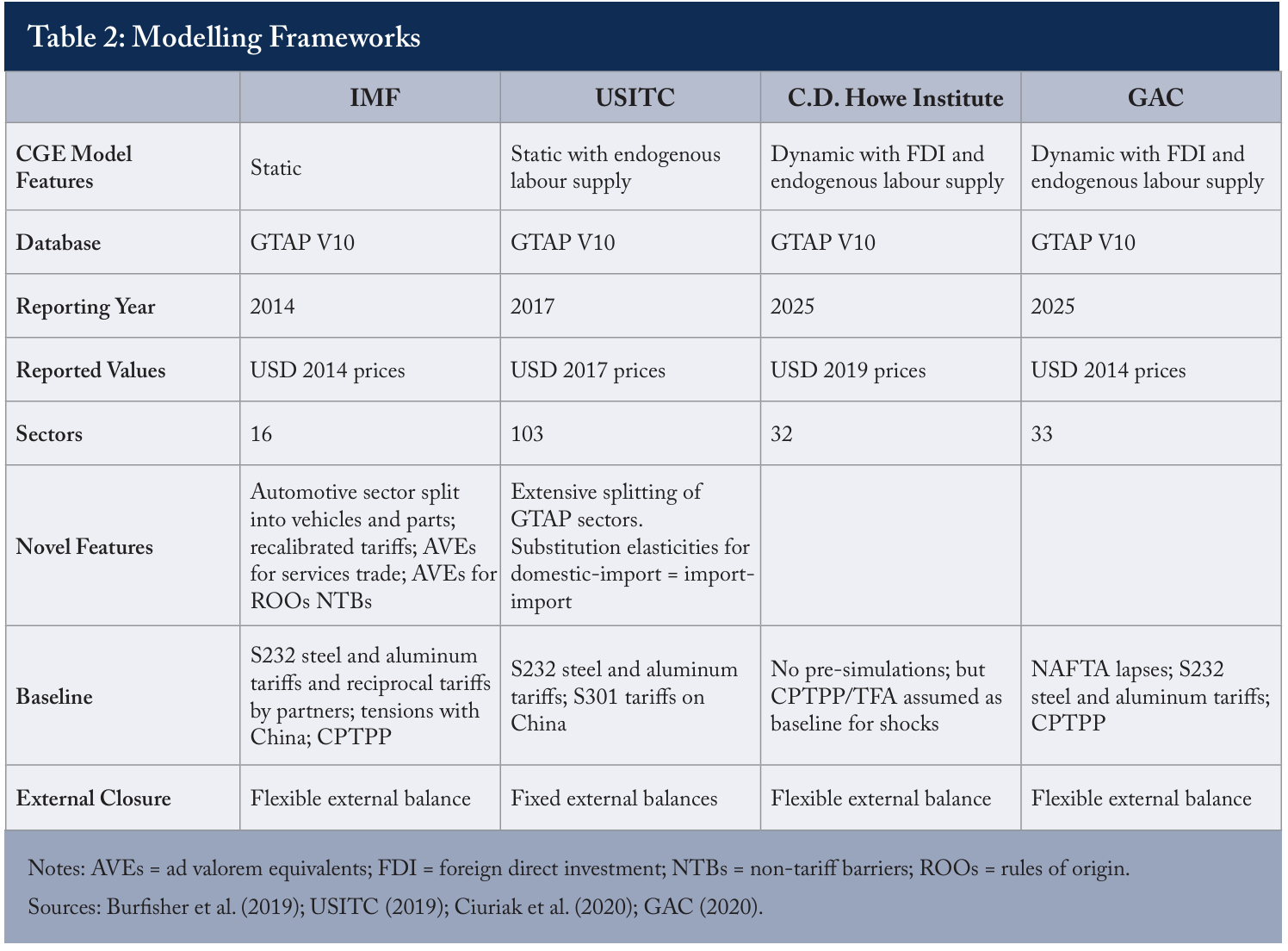
Fourth, under alternative closures of a CGE model, the external balance can be either fixed or allowed to adjust depending on the trade impacts. When trade impacts are highly unbalanced across the parties, a fixed external trade balance assumption can drive large real exchange rate adjustments in order to restore the external balance to its pre-shock value. This is not a major issue for the CUSMA impact analysis since the trade balance implications under a flexible external account are relatively small (this can be read from the C.D. Howe Institute report, which provides the most comprehensive account of the impacts); by the same token, fixing the external account would imply relatively small real exchange rate adjustments.
Fifth, what is included in the baseline through pre-simulation has a significant influence on the outcomes of a simulation only if the baseline conditions are significantly impacted. In the present case, inclusion in the baseline of the NAFTA lapsing as well as US Section 232 tariffs and the partner retaliation could have an impact on the sectoral impacts reported. The IMF and USITC studies build the Section 232 tariffs and partner retaliation into the baseline; the GAC study builds in only the US Section 232 tariffs but not (as far as can be inferred from the write-up) the partners’, and the C.D. Howe Institute study does not presimulate this effect. The GAC study, meanwhile, builds in NAFTA lapsing into the baseline, which has a more pervasive impact on the structure of intra-NAFTA trade.
As the above shows, the numbers from the studies reviewed here are not directly comparable because the studies use different rulers to measure the impacts; accordingly, care should be used in reporting them, especially in a comparative context.
Comparing the Numbers
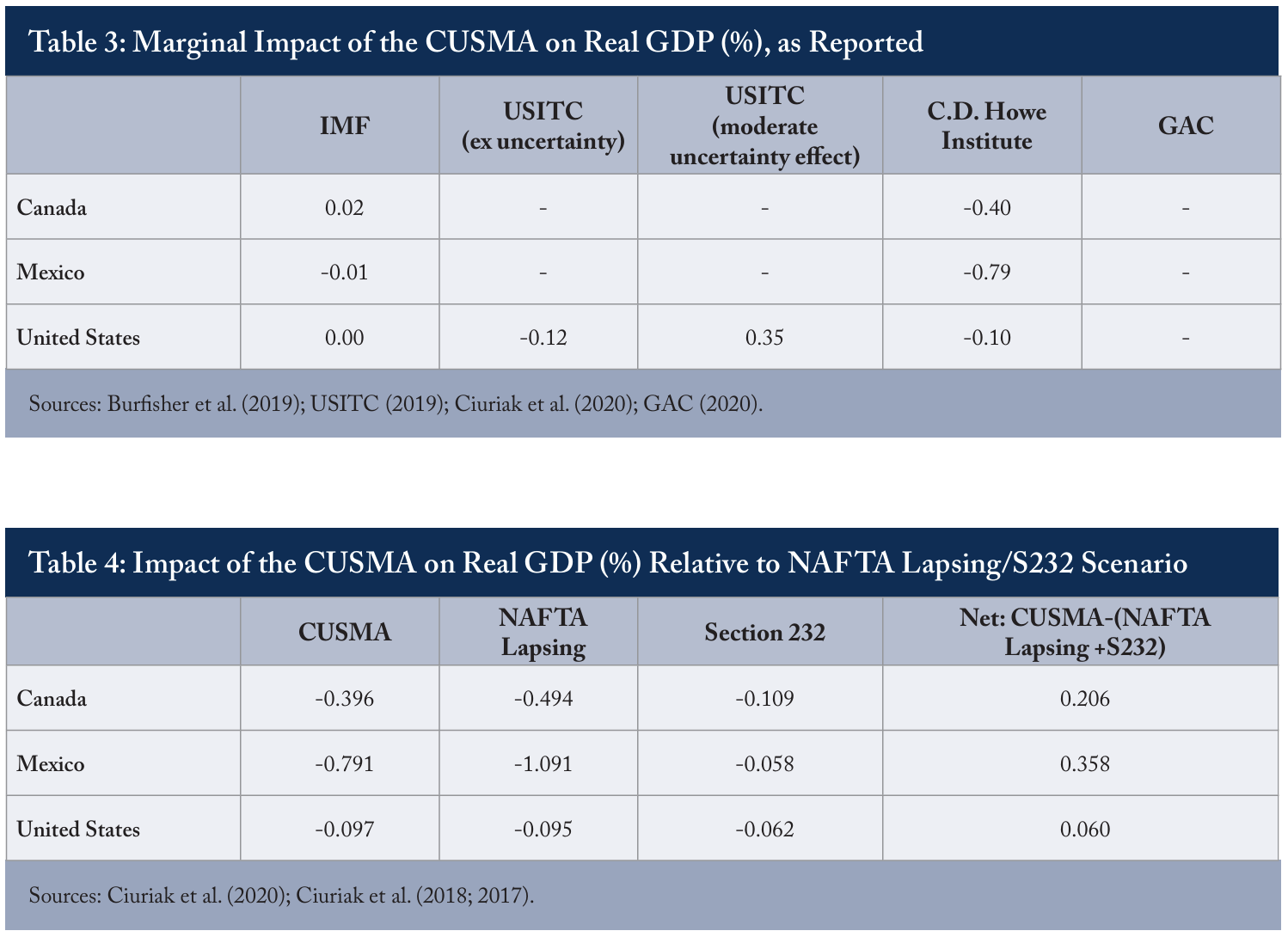
Three of the four studies provide the marginal effect of the USMCA on real GDP; the GAC study does not. Table 3 shows the results for the four studies as reported. The only estimate for which there is a reasonable degree of agreement is on the impact on the United States, excluding the uncertainty effects; on this the USITC and C.D. Howe Institute studies have similar figures.
So far, so difficult. The GAC (2020) study poses a particular problem of interpretation because it does not report the marginal impact of the CUSMA; rather it reports the net impact of the CUSMA relative to a counterfactual in which NAFTA lapses and US Section 232 tariffs persist on aluminum and steel. It is however possible to gain a perspective on the general scale of the GAC estimate of the marginal effect relative to the current status quo by combining the information from three separate studies published by the C.D. Howe Institute on the effects of NAFTA lapsing, the US Section 232 tariffs and the CUSMA.
Table 4 constructs an impact estimate of the CUSMA relative to a counterfactual scenario in which NAFTA lapses and US Section 232 tariffs are in place based on these three published studies, all of which were done on the same model and using similar modelling protocols. As can be seen, the CUSMA impact for Canada is as presented above (-0.396 percent). The impact of NAFTA lapsing is -0.494 percent, while the impact of the Section 232 tariffs is -0.109 percent. As can be seen, the CUSMA negative effect is smaller than the combined effect of the other two shocks. Accordingly, presented this way, it represents a gain for Canada in net real GDP of 0.206 percent, compared to that alternative. In effect, even though the CUSMA digs a hole for Canada, NAFTA lapsing combined with US tariffs on aluminum and steel dig a deeper hole. This figure of 0.206 percent compares reasonably well with the GAC (2020) figure of 0.249 percent.
It is not unreasonable to expect that the GAC (2020) modelling framework would yield reasonably similar estimates for the impact on Canada of NAFTA lapsing and US steel and aluminum tariffs continuing – these are largely tariff events, which are simpler to construct and model. The GAC (2020) estimate for the marginal effect of the CUSMA can be inferred to be a negative impact in the general vicinity of -0.4 percent for real GDP.
As a by-product of this comparison, we also obtain a way to compare the GAC and USITC official estimates. It is likely that the GAC modelling framework would also produce a modest positive effect for the United States when presented in this way, even excluding the uncertainty effect.
This exercise suggests that the outlier is the IMF study, which, for reasons outlined above, appears to differ mainly because of the way the model is run, which channels the impacts primarily into price effects rather than real effects.
Discussion and Conclusions
The above discussion brings into reasonably clear focus the disparate estimates of the impact of the new NAFTA. It draws on three studies of NAFTA lapsing, the impact of US Section 232 tariffs on aluminum and steel, and the CUSMA itself, to tease out the likely relationship between the official studies posted by the Canadian and US governments (GAC 2020 and USITC 2019). By considering the official US and Canadian accounts on as close to a comparable analytical basis as possible, it can be seen that both anticipate the Agreement would result in a lowering of economic potential in the North American economy, at least if the (net) impact of the Agreement on uncertainty is excluded. The C.D Howe Institute Working Paper estimates for the United States and Canada are in the same ballpark as the official estimates when uncertainty effects are excluded. By extension, the C.D. Howe Institute estimates also provide insight into the likely results in the official studies for Mexico (again when uncertainty effects are excluded), although these have not been officially published.
If, as evaluated by the USITC, the CUSMA reduces uncertainty for trading firms, then the negative effects of more restrictive rules of origin might be partly, fully, or more than fully offset. This warrants comment. Ciuriak et al. (2020) acknowledges the validity of the methodology deployed by the USITC to generate the result but declines to follow suit for three reasons:
- Canada and Mexico have already signed onto similar provisions in the Comprehensive and Progressive Agreement for Trans-Pacific Partnership (CPTPP); the CUSMA changes matter comparatively little, introducing these bindings only on the United States itself, the value of which in constraining future US data policy is likely to be very modest. The implications of not taking into account Canada’s and Mexico’s data commitments in the baseline for reducing the value of the CUSMA provisions is acknowledged in the USITC report.
- The future regulatory regime for data flows in areas ranging from privacy, to competition policy, to taxation, to protection of democratic processes is being actively pursued worldwide; outcomes are highly uncertain and there is little empirical evidence on the extent to which restrictions will be safeguarded as legitimate as opposed to potential barriers to digital trade that would be prevented by the CUSMA measures.
- The United States has articulated an extraordinarily expansive scope for national security as grounds for intervention in the economy, which suggests that all three parties will have considerable latitude to develop regulations on data flow to ensure national security – at least in the backbone services sectors (communications, transportation, power, and finance).
Two other considerations are worth raising.
First, an uncertainty effect of this nature would in principle have symmetric effect (Lerner 1936; Costinot and Werning 2017). Thus, even if the impact on the Canadian and Mexican trade regimes was minimal, US adoption of the measures would work at the margin to increase both US exports and imports in all the traditional goods and services sectors. In other words, it would be a positive effect for all three economies.
Secondly, as noted, none of the estimates take into account the general uncertainty effect for businesses generated by the Trump Administration’s rhetoric and embrace of trade protection (Crowley and Ciuriak 2018).
Overall, on the basis of what can be reasonably determined, the new Agreement represents a significant step back from the three-decades-old partnership in North America launched with the 1989 Canada-United States Free Trade Agreement (CUSFTA) and further developed with the addition of Mexico in the NAFTA. This is signaled clearly: the words “North America,” and “free trade” are conspicuously absent from the title.
The long-run impetus prompted by the pandemic to “near-shoring” or “re-shoring” due to concerns about extended supply chains would appear to work in the same direction as the CUSMA in terms of creating a more insular North American economy at some expense in efficiency. These pandemic effects would primarily be in the sectors that have been identified as “essential goods” in the early analysis of this issue (see, for example, the list identified in Leibovici and Santacreu 2020).
Bottom line: on the basis of what can be evaluated as regards the traditional industrial/ services economy, the new NAFTA is likely a better outcome for the parties than no NAFTA, but not clearly better than the existing NAFTA. The implications for the data-driven economy are unclear – data is not “treaty ready” in the sense that regulatory frameworks are only at a nascent stage.
References
Burfisher, Mary E., Frederic Lambert, and Troy Matheson. 2019. “NAFTA to USMCA: What is Gained?” IMF Working Paper WP/19/73.
Ciuriak, Dan, Ali Dadkhah, and Jingliang Xiao. 2020. “Quantifying CUSMA as Amended: The Economic Consequences of the New North American Trade Regime.” Working Paper. Toronto: C.D. Howe Institute. February.
Ciuriak, Dan. 2019. “From NAFTA to USMCA and the Evolution of US Trade Policy.” Verbatim. Toronto: C.D. Howe Institute. June.
Ciuriak, Dan, and Jingliang Xiao. 2018. “Quantifying the Impacts of the US Section 232 Steel and Aluminum Tariffs.” Working Paper. Toronto: C.D. Howe Institute. June.
Ciuriak, Dan, Lucy Ciuriak, Ali Dadkhah, and Jingliang Xiao. 2017. “The NAFTA Renegotiation: What if the US Walks Away?” Working Paper. Toronto: C.D. Howe Institute. , November.
Costinot, Arnaud, and Iván Werning. 2017. “The Lerner Symmetry Theorem: Generalizations and Qualifications.” NBER Working Paper 23427, May.
Crowley, Meredith A., and Dan Ciuriak. 2018. “Weaponizing Uncertainty.” Verbatim. Toronto: C.D. Howe Institute. June.
Heath, Michael. 2020. “Australia Goes Back to the 1980s With Its Economy Closed to World.” Bloomberg, 19 May.
Helmer, Aedan. 2020. “‘There is no going back’: How COVID-19 forced courts into the digital age.” Ottawa Citizen, 17 May.
Lerner, Abba P. 1936. “The Symmetry Between Import and Export Taxes.” Economica 3.11: 306-313.
Leibovici, Fernando, and Ana Maria Santacreu. 2020. “International Trade of Essential Goods During a Pandemic.” Working Paper, Federal Reserve Bank of St. Louis.
Peterson, Hayley. 2020. “More than 3,000 stores are closing in 2020 as the retail apocalypse drags on. Here's the full list.” Business Insider, 11 May.
Vlastelica, Ryan. 2020. “E-commerce stocks soar with pandemic gains seen as long-lasting,” Bloomberg News, 24 April.